

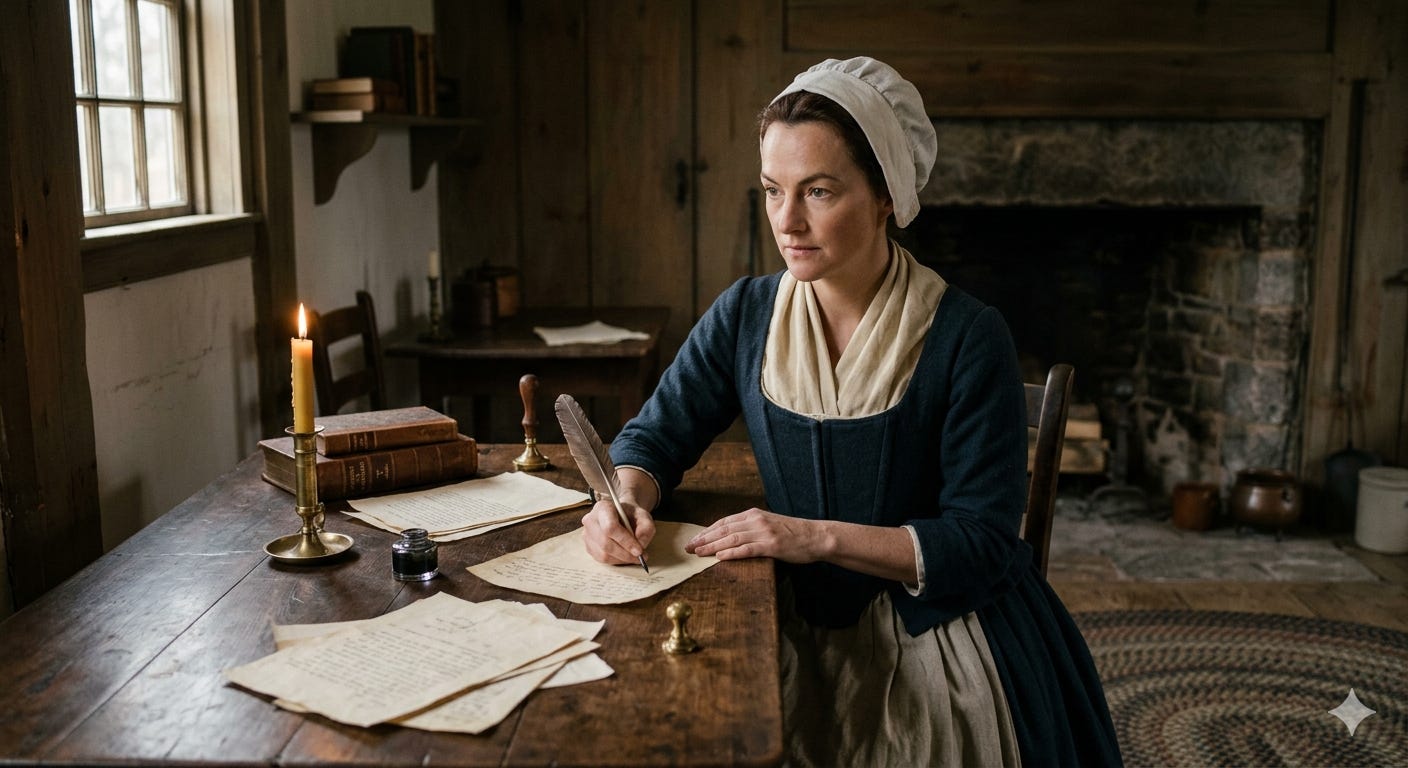
By the time Abigail Adams enters the record, the language of rights is emerging. Revolution is reshaping political thought. New systems are being built.
The question appears to open. Who is included in the idea of representation?
Abigail Adams stood at the center of that moment, not as an officeholder, but as a participant in political thought. Through extensive correspondence with her husband, John Adams, and others, she engaged directly with the formation of a new nation.
She was not outside the conversation. She was inside it. Her most cited line remains direct. She urged the framers to “remember the ladies” as they constructed new laws. The statement is often quoted as early awareness, almost a polite suggestion.
It was not. It was a warning. That matters because it shows clarity, not novelty.
Abigail understood that a system built on rights could still exclude women if that exclusion was left unchallenged. She did not assume inclusion. She named the gap. And the response was revealing.
Her concerns were acknowledged, but not acted upon. The emerging structure of American governance did not incorporate women as political actors. Representation expanded, but not to include them.
That is the mechanism. Proximity to power does not guarantee equal participation in it.
Abigail Adams had access, influence, and awareness. She could observe the construction of a political system from within its inner circle. But observation did not translate into authority. Her role remained advisory, informal, and ultimately limited.
That boundary held. Her voice survives through letters, which gives the impression of presence. But presence is not the same as power. Her ideas circulated, but they did not shape law in the moment they were needed. That is the narrowing.
She is often remembered as supportive, insightful, and ahead of her time. These descriptions are accurate, but they soften the structural reality. She was not simply insightful. She was excluded. That exclusion was not accidental. It was foundational.
Abigail Adams matters because she shows that early democratic systems were built with clear awareness of women, and with equal clarity in choosing not to include them. The argument was present. The capacity was present. The access was present.
Inclusion was not. She did not fail to participate. She was not permitted to. And the system that claimed representation began by defining its limits.
“Presence is not the same as power” stayed with me. The piece does something important by showing that exclusion is not always absence from the room. Sometimes it is being visible, heard, and still structurally denied participation.