

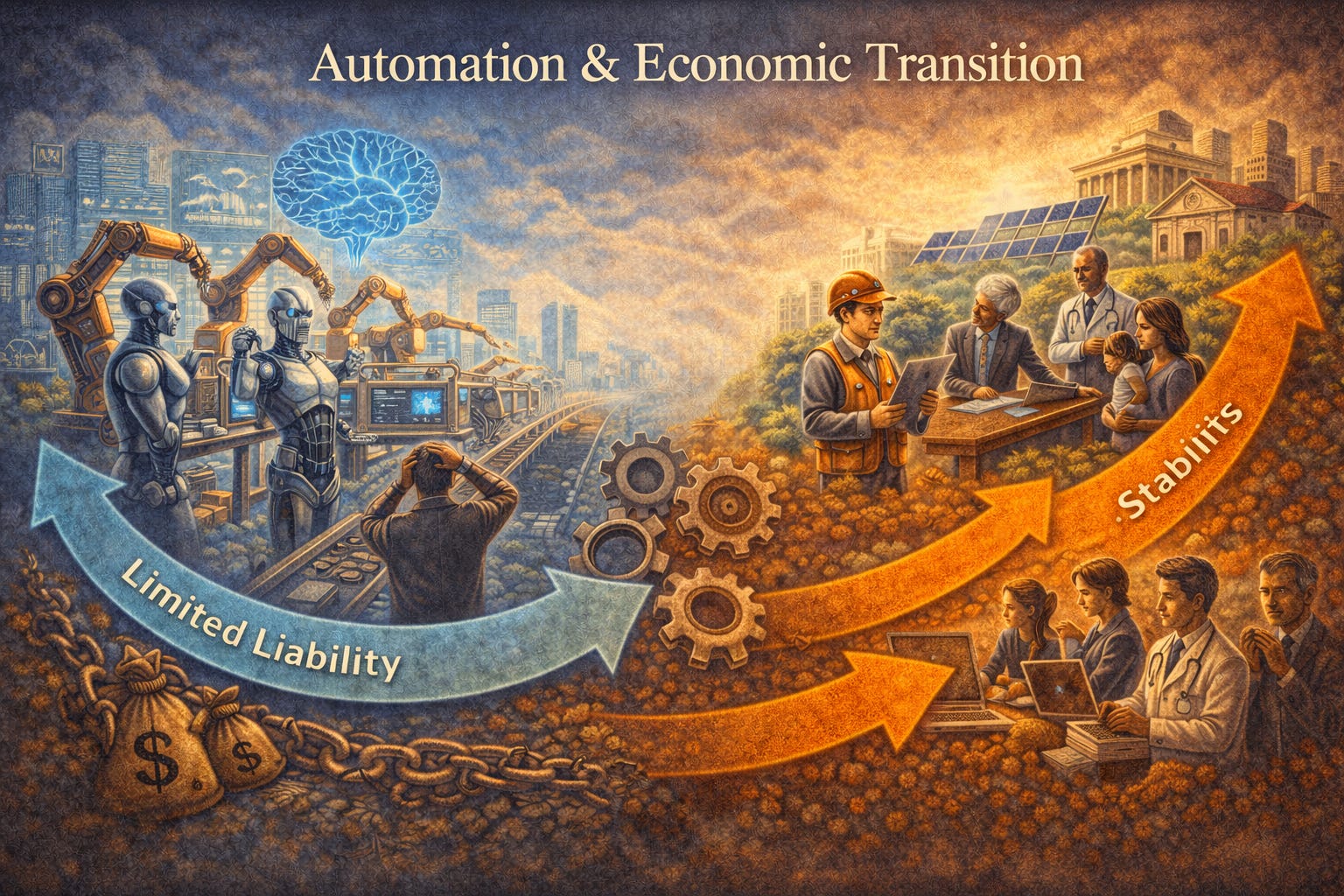
Technological progress has always reshaped the structure of economic life. From early agricultural tools to industrial machinery and modern computing systems, technological development has repeatedly increased the productive capacity of societies. Each period of transformation has altered how labor is organized, how goods are produced, and how economic opportunity is distributed.
Automation represents the most recent phase of this long historical pattern. Advances in computing, artificial intelligence, robotics, and digital systems allow tasks once performed by human labor to be completed by machines or software. These changes can increase efficiency, reduce costs, and expand the productive capacity of economies.
At the same time, automation alters the relationship between labor, income, and economic participation. When machines perform tasks previously completed by workers, the structure of employment shifts. Some occupations decline or disappear while others emerge. New industries form even as older ones contract.
Historically, societies have adapted to technological change through a combination of economic expansion, education, and the emergence of new forms of work. Agricultural societies transitioned to industrial economies, and industrial economies gradually evolved toward service and knowledge-based sectors.
However, the pace and scope of contemporary technological change present new challenges. Automation increasingly affects not only physical labor but also cognitive and administrative tasks. Systems capable of performing complex calculations, pattern recognition, and decision-support functions are now used across fields ranging from finance and medicine to logistics and communications.
As these systems expand, the connection between productivity and human labor may change in ways that previous economic transitions did not fully anticipate. Economic output can increase even when fewer people are required to perform certain categories of work.
This shift raises important questions for societies organized around the assumption that employment is the primary mechanism through which individuals secure income, stability, and participation in economic life.
If technological systems significantly increase productive capacity while reducing the amount of human labor required to produce goods and services, economic structures must adapt in order to maintain participation and stability.
Historically, societies have addressed similar transitions through several mechanisms. Education systems have retrained workers for emerging fields. Public investment has supported new industries and infrastructure. Social institutions have helped individuals navigate periods of transition and displacement.
These approaches remain important. However, the scale of technological change suggests that economic systems may need to consider broader adjustments that recognize productivity gains generated by automation.
A society capable of producing greater abundance through technology has the opportunity to translate that productivity into broader stability and opportunity. If managed carefully, technological progress can reduce scarcity, support higher standards of living, and expand the time individuals have available for education, caregiving, creative work, and civic participation.
The challenge lies in ensuring that the benefits of increased productivity circulate throughout society rather than concentrating within narrow structures of ownership or control.
A constitutional framework concerned with human dignity and civic participation must therefore recognize the long-term implications of technological change. Economic systems should remain flexible enough to incorporate new forms of production while preserving the material stability required for individuals and communities to participate in civic life.
Automation is not inherently a threat to democratic systems. Properly integrated, it can strengthen the foundations of social stability and economic opportunity. The outcome depends on whether institutions adapt to ensure that productivity gains remain aligned with the broader public good.
Technological progress will continue. The responsibility of democratic systems is to ensure that its benefits remain compatible with the dignity, participation, and stability of the societies it serves.