

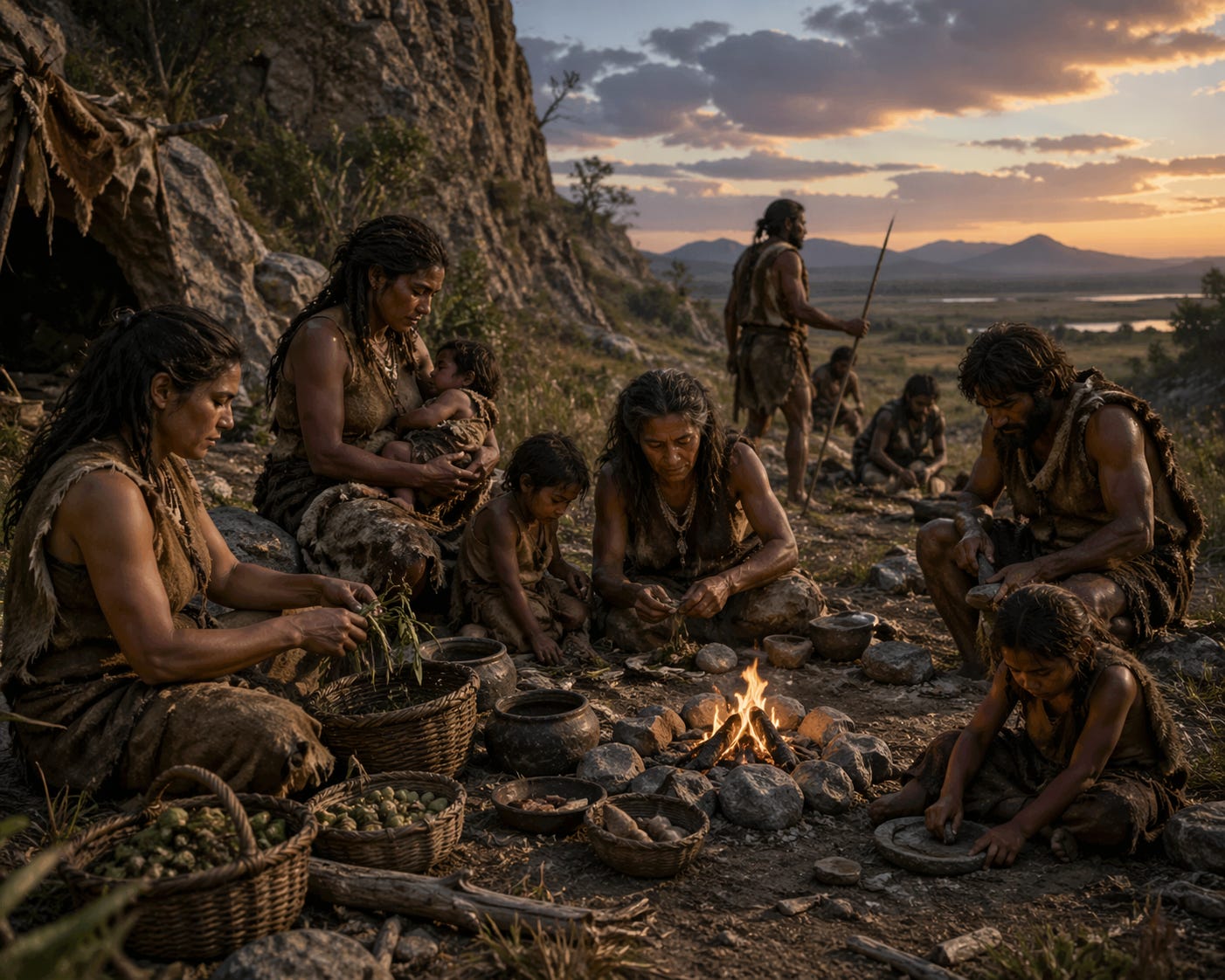
Before the throne, before the church, before the state, human life was a collective struggle to survive. There was no single heroic builder standing at the center of the story, no lone lawgiver carving order out of chaos, no early world run by titles alone. What the scientific record suggests instead is something less arrogant and far more human. We emerged through interdependence.
The older simplified story liked a single cradle and a cleaner line. The newer record points to something broader within Africa: multiple connected populations, adapting, separating, rejoining, surviving, and passing knowledge along over time. Humanity did not rise from one isolated genius moment. It emerged through continuity, contact, memory, movement, and shared life.
That matters because it changes the shape of the story from the start. If early human emergence was collective, then the question is not which man stood first at the center. The question is what kinds of labor made human life possible at all.
And women were there from the beginning.
Not as decoration. Not as passive support waiting for history to begin. Not as an afterthought added once men had already built the world. Women were part of the human struggle that made any future world possible. Birth alone makes that obvious, but it does not stop there.
The survival of children, the continuity of kinship, the carrying of memory, the passing on of practical knowledge, the rhythms of care, the stabilizing of group life, the repeated labor of keeping human beings alive long enough to become a people, these are not side tasks in the making of humanity. They are central.
The scientific record cannot give us names for most of this early span, and it should not be forced to pretend otherwise. But it does point toward a reality of shared survival. Early humans lived through food knowledge, environmental memory, cooperative labor, child care, teaching, tool use, movement, and social dependence.
The old fantasy of the solitary male conqueror does not hold up well against a species that survived by transmitting what worked. Women must be visible inside that truth.
Even the body preserves part of the record. The maternal line reaches everyone through mitochondrial inheritance. Every child also receives an X chromosome from the mother. The father contributes differently, but the older mythology of male centrality begins to look thinner when even biological continuity tells a more collective and less arrogant story.
This does not make women superior, and it does not turn biology into destiny. It does remind us that continuity was never his alone to claim.
That is the point at the beginning of this series. Women were not absent from human emergence. They were present in the life-making, life-carrying, and life-sustaining work that made collective survival possible. If later patriarchal societies handed men the title and called them the makers of civilization, that was not the beginning of the story. It was a rewrite.
Before authority hardened into office, before rule hardened into law, before public history narrowed around male names, humanity was already being carried forward by a collective struggle in which women were essential.
The story was not yet stolen. But the conditions for stealing it were coming.