

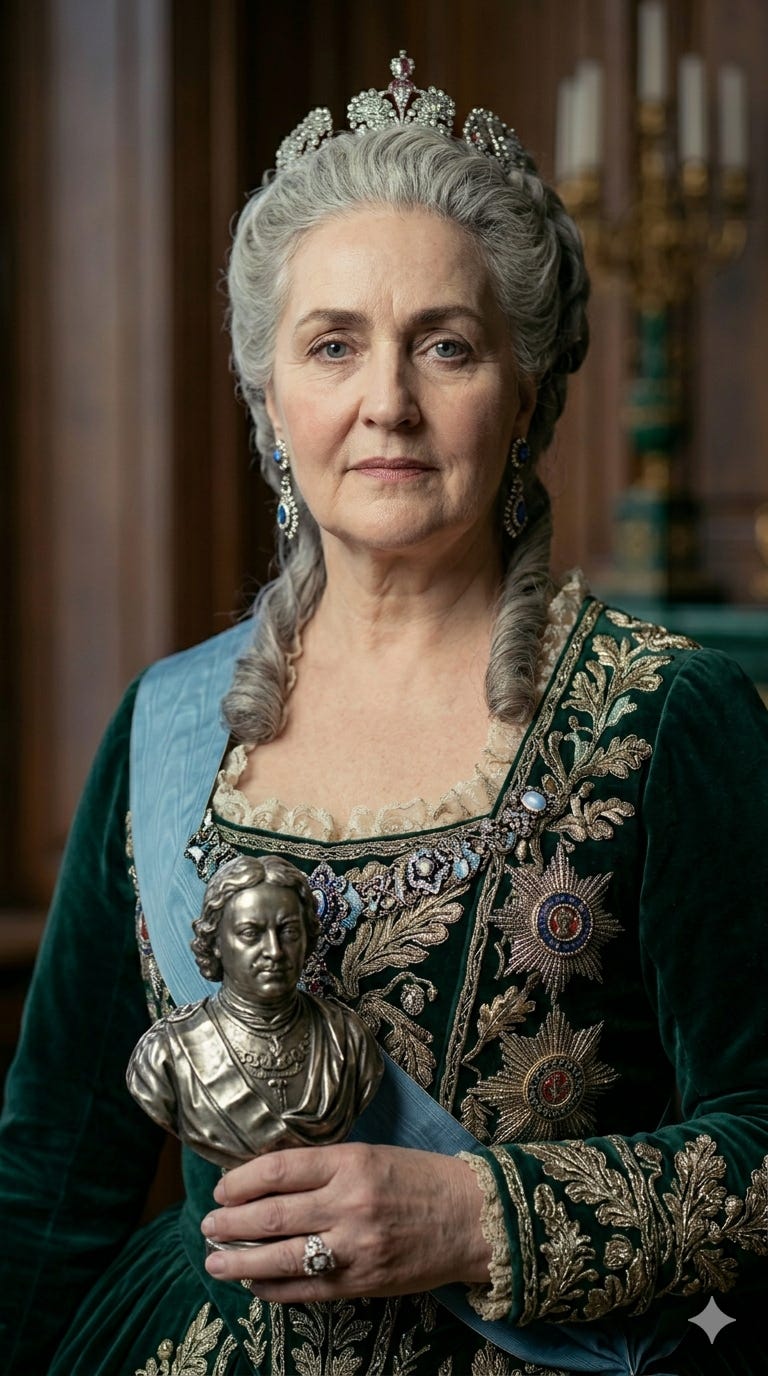
By the time Catherine enters the record, female sovereignty is no longer impossible, but it is still treated as suspect. Women have inherited crowns, defended succession, and ruled empires.
The question changes again. What happens when a woman takes power directly, succeeds visibly, and history still insists on explaining her through scandal.
Catherine II of Russia did not inherit the throne by simple succession. She seized it. Born a German princess, she married into the Russian imperial family, navigated an unstable court, and eventually supported the coup that removed her husband, Peter III. Soon after, she ruled as empress.
That matters because it strips away the illusion of passive authority.
Catherine did not wait for permission.
She ruled for more than three decades, expanded Russian territory, strengthened imperial administration, engaged with Enlightenment thinkers, and positioned Russia as a major European power. Her reign was long, effective, and structurally significant.
And still, the public imagination often reaches somewhere else first. Not reform. Not governance. Not empire. Sex. That is the mechanism.
Catherine is one of the clearest examples of female political authority being reduced through sexual narrative. Rumors, gossip, and fabricated scandal overwhelm discussion of actual rule. Her competence becomes secondary to stories designed to make power feel illegitimate. That framing serves a purpose.
A woman who rules successfully without apology threatens the assumption that power is naturally male. If her authority can be explained as sexual manipulation, excess, or moral corruption, then the discomfort resolves. She is no longer a ruler to be taken seriously. She becomes a warning.
That is containment. Male rulers are allowed ambition. Female rulers are often assigned appetite.
Catherine’s personal life becomes political shorthand in a way that obscures the scale of her reign. Her reforms, correspondence, patronage, and imperial expansion remain, but they compete with stories built specifically to diminish seriousness.
That is not accidental. She was too successful to erase. So she was made disreputable instead.
Catherine matters because she shows that visibility does not protect legitimacy. A woman can rule one of the largest empires in the world, leave unmistakable political impact, and still be remembered through insult first.
She was not reduced because she failed. She was reduced because she did not. She took power. She held it. She expanded it. And history kept trying to turn authority into gossip.