

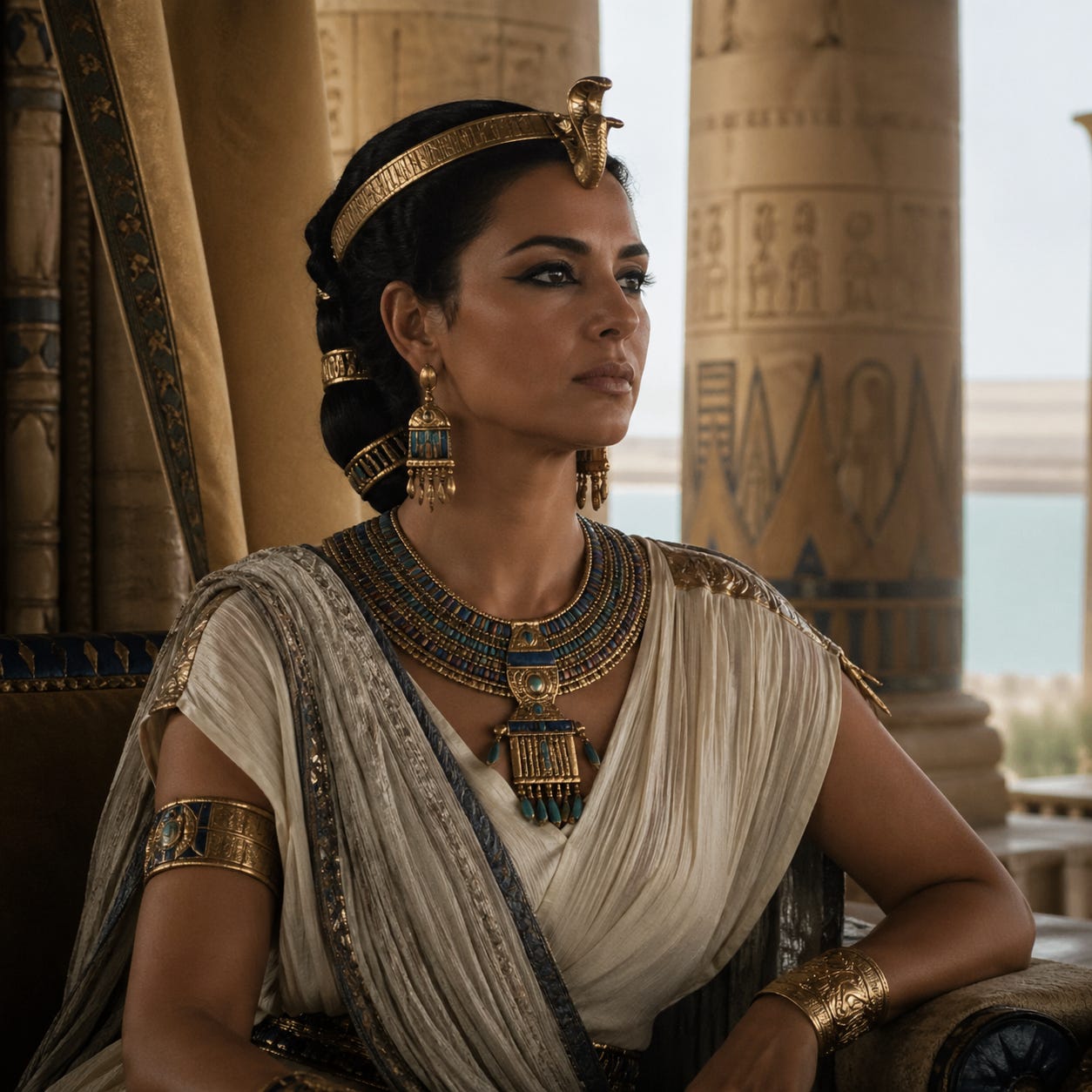
By the time Cleopatra enters the record, female power is no longer unfamiliar. Women have ruled, advised, resisted, and commanded. They have appeared in religion, dynasty, war, and statecraft. The question is no longer whether a woman can hold power. The question is what happens when that power threatens a system larger than her.
Cleopatra VII was not an anomaly at the edge of history. She was the last active ruler of the Ptolemaic Kingdom of Egypt, a monarch operating within one of the most politically volatile regions of the ancient world. She governed, negotiated, aligned, and strategized in the face of Roman expansion. Her reign was not symbolic. It was active, calculated, and deeply political.
That matters because the way Cleopatra is remembered often has little to do with that reality. Cleopatra is one of the clearest examples in this series of power being rewritten after the fact. Not erased. Not fully denied. But reshaped into something easier to contain.
Her political intelligence, her multilingual ability, her economic control, and her strategic alliances are part of the record. But they do not dominate the story that survives. Instead, Cleopatra is remembered through her relationships with Julius Caesar and Mark Antony, framed through seduction, allure, and personal influence.
That is the shift. A ruling woman, operating at the level of statecraft and survival, is reduced to intimacy. Her power is made legible through the men around her. Her decisions become personal. Her strategy becomes emotional. Her authority becomes suspect. That is not an accident.
The Roman system that ultimately absorbed Egypt had every incentive to control the narrative of its final independent ruler. Cleopatra could not remain a capable monarch defending her state. That would make Rome’s conquest look like what it was, an expansion over another sovereign power.
Instead, she becomes excess. Danger. Seduction. Foreign intrigue. A queen who did not rule, but ensnared. That framing serves a purpose.
If Cleopatra’s influence is sexual, Roman men remain politically intact. If her power is personal, her governance disappears. If her alliances are seduction, her strategy becomes irrelevant. The conquest becomes cleaner. The woman becomes smaller. That is how the record narrows her.
Cleopatra’s life shows a different mechanism in full form. Female power can be neutralized by reframing it as something other than power. Not myth alone, as with Sammu-ramat. Not exception, as with Artemisia. Not resistance, as with Tomyris.
Cleopatra’s authority is translated into narrative. A story that replaces governance with personality, policy with intimacy, and rule with influence. And that story holds.
For centuries, Cleopatra has been remembered more for her beauty than her politics, more for her relationships than her rule, more as symbol than sovereign. The distortion is so complete that it often passes as fact. But the record does not support that reduction.
Cleopatra held power in one of the most dangerous political environments of her time. She navigated Rome not from weakness, but from necessity. She attempted to preserve Egyptian sovereignty under immense pressure.
Her actions were not the work of a passive figure shaping events through charm. They were the decisions of a ruler managing survival in a system designed to absorb her. That is the reality beneath the story.
Cleopatra matters because she reveals how thoroughly female authority can be rewritten when it becomes inconvenient. She was not erased. She was transformed. Her power did not disappear. It was recast into something easier to dismiss.
That is one of the most effective forms of narrowing. A woman can remain famous and still be misrepresented. She can be remembered everywhere and understood nowhere. She can be turned into a symbol so large that the person becomes unreachable.
Cleopatra stands as one of the strongest examples of that process. She did not lose power because she lacked it. She lost power because she faced a system larger than any one ruler.
But the story that follows suggests something else. It suggests she was undone not by empire, but by herself. That is the final distortion.
Cleopatra did not fail as a ruler in the way the story implies. The system around her reframed her so that her defeat could be explained in terms that protected its own legitimacy. She was not reduced in her lifetime. She was reduced in the story that followed.
What stayed with me most is not Cleopatra herself, but the mechanism you describe around her.
A woman can remain visible in history and still disappear inside the story told about her. That distinction feels essential.
You show very clearly how power is often neutralized not only through conquest, but through narrative reduction: governance transformed into seduction, strategy into personality, sovereignty into spectacle.
And perhaps that process still exists everywhere today, only in different forms.
What I appreciated here is that you did not try to “redeem” Cleopatra through mythology or modern idealization. You brought her back into the harsh political reality she was actually navigating.
That changes the entire perception of her.