

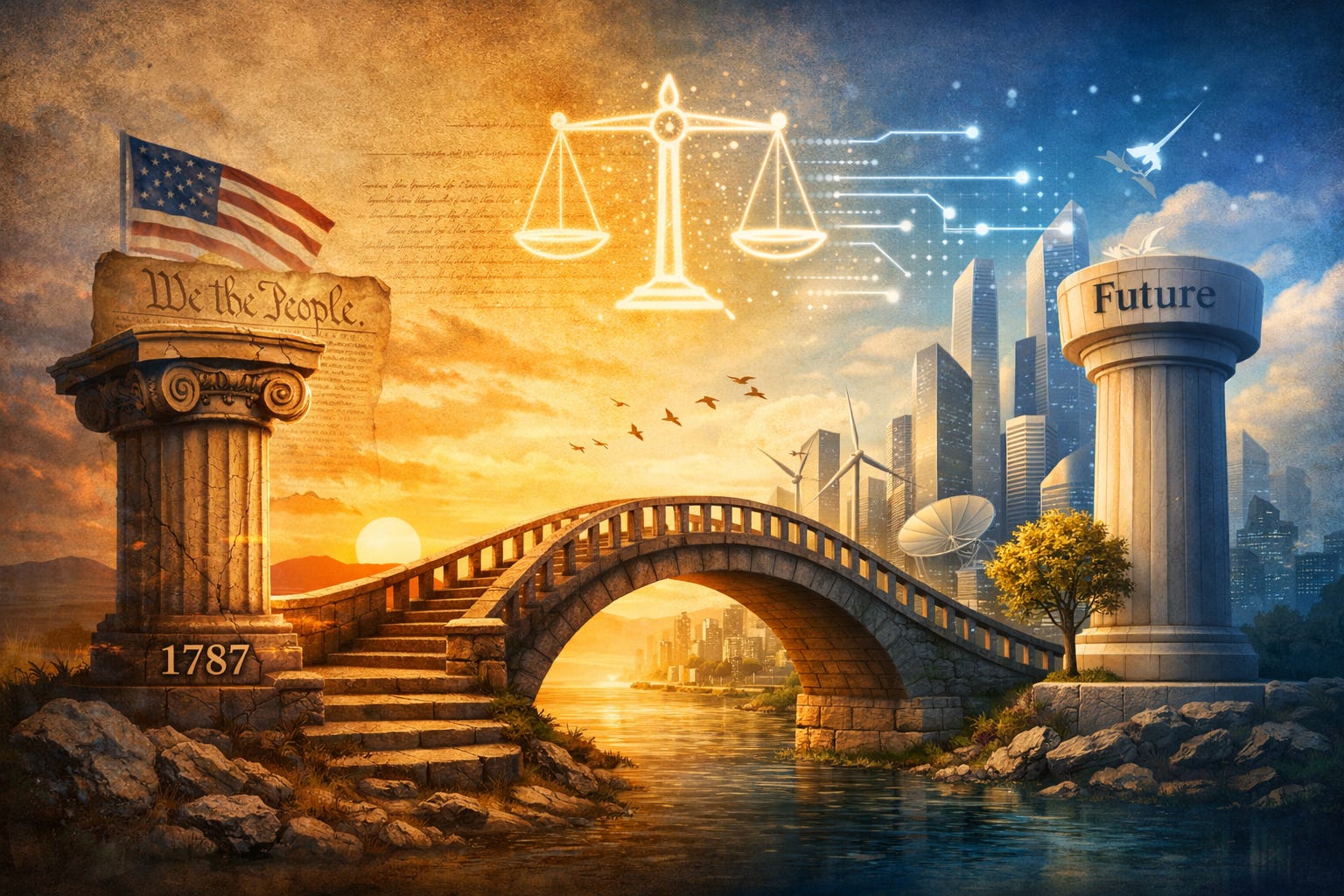
The Constitution of the United States was written within a specific historical moment. It emerged from a population small in number, a territory limited in scale, an economy grounded largely in land and labor, and a technological environment where communication and power moved slowly. The document established a structure of governance designed to balance authority, prevent tyranny, and allow a diverse society to function under shared rules.
For its time, the Constitution was a remarkable achievement. It created a durable framework capable of surviving expansion, conflict, and transformation. Amendments and institutional development allowed the system to adapt in meaningful ways, expanding rights, correcting injustices, and refining democratic practice.
However, no constitutional structure exists outside the conditions that shaped it. Over time, the scale, complexity, and concentration of modern systems have grown far beyond the assumptions present at the founding.
The United States now governs a population and economy operating at global scale. Institutions manage systems of finance, information, infrastructure, and technology that affect billions of people and move at speeds unimaginable in earlier centuries. Corporate entities now operate with resources and influence that rival governments. Information flows now shape perception and decision-making in ways traditional checks and balances were never designed to address.
The original constitutional structure remains an important foundation, but it was not designed to regulate concentrated corporate power, globalized financial systems, or technological infrastructures capable of shaping the conditions of daily life. These developments have created gaps between the protections envisioned in the original framework and the realities people now experience.
Many challenges facing democratic societies today emerge from this gap. When systems grow beyond the structures designed to govern them, accountability becomes difficult to maintain. Institutions can remain procedurally intact while substantive participation erodes. Legitimacy weakens when people experience systems as operating beyond their reach or against their interest.
Constitutional evolution becomes necessary when existing frameworks can no longer adequately protect the conditions required for democratic participation. Evolution does not mean discarding the past. It means recognizing that the principles of liberty, dignity, participation, and accountability must be expressed in ways that match present realities.
The purpose of constitutional evolution is therefore not replacement, but continuation. The goal is to extend the founding commitment to self-governance into a world of greater complexity and scale. This requires clarifying protections that earlier generations could assume but no longer can.
Modern constitutional systems must address forms of power that did not previously exist at comparable scale. Economic concentration, institutional capture, and information manipulation can undermine democratic participation even when formal institutions remain intact. Safeguards must therefore account for structural conditions that shape the ability of people to participate meaningfully in civic life.
The evolution proposed in this framework centers on a simple premise: systems of governance exist to sustain human participation and dignity across time. When structures drift away from that purpose, correction becomes necessary.
This document does not seek to erase the constitutional tradition of the United States. It builds upon it. The original Constitution established a framework for a free society. The task now is to extend that framework so it remains capable of protecting freedom, dignity, and participation under modern conditions.
Constitutional evolution is not a rejection of the founding vision. It is its continuation.