

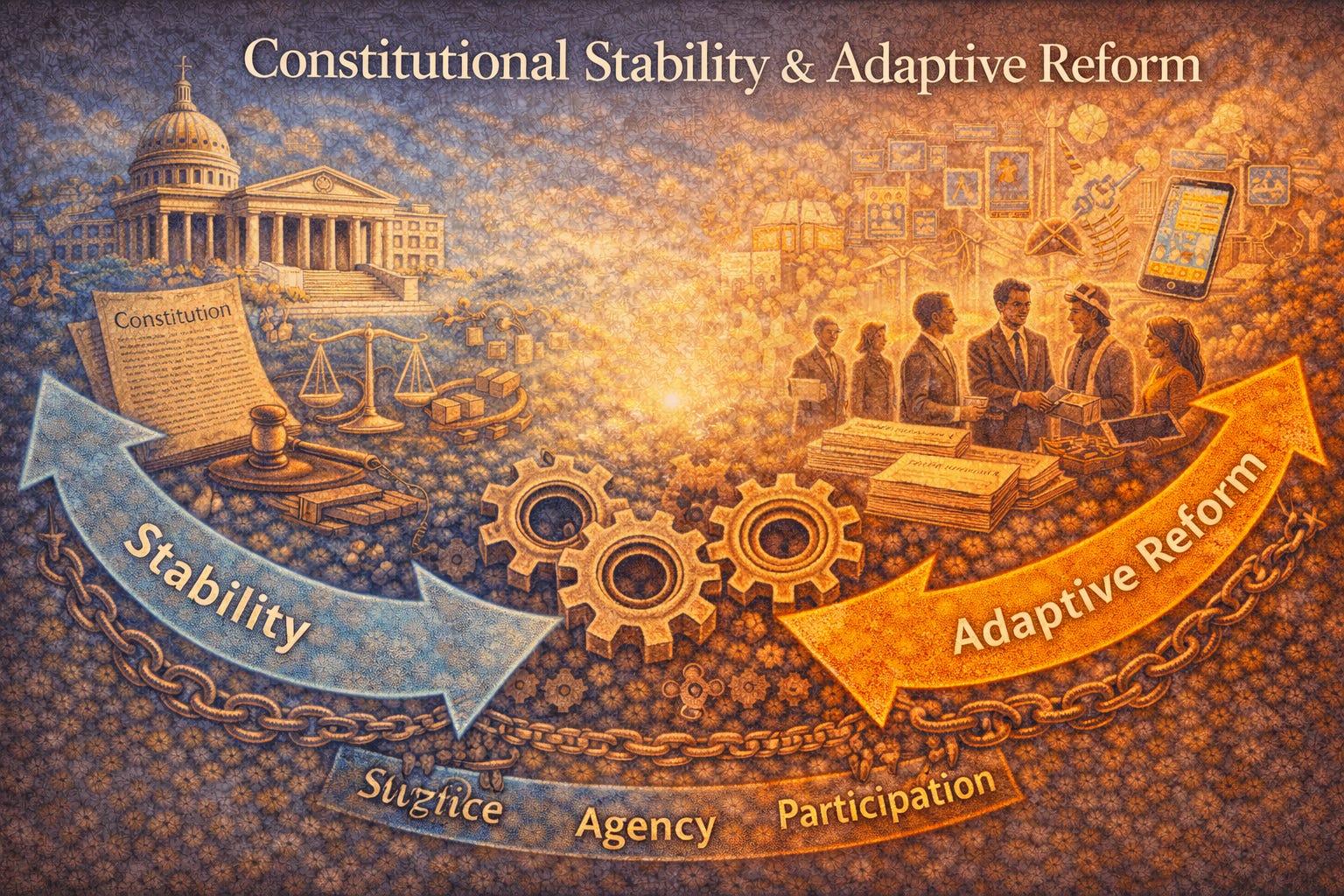
Durable constitutional systems must balance two essential qualities that can appear to be in tension. They must provide stability while also allowing for adaptation. Stability allows societies to rely upon consistent rules, predictable institutions, and protected rights. Adaptation allows constitutional systems to respond to new conditions, technologies, and social realities that earlier generations could not fully anticipate.
A constitution that cannot change risks becoming detached from the society it governs. Over time, rigid systems may fail to address emerging challenges, creating pressures that accumulate outside the formal structure of governance. When adaptation becomes impossible within constitutional frameworks, instability often follows.
At the same time, constitutional systems that change too easily can lose their ability to provide stability. If fundamental rules are altered frequently or for short-term political advantage, institutions may become unpredictable and public trust can weaken.
The design of constitutional systems therefore often includes mechanisms that make amendment possible but deliberate. These mechanisms typically require broad consensus, extended public deliberation, or multiple stages of approval. The goal is to ensure that constitutional reform reflects sustained collective judgment rather than temporary political pressures.
This balance between stability and adaptability allows constitutions to function across long spans of time. Foundational principles remain durable while institutional arrangements can evolve as circumstances change.
Adaptive reform also allows societies to incorporate new knowledge and understanding. Scientific discovery, technological innovation, and changing social conditions frequently reveal limitations in earlier institutional designs. Constitutional systems that can respond to these developments are better positioned to maintain legitimacy and effectiveness.
Importantly, adaptive reform does not imply abandoning foundational commitments. Principles such as human dignity, equal protection, accountability, and participation can remain constant even as the structures used to implement them evolve.
Historical experience demonstrates that constitutional systems which incorporate thoughtful mechanisms for reform often achieve greater longevity. By allowing change to occur within established legal processes, societies can avoid cycles of crisis that arise when institutional evolution is delayed too long.
Public participation also plays an important role in adaptive reform. Constitutional amendments and major institutional changes often involve public dialogue, legislative deliberation, and democratic decision-making. These processes allow citizens to contribute to the ongoing development of their governing systems.
In this sense, constitutional reform becomes part of the broader civic project through which societies shape their collective future.
The goal is not to treat constitutions as static monuments. Instead, they function as enduring frameworks capable of guiding societies through changing conditions while preserving the principles that sustain democratic life.
By maintaining both stability and adaptability, constitutional systems can continue to serve successive generations while remaining responsive to the evolving needs of the communities they govern.