

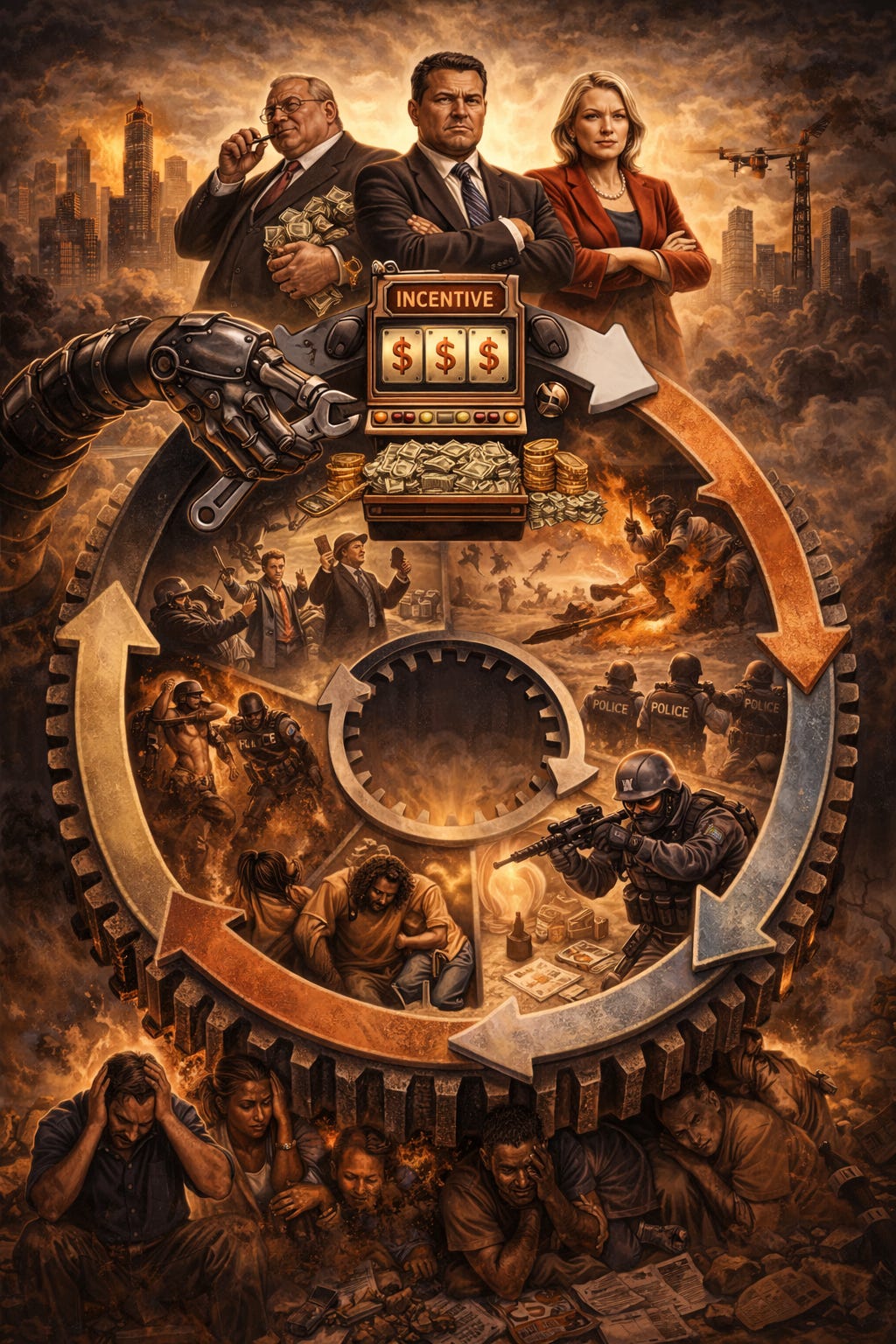
Every generation eventually reaches the same conclusion. This collapse feels different. Deeper. More final.
The explanations follow quickly. Charts appear. Timelines circulate. Predictions settle into certainty. This time, recovery will not come. This time, history runs out.
What rarely gets asked is a simpler, more uncomfortable question. Are cycles acting on us, or are we rebuilding them? The answer is not mystical. It is mechanical.
Economic and social breakdowns recur not because history is trapped in a loop, but because systems behave predictably when incentives remain unchanged. Structures designed to reward the same behaviors will produce the same outcomes, regardless of era, ideology, or intent.
Calling this a cycle makes it sound natural, like seasons. Calling it destiny makes it sound unavoidable. Neither description is accurate. What actually repeats are incentive structures.
After every major crisis, safeguards are created. Regulations are strengthened. Risk is redistributed. Those changes work. Stability returns. Over time, however, the very mechanisms that prevent collapse are weakened. Efficiency is prioritized. Profit is concentrated. Oversight is framed as obstruction. Memory fades.
Eventually, the system fails again under the weight of its own incentives. This pattern is well documented. It does not require belief. It requires observation.
Speculation outperforms production when rules allow it. Consolidation accelerates when failure is removed as a consequence. Short-term gain dominates when long-term cost is externalized. These are not moral failures. They are predictable responses to reward design.
This is why predictions of collapse often sound prophetic. They are not describing fate. They are extrapolating from conditions that have been allowed to persist.
The Great Depression did not end because a historical arc completed itself. It ended because incentives were deliberately changed through labor protections, financial regulation, public investment, and shared risk. When those incentives were later dismantled, the conditions for instability quietly returned.
Nothing mystical occurred. Nothing inevitable resolved.
Claims that recovery cannot happen until some distant decade are not prophecy. They are estimates based on how long societies typically delay structural correction after warning signs are obvious. When reform is postponed until breakdown forces it, recovery is slow and costly. When intervention comes earlier, collapse often never materializes.
This distinction matters because predictive language carries risk.
Once expectation hardens into inevitability, agency erodes. Suffering is reframed as necessary. Inaction becomes reasonable. Responsibility dissolves into timing rather than choice. At that point, prediction quietly becomes prophecy. Prophecy does not describe the future. It excuses the present.
Cycles do not exist to teach lessons. They persist because incentive structures remain intact while outcomes are lamented. Societies repeatedly treat symptoms as surprises while protecting the conditions that generate them.
The uncomfortable truth is this. History does not repeat because people refuse to learn. It repeats because systems are allowed to reward the same behaviors indefinitely.
Change the incentive, and behavior changes. Change the incentive, and the so-called cycle breaks. This is not optimism. It is design logic. The future is not waiting for a collapse to complete itself. It is waiting on whether structural incentives are corrected before damage becomes irreversible.
No date determines that outcome. No prophecy governs it. Only choices do.
And those choices are not abstract or collective. They are embedded in policy, enforcement, investment, and tolerance. They are made daily, often quietly, often by default.
Cycles feel inevitable only when they are left intact.