

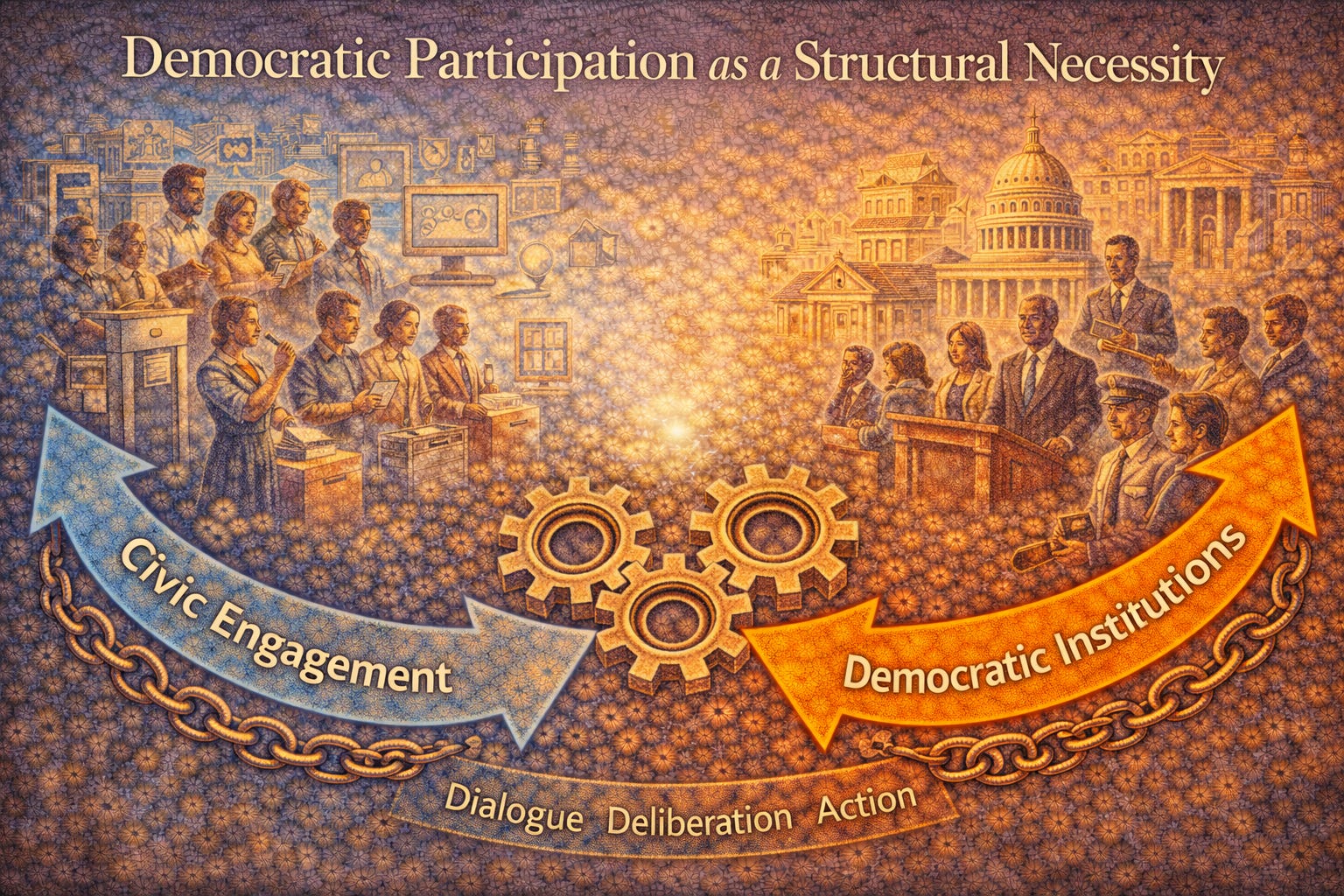
Democratic systems are often described in terms of elections, representation, and institutional structures. While these elements are essential, they depend upon a deeper condition for their effectiveness. Democratic governance requires ongoing participation by the people who live within those systems.
Participation is not merely a symbolic act performed during election cycles. It represents the continuous engagement of citizens in the processes through which societies deliberate, make decisions, and hold institutions accountable.
When participation is broad and sustained, democratic systems gain resilience. Citizens bring diverse perspectives to public debate, institutions remain responsive to changing conditions, and political authority retains legitimacy through visible public involvement.
Participation takes many forms. Voting remains one of the most widely recognized expressions of democratic engagement, but it is only one component. Public dialogue, community organization, civic associations, local governance, and peaceful advocacy all contribute to the functioning of democratic systems.
These activities create the connective tissue between citizens and institutions. They allow individuals to express concerns, propose solutions, and collaborate with others in shaping the direction of their communities.
A healthy democratic system encourages participation by lowering unnecessary barriers to engagement. Accessible voting systems, transparent decision-making processes, and opportunities for public input all help citizens contribute meaningfully to governance.
Education also plays a critical role. Individuals who understand the structure of institutions and the mechanisms of civic engagement are more likely to participate effectively in public life.
Economic and social stability influence participation as well. Citizens facing severe insecurity may struggle to devote time and attention to civic engagement. Systems that provide basic stability often see higher levels of sustained democratic involvement.
Participation must also be protected from manipulation. When political processes are distorted by misinformation, intimidation, or unequal access to influence, genuine public participation becomes more difficult to sustain.
For this reason, constitutional systems often establish safeguards that protect the integrity of elections, the freedom of speech and association, and the transparency of public decision-making.
Democratic participation also requires a culture that values dialogue and mutual respect. Societies characterized by extreme polarization or hostility may find it difficult to sustain constructive civic engagement.
Institutional frameworks can support healthier participation by encouraging deliberation rather than confrontation. Structured forums, community assemblies, and collaborative problem-solving initiatives allow citizens to engage with complex issues more productively.
Ultimately, democratic participation reflects the principle that political authority originates from the people. Institutions exist to coordinate collective decision-making, but they remain accountable to the public whose interests they serve.
When participation becomes limited to a narrow segment of society, democratic systems lose representativeness and responsiveness. When participation expands across diverse communities, institutions gain insight, legitimacy, and adaptability.
Democracy therefore functions most effectively not as a passive system administered by institutions alone, but as an ongoing civic process in which citizens actively contribute to the shaping of their collective future.