

Democratic systems are often described through their visible structures: constitutions, elections, legislatures, courts, and administrative institutions. These structures form the framework through which collective decisions are made and authority is exercised.
Yet the presence of these institutions alone does not guarantee democratic stability.
History demonstrates that democratic systems can weaken or collapse even when their formal structures remain intact. Elections may still occur, laws may still be written, and institutions may continue operating. However, when the underlying conditions that support democratic life deteriorate, the system itself becomes fragile.
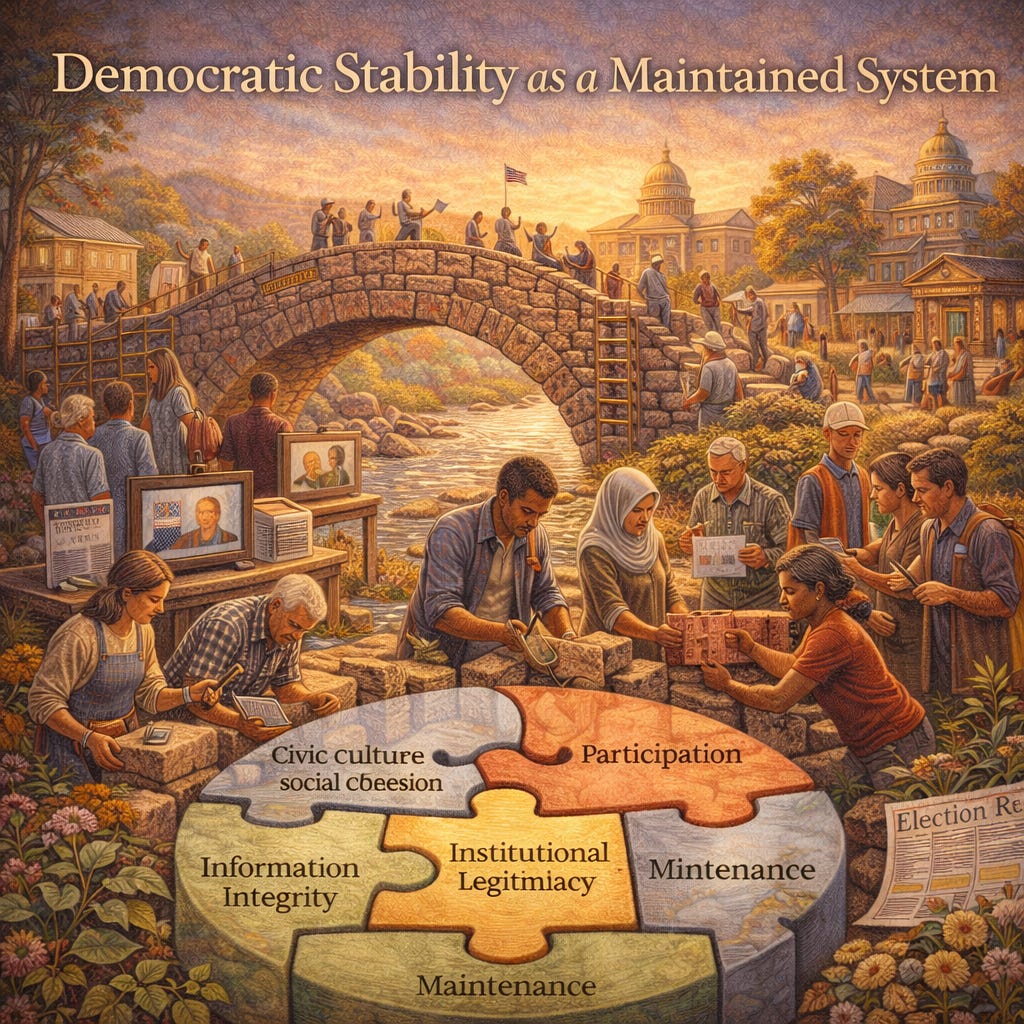
Democratic stability therefore depends not only on institutional design, but on the maintenance of several interconnected conditions.
Participation allows citizens to remain active contributors to public decision-making. When participation declines or becomes uneven, institutions risk losing their connection to the people they serve.
Information integrity allows citizens to form judgments based on credible knowledge. Without reliable information environments, public debate becomes vulnerable to confusion, manipulation, and mistrust.
Institutional legitimacy allows the public to recognize authority as valid and accountable. When institutions consistently demonstrate fairness, transparency, and responsiveness, trust can develop across generations.
Civic culture and social cohesion provide the human environment within which democratic disagreement can occur constructively. Citizens who continue to recognize one another as members of a shared political community are more capable of navigating conflict without destabilizing the system itself.
Maintenance connects all of these elements. Democratic systems must adapt as societies evolve, technologies change, and new challenges emerge. Periodic review, reform, and renewal allow institutions to remain aligned with the realities of the communities they govern.
When these conditions reinforce one another, democratic systems develop resilience. Institutions remain capable of responding to crises, correcting mistakes, and adjusting to new circumstances without abandoning their foundational principles.
When these conditions weaken simultaneously, democratic systems may struggle to function even if their formal structures remain in place.
Understanding democracy as a maintained system changes how societies approach governance. Rather than assuming that stability will persist automatically, citizens and institutions recognize the need for continuous care and attention.
Just as physical infrastructure requires inspection, repair, and renewal, democratic infrastructure must also be sustained through deliberate effort.
Participation, trustworthy information, legitimate institutions, civic culture, and ongoing maintenance together form the ecosystem that allows democratic societies to endure.
In this sense, democracy is not a finished achievement handed down intact from the past. It is a living system that each generation inherits, maintains, and ultimately passes forward to those who follow.