

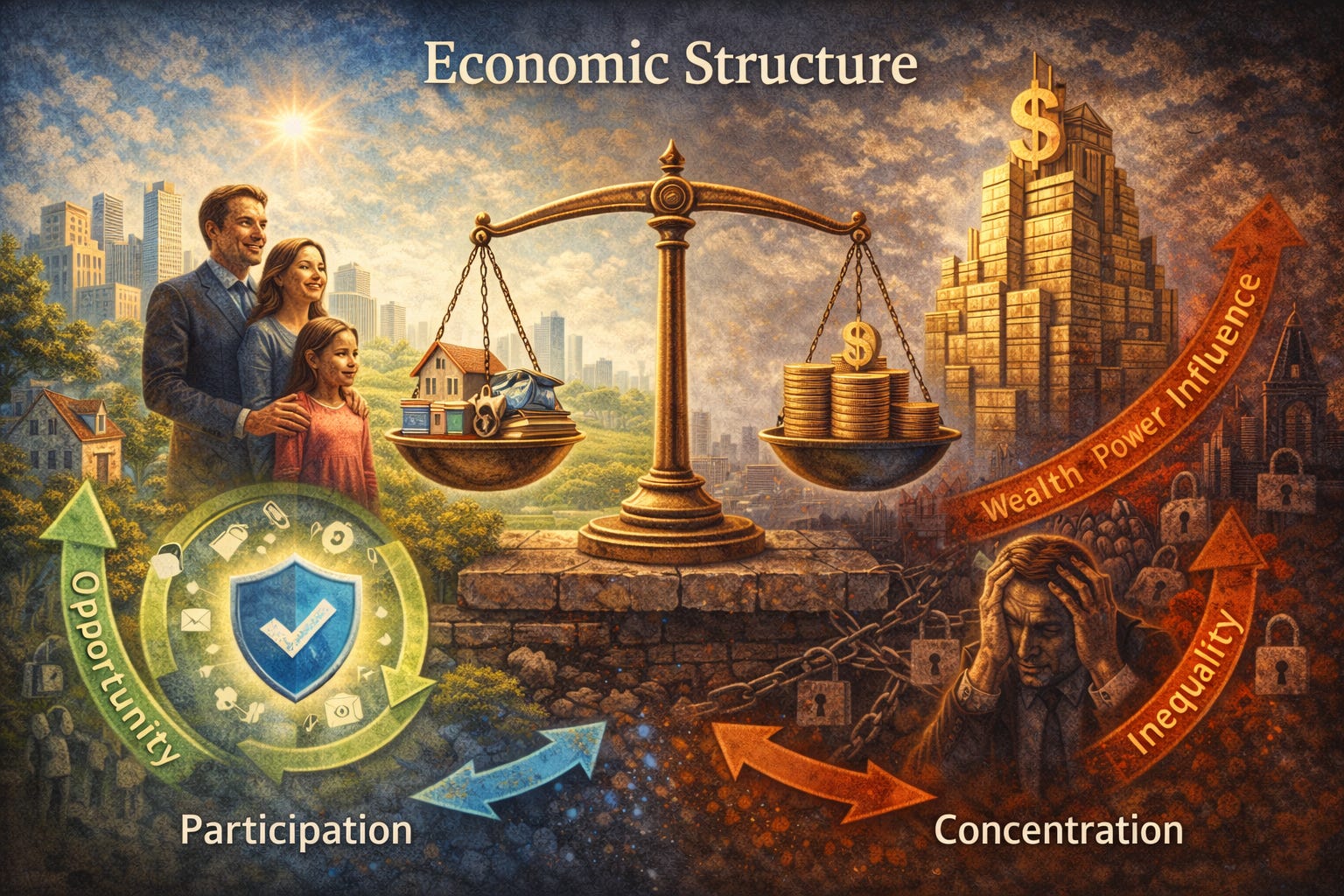
Economic systems shape the conditions under which people live, work, and participate in society. They determine how resources circulate, how labor is valued, and how stability is maintained across generations. For democratic systems to function, economic structures must support participation rather than undermine it.
Markets play an important role in organizing production, exchange, and innovation. They allow individuals and organizations to respond dynamically to changing needs and opportunities. When functioning within appropriate boundaries, markets can support creativity, efficiency, and the development of new ideas and technologies.
However, markets are not self-governing systems. Without structural limits, they tend to concentrate wealth, power, and influence over time. This concentration can gradually reshape political and social institutions, placing economic power in a position to influence or direct the structures intended to regulate it.
When economic power becomes sufficiently concentrated, democratic participation weakens. Individuals and communities with limited economic resources may lose meaningful influence over decisions that affect their lives. Institutions designed to represent the public may become increasingly responsive to concentrated interests.
A stable democratic society therefore requires an economic structure that balances market activity with civic safeguards. Markets must operate within boundaries that preserve the conditions necessary for broad participation, institutional independence, and social stability.
Economic systems should allow individuals to pursue opportunity and build prosperity through effort, skill, and innovation. At the same time, they must prevent structural conditions that produce permanent economic exclusion or generational economic captivity.
Participation in economic life requires access to basic stability. When individuals lack reliable access to housing, healthcare, education, or other foundational conditions of life, their ability to participate meaningfully in civic and economic systems diminishes. Economic instability therefore affects not only individual well-being but also the functioning of democratic institutions.
Circulation is central to the long-term health of economic systems. Resources, capital, and opportunity must continue to move through society rather than accumulate indefinitely within narrow structures of ownership or control. When circulation slows or stops, economic mobility declines and inequality becomes increasingly entrenched.
Economic policy within democratic systems must therefore balance several objectives. It must allow productive activity and innovation to flourish while preventing concentrations of power that undermine democratic governance. It must support individual initiative while maintaining the shared foundations that allow society to function as a whole.
These goals do not require the elimination of markets or private enterprise. Rather, they require the establishment of clear civic boundaries within which economic activity operates.
Within this framework, the purpose of economic structure is not simply growth or accumulation. Its purpose is to sustain the material stability, opportunity, and circulation necessary for individuals and communities to participate fully in civic life.
When economic systems support these conditions, they strengthen democratic institutions. When they undermine them, political systems become increasingly difficult to sustain.
A democratic constitution must therefore recognize the relationship between economic structure and civic participation. By establishing boundaries that prevent structural concentration and protect the foundations of participation, constitutional systems help ensure that economic life remains compatible with democratic governance.