

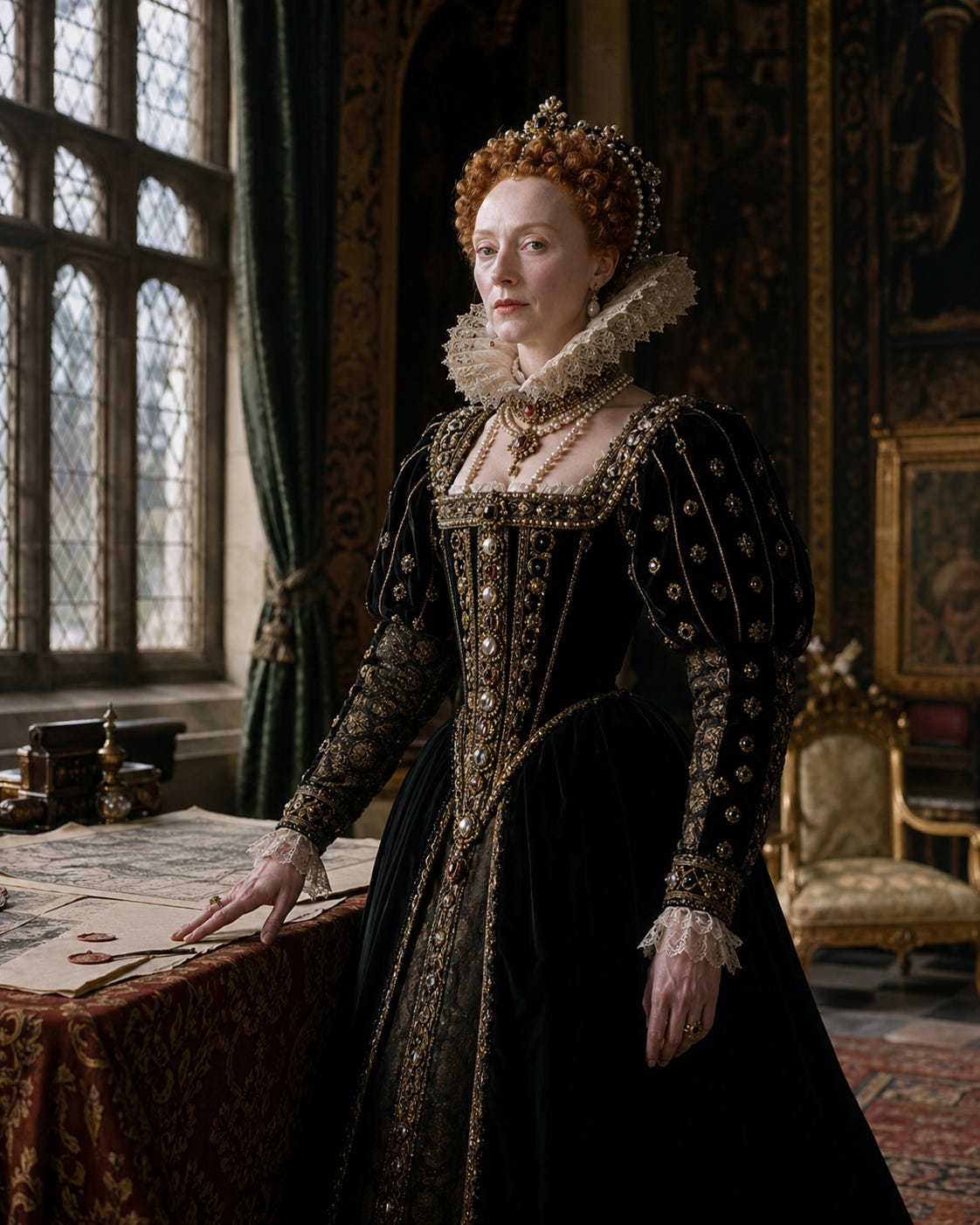
By the time Elizabeth enters the record, the pattern has become familiar. Women have inherited, ruled, resisted, been denied, been reframed, and been turned into symbols.
With Elizabeth, the question changes again. What happens when a woman rules successfully, for a long time, and the system still treats her authority as conditional?
Elizabeth I did not inherit an easy throne. She inherited instability. Questions of legitimacy had followed her since birth. Her mother, Anne Boleyn, had been executed. Her father’s marriages had fractured both family and kingdom.
Religion and succession had become political weapons. Even before she ruled, Elizabeth existed inside dispute. That matters because her authority began under suspicion.
When she became queen in 1558, England was divided by religious conflict, weakened by instability, and surrounded by political threats. She was not stepping into secure power. She was expected to prove she could hold it. And she did.
Elizabeth ruled for more than forty years. She stabilized the crown, managed religious settlement, navigated foreign threats, and maintained political control in a court built to test weakness. She did not inherit peace. She governed through tension. That is the shift.
Unlike Matilda, whose claim was blocked, or Joan, whose authority was destroyed, Elizabeth held the crown fully. She was not near power. She was the sovereign. And still, the terms of her rule remained different. A king is expected to rule. A queen must explain how.
Elizabeth’s reign was shaped constantly by the question of marriage. Advisers, nobles, and foreign powers pressed the issue again and again. Who would she marry? Who would gain influence? Who would secure succession?
Her body was treated as state infrastructure. That is the mechanism.
Even as reigning monarch, her legitimacy was tied to whether she would transfer, stabilize, or justify power through a man. Her unmarried status was treated not as political strategy, but as a problem requiring resolution. That framing reveals the limit.
Elizabeth could govern successfully and still be measured against expectations built for male succession. Her intelligence, discipline, and statecraft did not remove the question. They existed beside it. She became exceptional.
The “Virgin Queen” is remembered as image as much as ruler. Her unmarried status became myth, branding, and political symbol. It gave her control, but it also narrowed the story. Her reign is often framed through personal identity first, governance second.
That is the familiar pattern. A woman’s political success becomes attached to personality. Her authority is translated into character. The sovereign becomes the symbol. That softens the reality.
Elizabeth was not powerful because she remained unmarried. She remained unmarried because it protected her power. Marriage in her position was not private life. It was transfer of influence, foreign leverage, and domestic instability. Refusal was governance. That distinction matters.
She understood that every marriage proposal carried political cost. To remain unbound was not absence. It was strategy. She used expectation itself as a tool, delaying, negotiating, and preserving autonomy inside a structure that assumed she would eventually surrender part of it.
That is not romantic independence. It is disciplined rule.
Elizabeth matters because she shows that even full sovereignty does not erase structural suspicion. A woman can reign successfully for decades and still be treated as a temporary exception rather than a normal possibility.
She was not denied the throne. She was required to justify holding it. That is a quieter form of resistance, but it is still resistance.
Her reign did not erase the assumption that kingship was male by default. It proved a woman could govern brilliantly, and still be remembered as unusual for doing what a man would simply be expected to do.
That is the threshold she exposes. Elizabeth did not fail the system. She mastered it. And the story that followed still worked to explain why her rule should be treated as singular, rather than ordinary.
“She was not denied the throne. She was required to justify holding it.”
That line reframed the entire piece for me.
What feels strongest here is how you keep bringing the focus back to structure rather than personality. Elizabeth is often remembered as myth, image, exception, symbol — but this piece keeps returning her to the reality of governance, strategy, and conditional legitimacy.
“Refusal was governance” is another deeply sharp observation. It strips away the romantic reading of her unmarried status and restores the political intelligence beneath it.
The essay works because it never turns Elizabeth into inspiration. It keeps her inside the machinery she had to survive and master.