

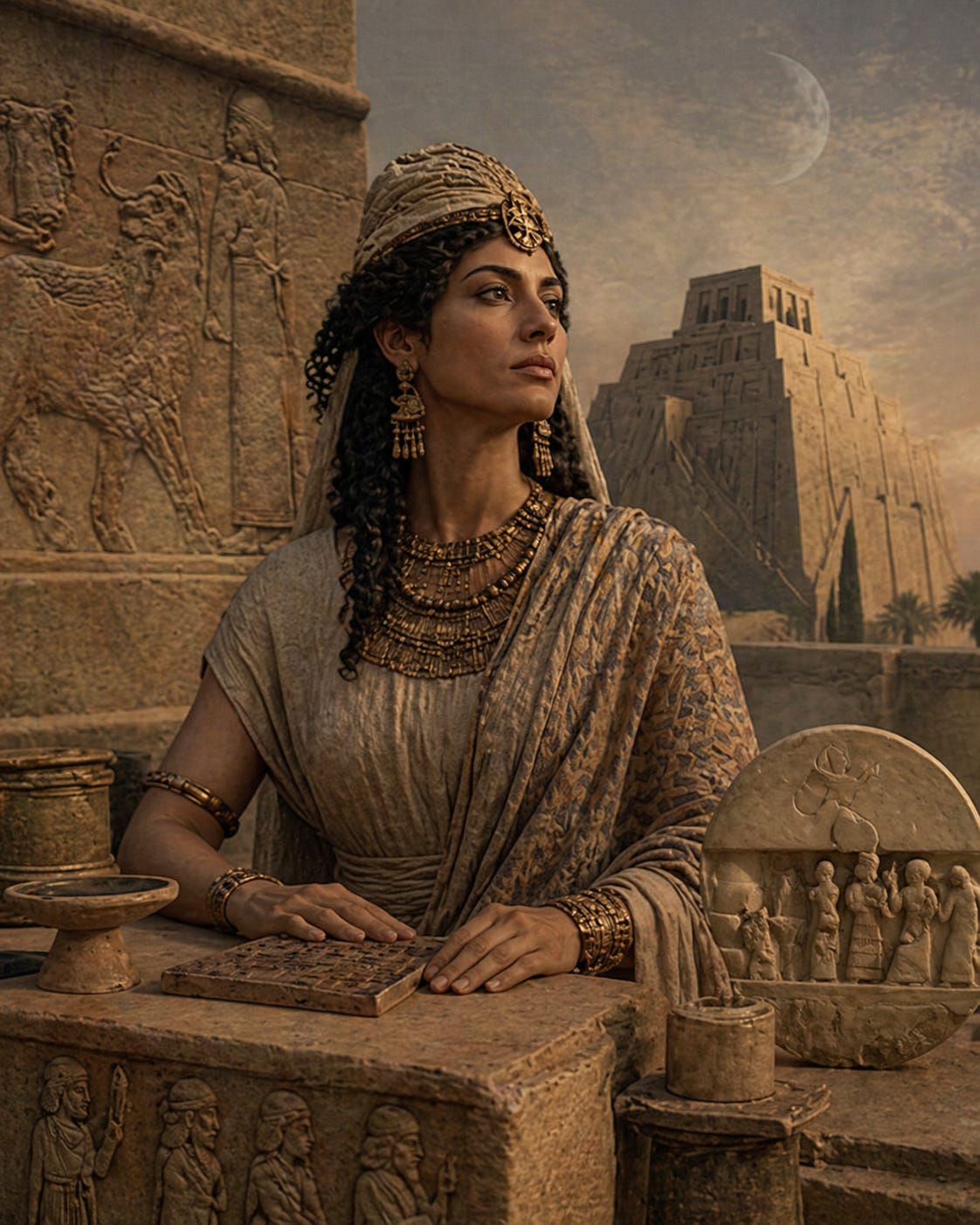
By the time Enheduanna enters the record, the world has already changed. Settlement has hardened. Cities have risen. Priesthood, empire, dynasty, and state power are no longer emerging conditions, but established forms. The archive has begun to keep names. And one of the earliest names it keeps is a woman’s.
That matters.
Enheduanna is often regarded as the earliest known author named in history. Not one of the earliest female authors. One of the earliest named authors, period.
That fact alone disrupts a great deal of lazy historical storytelling. Women did not arrive late to language, thought, authorship, or public meaning. Near the beginning of the written world, one of the first preserved voices belongs to a woman.
But even here, the shape of her visibility tells us something about the world she lived in.
Enheduanna was not preserved because history suddenly decided women were fully worth remembering. She was preserved because she stood where sacred authority, political power, and dynastic importance met.
As the daughter of Sargon of Akkad and high priestess of the moon god Nanna at Ur, her position was not private, marginal, or accidental. She occupied one of the most powerful religious offices in her world. She appears not outside civilization’s center, but inside it.
That is what makes her so important to this series.
Enheduanna breaks the old lie twice at once. First, she breaks the fiction that women were absent from the making of early civilization. Second, she exposes the narrower truth beneath that correction. Women could be central, and still be central under terms shaped by empire, priesthood, and dynastic utility.
Her authorship matters because it is not merely evidence that a woman could write. It is evidence that a woman could speak into the sacred and political life of her age. With a voice strong enough to survive it.
Her existence tells us that female intellect, ritual authority, and public expression were not foreign to the ancient world. They were present at its foundations. And still, her position came through an institution already structured by power.
Enheduanna was visible because she was useful to empire, useful to priesthood, and useful to the ordering of rule. She was not a free-standing example of female equality in some open world of broad recognition. She was a woman who reached the record through one of the few doors power left open.
That does not diminish her. It clarifies the conditions under which women could be preserved at all.
This is one of the earliest lessons the archive gives us. Female authority could exist. Female authorship could exist. Female public significance could exist. But they were most legible when tied to sacred office, dynastic strategy, or the needs of a ruling structure.
That is not absence. But neither is it freedom.
So Enheduanna should not be reduced to a celebratory first. She is more useful than that. She is an early proof of female presence in the making of civilization, and an early reminder that visibility is not the same as equality.
She was remembered, but through power. Preserved, but through office. Heard, but from within a system that already knew how to rank, assign, and contain. That is what makes her the right first individual woman in this series.
She stands near the beginning of the written world as evidence that women were never strangers to authority, thought, or public meaning. But she also stands as evidence that, from the beginning, women were most safely remembered when their importance could be attached to institutions men were consolidating around them.
The archive keeps her. It also tells on itself by showing the terms under which it did.
That is where the pattern sharpens.