

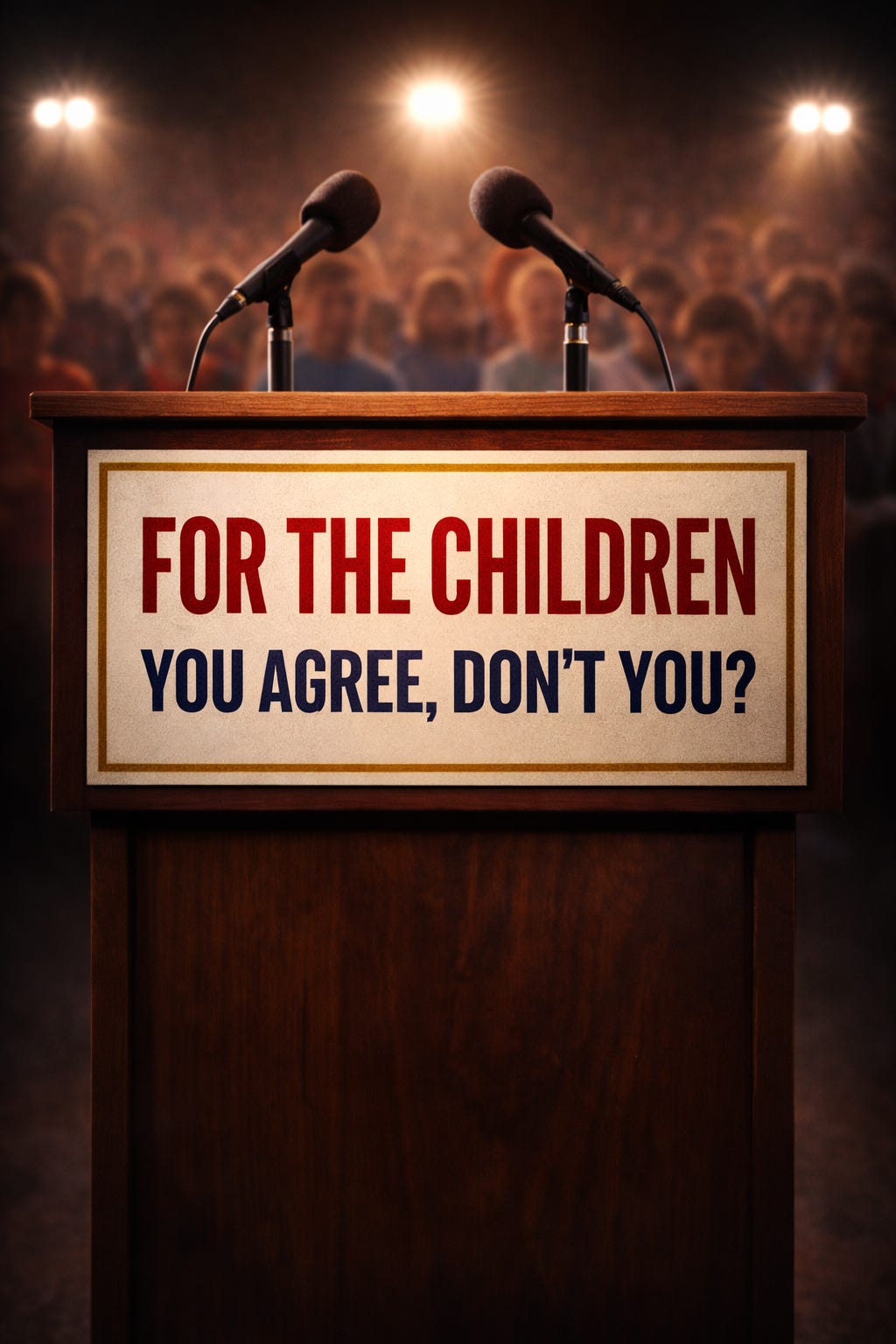
Since the 1970s, nearly every major expansion of state power that restricts rights, widens surveillance, or concentrates authority has been sold under the same refrain, for the children. The phrase is not incidental. It is strategic.
Invoking children short-circuits scrutiny. It reframes opposition as cruelty, transforms power grabs into moral duty, and allows extraordinary measures to pass without the evidentiary burden normally required. But claims of protection are not proven by intention. They are proven by outcomes.
If policies enacted “for the children” consistently make children safer, supported, and protected, the claim holds. If they do not, the claim collapses. Over five decades, the pattern is clear.
We expanded policing and surveillance “for the children,” while abuse inside institutions went unreported, unpunished, or actively concealed. We hardened borders “for the children,” while separating families, detaining minors, and outsourcing care to contractors with minimal oversight. We restricted bodily autonomy “for the children,” while refusing to protect children from domestic violence, religious abuse, trafficking, and exploitation by powerful adults.
When harm occurs, the response is rarely accountability. It is performance. Outrage is expressed. Statements are issued. Investigations are promised. Then institutions close ranks around the adults who held authority, while children absorb the cost. This is not protection. It is insulation. The contradiction is not subtle. Children are invoked rhetorically while being sacrificed materially.
If children were truly the priority, outcomes would look different. Abuse would be prosecuted regardless of status. Victims would be supported without condition. Institutions would be dismantled when they fail, not defended.
Instead, we see the inverse. Those with power receive delay, discretion, and defense. Those without it receive punishment, silence, or disbelief. The phrase “for the children” does not describe a goal. It describes a permission structure.
It allows the state to expand control while evading responsibility for harm. It allows moral authority to be claimed without moral obligation being met. It allows cruelty to be reframed as care. This pattern reshapes culture as well as policy.
Generations were raised hearing that everything was “about them,” while watching their safety treated as negotiable in practice. They grew up inside the contradiction. When they later expressed anger, mistrust, or withdrawal, they were labeled selfish, entitled, or fragile, as if they had not been paying attention. They had.
They learned that protection was conditional. That authority was performative. That responsibility flowed downward, never up. And once again, the phrase is being deployed. Not to protect children from harm, but to justify control over bodies, families, and futures.
If a policy claims to protect children while increasing violence, detention, coercion, or silence, the claim is false. If it shields abusers while punishing the vulnerable, it is worse than false. It is inverted. A society that genuinely prioritizes children does not need to say so constantly. It proves it through outcomes.
Protection does not require spectacle. It requires restraint, accountability, and the willingness to confront power, especially when power claims to act in our name. Until those standards are met, “for the children” is not a justification.
It is a warning. And warnings, when ignored, do not disappear. They compound.