

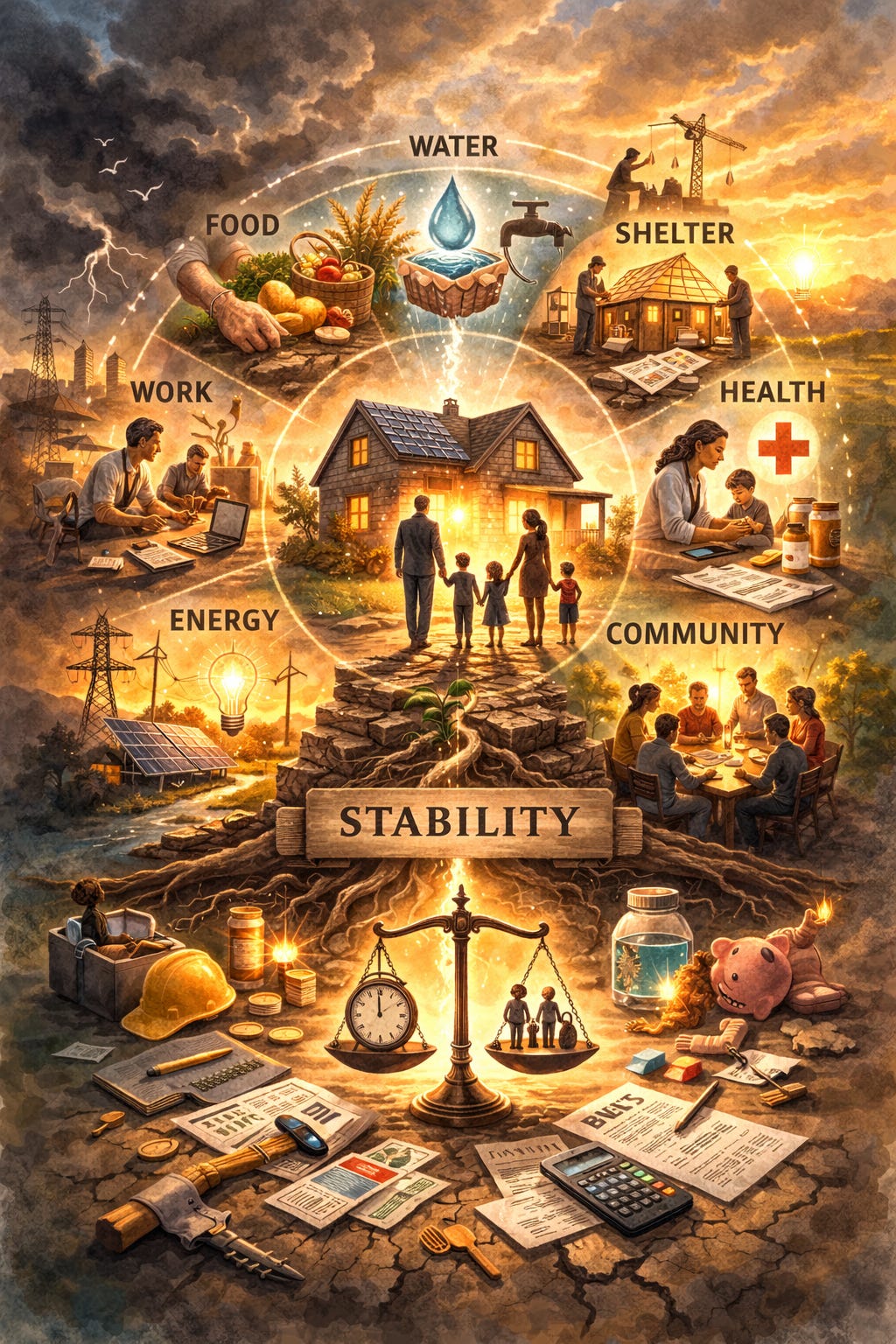
Purpose
The purpose of this framework is to ensure that no person’s life is destabilized by preventable deprivation, and that basic survival and safety conditions are reliably maintained.
Survival and material stability are not rewards for compliance, productivity, or moral judgment. They are baseline conditions of a legitimate society.
Core Orientation
Humanity sits above survival needs.
Government exists below them, as obligated infrastructure.
Scope
This framework covers baseline survival and stability, corresponding to:
Physiological needs (food, water, shelter, healthcare, energy)
Safety needs (predictability, continuity, protection from sudden loss)
Universality
All persons under the authority of the Nation are guaranteed baseline survival and material stability.
This guarantee applies regardless of citizenship, status, documentation, productivity, or circumstance.
Visitors are guaranteed:
emergency medical care
shelter if needed
food if needed
Financial security guarantees beyond immediate survival needs do not extend to visitors.
Conditionality
Baseline survival may never be withdrawn as punishment, compliance enforcement, moral judgment, or administrative failure.
During periods of incarceration, individual financial support designated for baseline income may be redirected to the state solely for the purpose of funding care, custody, and basic needs.
Such redirection does not diminish the person’s entitlement to dignity, humane treatment, care, continuity, or constitutional standing. Support is transformed in form, not revoked in substance.
No other conditions are defined at this level.
Primary Design Priority
Prevention of destabilization is the governing priority of this framework.
Emergency response exists to address failure. Prevention exists to avoid it. Systems must be designed to anticipate and prevent foreseeable breakdowns before harm cascades.
Definition of Stability
Stability means protection from cascading failure across life domains.
A single disruption must not be allowed to trigger multi-domain collapse
(for example: housing loss leading to employment loss, healthcare loss, family destabilization, and long-term harm). Continuity without sudden loss is required insofar as it prevents cascade.
System Accountability Threshold
Harm is inevitable in human systems.
System failure is established when harm becomes predictable, repeats, and persists without correction. At that point, responsibility clearly shifts from individuals to the system.
System Must
Guarantee access to healthcare, shelter, food, water, energy, and baseline income support
Maintain continuity of access without sudden withdrawal
Prevent single disruptions from cascading across domains
Prioritize prevention over crisis-only intervention
Remain accessible without excessive administrative burden
Adapt to foreseeable changes in population needs and conditions
System Must Not
Condition survival on employment, behavior, or compliance
Rely on crisis response as primary operation
Externalize systemic risk onto individuals
Treat deprivation as a corrective tool
Normalize instability as inevitable or acceptable
Relationship to Other Frameworks
This framework is foundational. All other frameworks assume survival and stability are already secured. No framework may override or erode the guarantees established here.
Conclusion
A society that cannot reliably maintain the conditions for survival and safety is not merely inefficient. It is illegitimate.
This framework defines the minimum conditions under which people can remain human, systems can remain ethical, and democracy can remain real.