

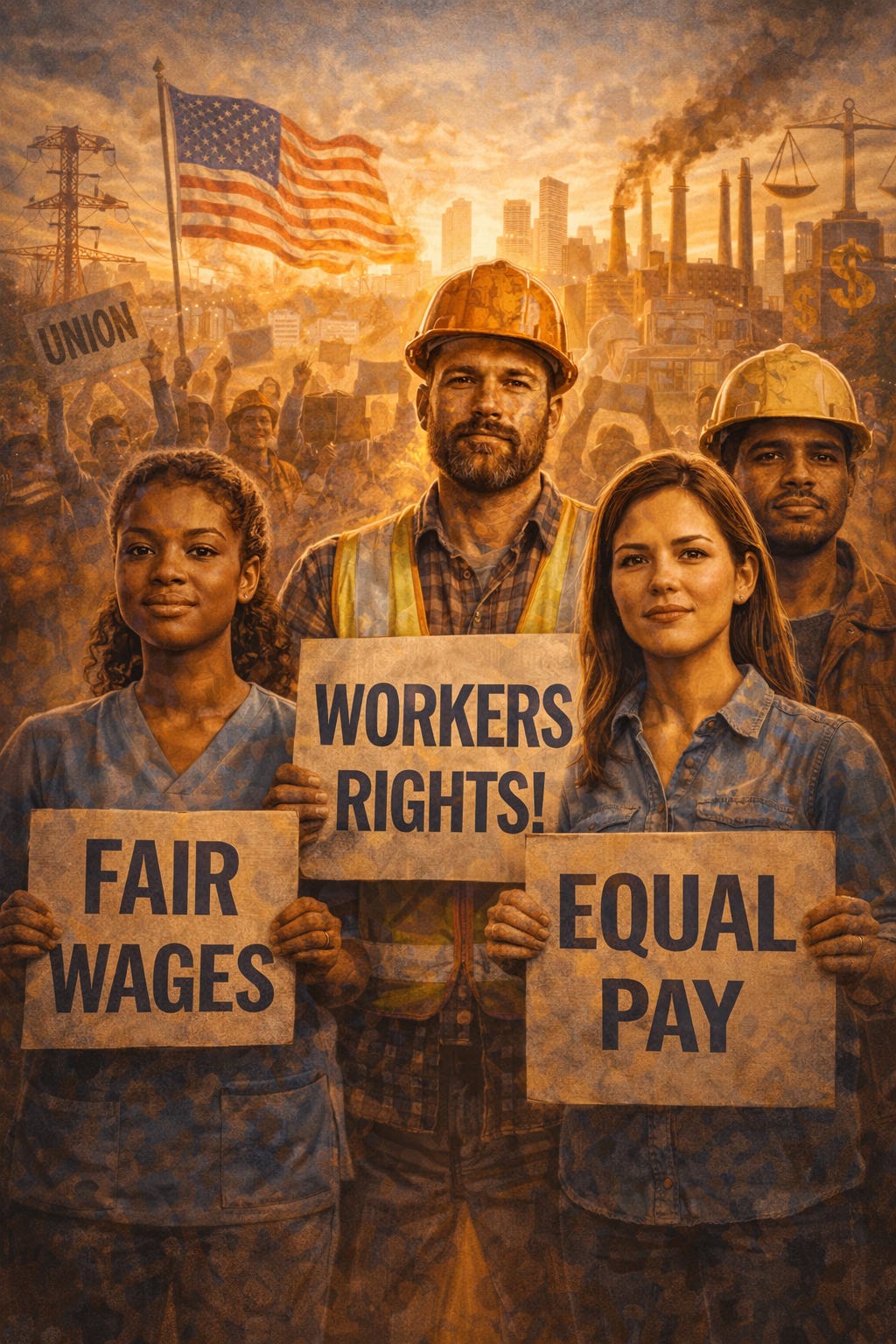
Purpose
The purpose of this framework is to align economic participation with human wellbeing, dignity, and stability.
Work is a means of sustaining life and contributing to society. It is not a measure of worth, morality, or entitlement to survival.
Core Orientation
The economy exists to serve people.
People do not exist to serve the economy.
Systems that reverse this relationship become extractive, destabilizing, and ultimately illegitimate.
Scope
This framework governs how labor and economic systems affect human life, including:
• wages and income stability
• job security and precarity
• working conditions and protections
• worker voice and bargaining power
• automation and productivity gains
• access to meaningful contribution
This framework addresses economic participation, not personal ambition.
Universality
All people are entitled to economic conditions that allow them to meet basic needs without constant precarity.
Economic security must not be restricted by:
• job type
• schedule structure
• bargaining power
• caregiving status
• health or disability
Participation may vary. Dignity does not.
Conditionality
Access to basic economic stability may not be withdrawn as punishment, leverage, or moral judgment. Work requirements may shape contribution pathways, but they may not be used to justify deprivation, instability, or coercion.
Economic participation is a relationship, not a test.
Primary Design Priority
Reduction of economic precarity is the governing priority of this framework.
Flexibility and efficiency may benefit systems. Predictability and stability protect human life. Systems must be designed to reduce volatility rather than transfer risk onto workers.
Definition of Economic Justice
Economic justice means:
• income sufficient for a dignified life
• stability without constant threat of loss
• protection from exploitation
• fair sharing of productivity gains
• access to meaningful contribution
Economic justice is not uniform outcomes. It is fair conditions.
Relationship to Automation and Productivity
As technology increases productivity and reduces necessary labor, economic systems must ensure that resulting gains benefit people broadly.
Automation that displaces workers without sharing gains violates this framework. Efficiency that increases precarity is not progress.
System Accountability Threshold
System failure is established when economic harm:
• is predictable
• disproportionately affects the same populations
• repeats across cycles
• is framed as personal failure rather than structural design
At that point, responsibility lies with the system, not the worker.
System Must
• Provide wages and income sufficient for a dignified life
• Protect workers from exploitation and arbitrary loss
• Share productivity gains with those affected
• Preserve access to meaningful work and contribution
• Support worker voice and collective bargaining
• Reduce volatility and economic cliff edges
System Must Not
• Condition survival on labor capacity alone
• Externalize business risk onto workers
• Reward extraction over contribution
• Treat precarity as motivation
• Obscure power imbalances through rhetoric
Relationship to Other Frameworks
This framework builds on Survival, Care, Psychological Safety, and Time.
Economic justice depends on stable foundations. Without them, labor systems become coercive rather than cooperative.
Conclusion
An economy that requires fear to function is not efficient. It is unstable.
Economic justice is not about eliminating work. It is about restoring work to its proper place in human life.