

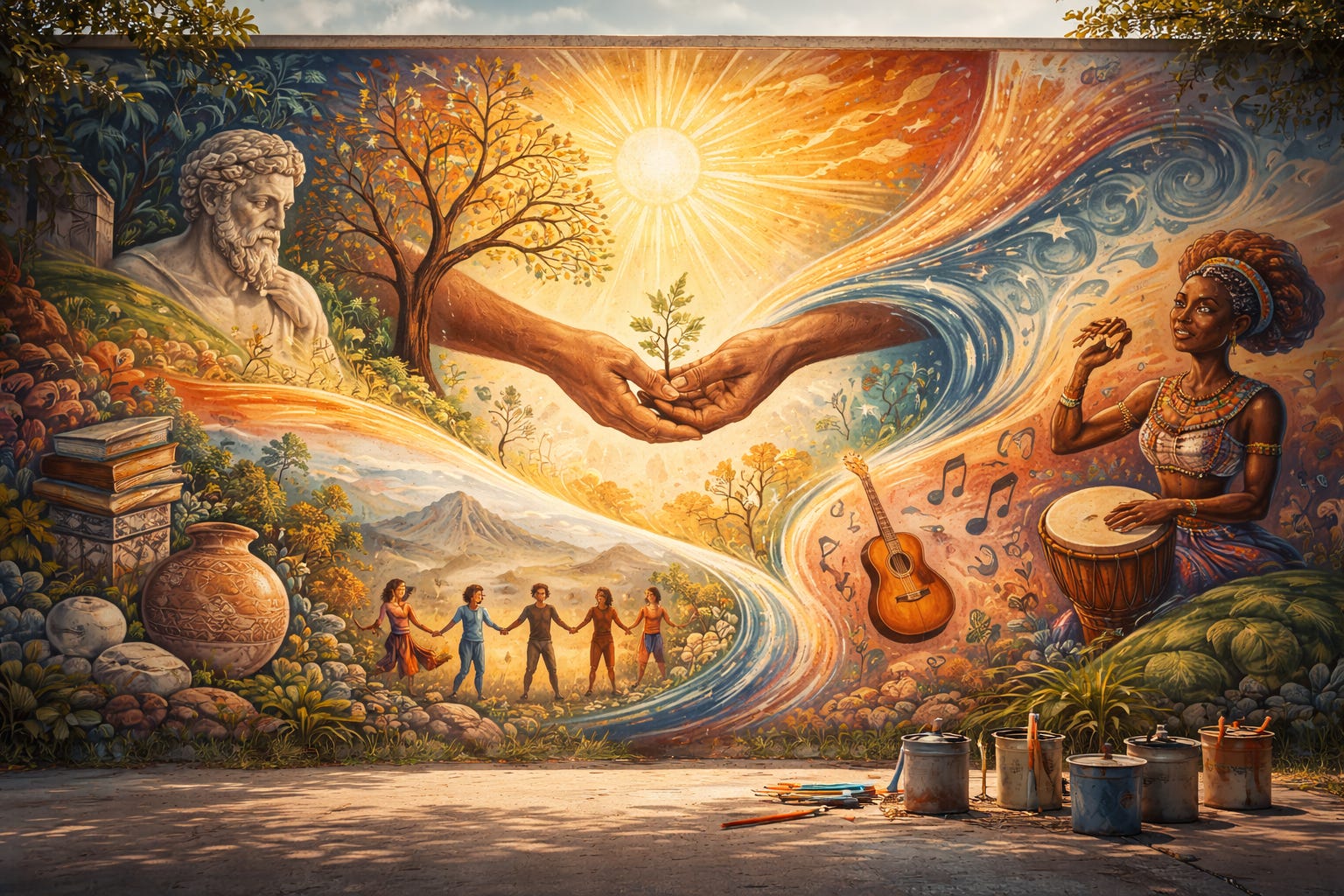
Purpose
The purpose of this framework is to sustain the cultural, emotional, and symbolic conditions that make life worth living.
Survival without meaning is endurance. A society must offer more than endurance.
Core Orientation
Meaning is essential, not ornamental.
Humans require purpose, expression, beauty, and belonging to remain psychologically whole and socially connected. Systems that treat meaning as optional produce despair, alienation, and fragmentation.
Scope
This framework governs how societies support meaning and shared purpose, including:
• arts, creativity, and cultural expression
• storytelling and collective memory
• ritual, tradition, and celebration
• spiritual and philosophical exploration
• play, joy, and non-instrumental life
• public spaces for expression and gathering
This framework addresses human depth, not productivity.
Universality
All people are entitled to access meaning, expression, and cultural participation.
Cultural life must not be restricted by:
• income
• education
• identity
• geography
• conformity
Meaning cannot be reserved for elites or treated as leisure alone.
Conditionality
Access to culture and meaning may not be withdrawn as punishment, leverage, or reward.
Expression is not a privilege. Joy is not indulgence. Periods of hardship do not negate the need for meaning, they intensify it.
Primary Design Priority
Preservation of shared meaning and cultural vitality is the governing priority of this framework.
Efficiency may organize systems. Meaning sustains people within them. Systems must protect space for expression, reflection, and joy beyond utility.
Definition of Meaning
Meaning includes:
• opportunity for creative expression
• connection to story, history, and place
• space for reflection and inner life
• rituals that mark time and transition
• experiences of beauty and joy
Meaning is collective as well as personal.
Culture as Infrastructure
Culture is not a byproduct of prosperity. It is infrastructure for resilience.
Shared stories and expression allow societies to:
• process grief
• transmit values
• sustain hope
• imagine futures
Without culture, systems hollow out even if they remain functional.
System Accountability Threshold
System failure is established when cultural harm:
• becomes widespread
• restricts expression to the privileged
• suppresses creativity or dissent
• treats despair as individual weakness
At that point, the system is sustaining bodies while eroding souls.
System Must
• Support arts, creativity, and cultural expression
• Preserve public spaces for gathering and expression
• Protect freedom of belief and reflection
• Enable joy, play, and celebration
• Honor cultural diversity without hierarchy
• Treat meaning as integral to wellbeing
System Must Not
• Reduce culture to commodity alone
• Treat creativity as expendable
• Suppress expression through fear or neglect
• Reserve meaning for those with leisure
• Confuse productivity with purpose
Relationship to Other Frameworks
This framework builds on Stability, Care, Time, and Belonging.
Meaning requires safety, time, and connection. In turn, it sustains psychological health, civic engagement, and social trust.
Conclusion
A society that preserves life but erodes meaning cannot endure.
Culture is not decoration. It is the reason survival matters.