

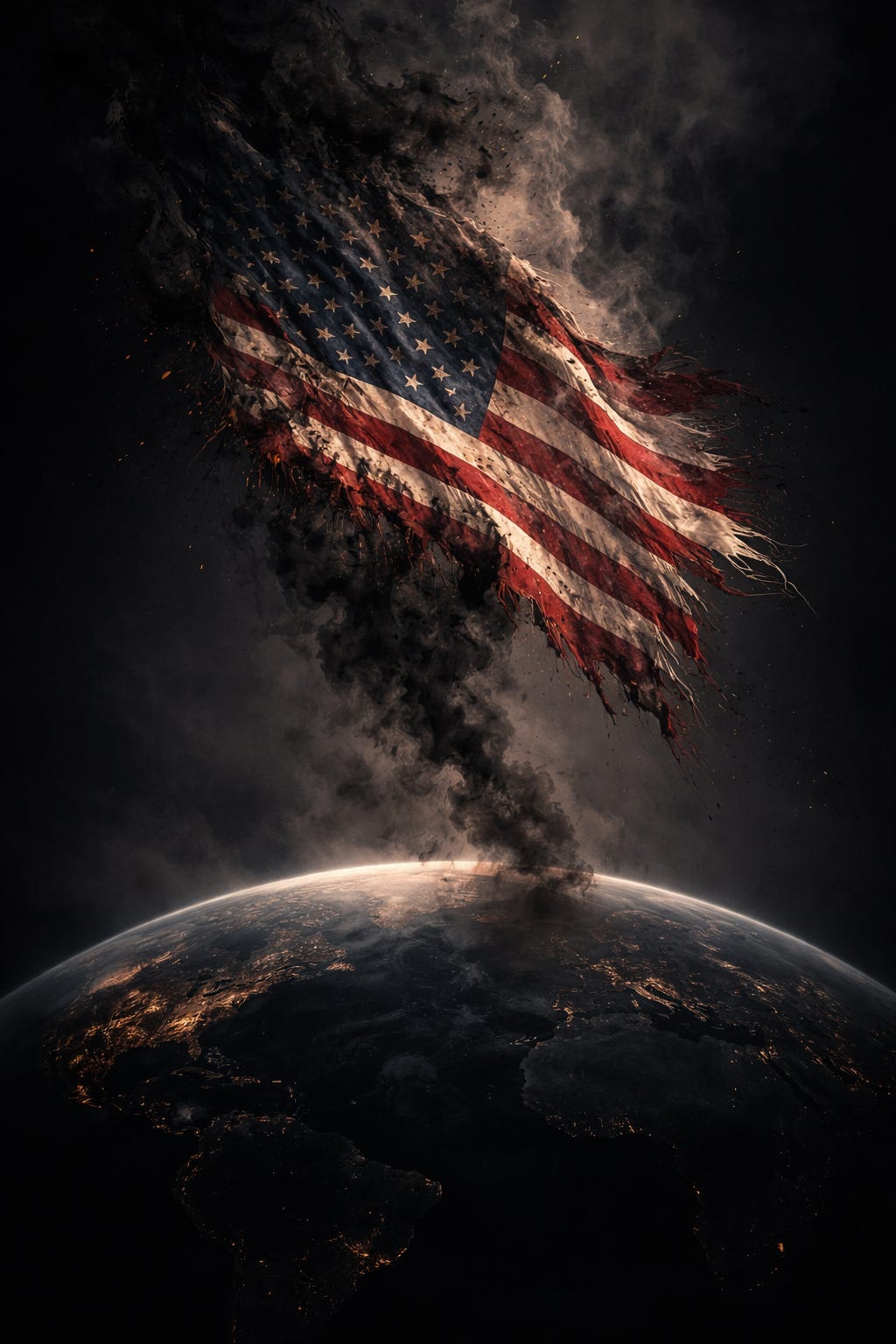
America ended the last world war it still worships. That fact sits at the center of our national mythology. We do not remember World War II simply as history. We remember it as proof. Proof that when the line between human and monstrous was drawn, we stood on the right side of it. Proof that when the world needed force in defense of something larger than force, we answered. Proof that we were, at least once, what we still insist we are.
That is why this possibility feels so vile.
Germany emerged from the end of one world war only to become the face of the next. The country shattered by one catastrophe became the engine of another. History did not preserve innocence because blood had already been spilled. Defeat did not guarantee wisdom. Suffering did not guarantee restraint. The lesson existed, but grievance, myth, humiliation, and power warped it into something far deadlier.
Now look at us.
The United States helped end World War II, then built an entire moral identity around that fact. We cast ourselves as liberator, defender, the necessary force that arrived when the world needed saving. Then we turned that memory into inheritance. Then into entitlement. Then into exemption. We stopped acting like a nation that had learned the cost of global catastrophe, and started acting like a nation convinced its past righteousness permanently excused its future violence.
That is the door.
The most unbearable part of the thought is not simply that America is in the process of igniting another world war. It is that the country that helped end the last great global horror may now be opening the next one. The former liberator becomes the next engine of ruin. Not because history is poetic, but because unexamined power rots. Because nations, like people, can turn self-regard into moral blindness. Because defeating one monster has never guaranteed you will not become another.
That is what shatters the comfort myth.
We are trained to believe that the nations that once stood against evil remain permanently marked by that virtue. That moral legitimacy, once earned, stays earned. That past heroism creates a permanent shield against present corruption. But history has never worked that way. History does not award lifelong innocence. It records what is done, not what was once deserved.
That is the accusation underneath the comparison.
Germany ended one world war and gave the world the next. America ended the second and may now be helping set the conditions for a third. If that feels too harsh, too dramatic, too obscene to say aloud, good. It should. The point is not to flatten history into slogan, and it is not to pretend every era is identical. The point is to force recognition. To ask what it says about a nation when the role reversal no longer sounds absurd. To ask what has decayed in us so badly that people can already see the outline. To ask how a country so obsessed with calling itself the defender of freedom became so comfortable with domination, dehumanization, spectacle, and war.
The deepest horror is not only what America may do. It is what America believes about itself while doing it.
This country still wants the moral language of World War II without the moral discipline that moment required. It still wants to be remembered as the nation that saved the world, even while behaving like a nation that assumes the world may be broken in its name. It still wants tribute for the past while rejecting accountability in the present.
That is how old victories become fuel for new disasters.
Not because they were forgotten. Because they were worshipped so completely that they stopped functioning as warnings.
If America helps drag the world toward another catastrophe, the indictment will not be that we failed to remember World War II. It will be that we remembered it in the most self-serving way possible. We remembered our glory, and forgot the warning.
The most damning thing is not that America might help start World War III. It is that America once stood at the end of World War II, wrapped itself in the memory of moral victory, and still learned nothing durable enough to prevent itself from becoming the kind of power history must one day condemn.
I am reminded of an observation made by Friedrich Nietzche, "Be careful who you choose as your enemy because that's who you become most like."
I sincerely hope future historians do not feel the need to hold symposiums determining the start of a Fourth Reich.