

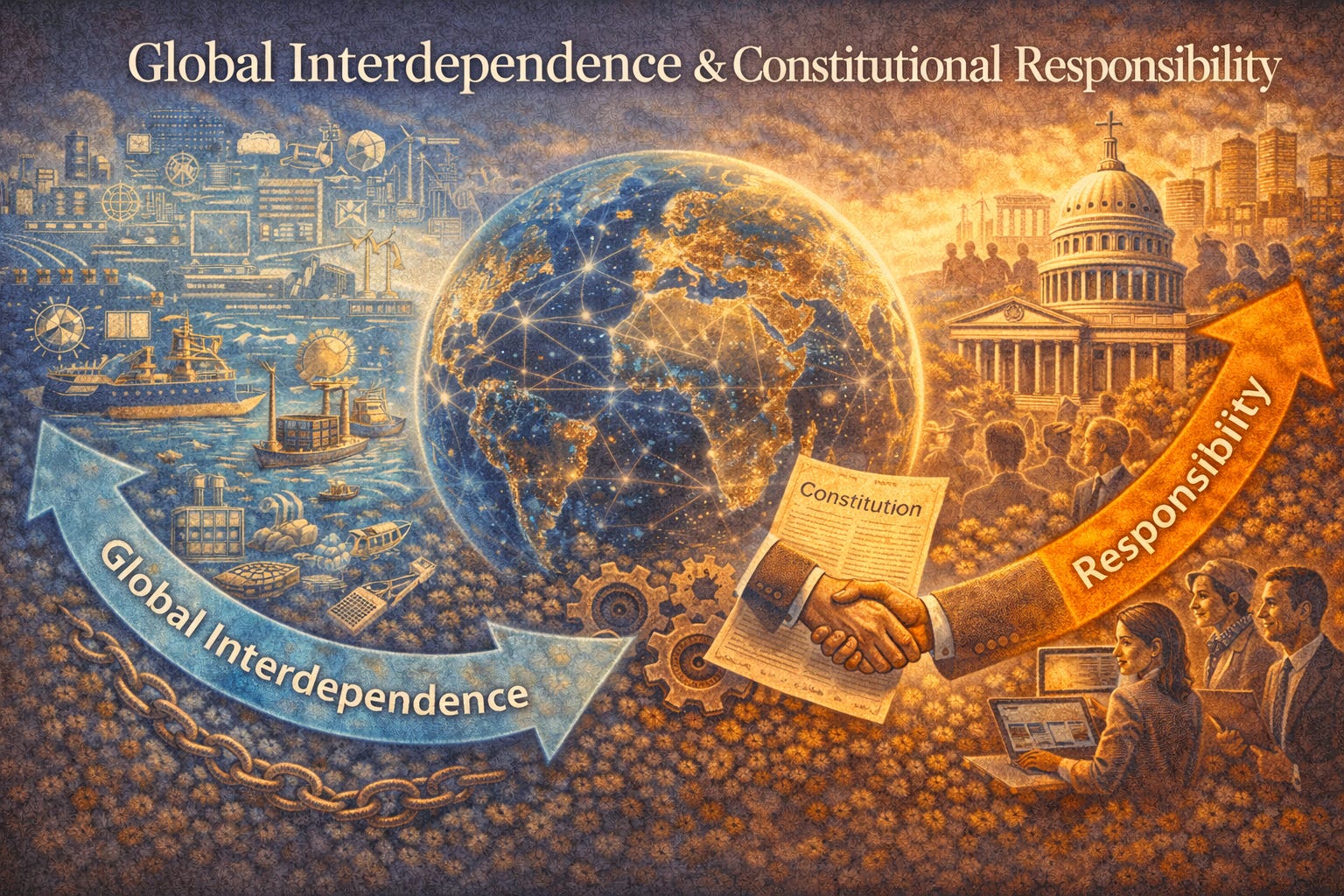
Modern societies operate within a world of increasing interdependence. Economic systems, environmental systems, technological networks, and public health conditions now extend beyond national borders in ways that were far less pronounced in earlier historical periods. Decisions made within one nation can influence conditions across many others.
Trade networks connect production and consumption across continents. Supply chains span multiple countries and rely on coordinated systems of transportation, finance, and regulation. Environmental systems such as oceans, atmosphere, and climate operate independently of political boundaries. Information networks transmit ideas, knowledge, and influence globally within moments.
This level of interconnection creates both opportunity and responsibility.
Economic cooperation allows societies to benefit from shared innovation, specialization, and exchange. Scientific collaboration accelerates discovery and the development of technologies that improve human well-being. Cultural exchange enriches understanding across societies and expands the range of perspectives available to individuals and institutions.
At the same time, global interdependence introduces new forms of vulnerability. Economic disruptions in one region can propagate rapidly through international markets. Environmental degradation in one location may affect ecosystems across entire continents. Public health challenges can spread quickly across highly connected populations.
These realities do not eliminate the importance of national constitutional systems. Nations remain the primary structures through which laws are enacted, rights are protected, and democratic participation is organized. However, constitutional systems increasingly operate within a global environment that influences domestic conditions.
Constitutional responsibility in an interconnected world therefore involves balancing national self-governance with awareness of broader global effects. Decisions made within one country can influence economic stability, environmental conditions, and technological development across borders.
This does not require uniform governance across nations. Societies differ in history, culture, and institutional design. Each constitutional system must reflect the values and circumstances of the people it serves.
However, awareness of interdependence encourages thoughtful engagement with global challenges. Issues such as environmental stewardship, technological governance, economic stability, and public health often require cooperation among multiple nations in order to address effectively.
Democratic societies can approach these challenges while preserving national sovereignty by participating in international dialogue, collaborative research, and cooperative agreements that respect constitutional principles.
Such cooperation becomes more effective when domestic institutions are stable, legitimate, and transparent. Nations that maintain strong democratic systems are better positioned to engage constructively with international partners while protecting the interests of their citizens.
A constitutional framework concerned with human dignity and civic stability therefore recognizes both dimensions of responsibility. It affirms the importance of national self-governance while acknowledging that the well-being of societies increasingly depends upon how nations interact within a shared global environment.
Global interdependence does not diminish the importance of constitutional systems. Instead, it highlights their role in guiding responsible participation within an interconnected world.
By maintaining stable institutions, protecting fundamental rights, and fostering informed civic participation, constitutional societies contribute not only to their own stability but also to the broader stability of the global community.
In an interconnected world, the health of democratic systems within individual nations becomes one of the foundations upon which wider cooperation and shared progress depend.