

By the time Hatshepsut enters the story, the question is no longer whether women could stand near power. That had already been established. Women had appeared near the first throne, inside dynastic continuity, inside sacred office, and inside the early archive itself.
The question with Hatshepsut is harder, and more revealing. What happens when a woman does not merely stand near rule, but takes it. Hatshepsut was not a rumor at the edge of kingship. She was not a faint possibility preserved through a fractured early archive.
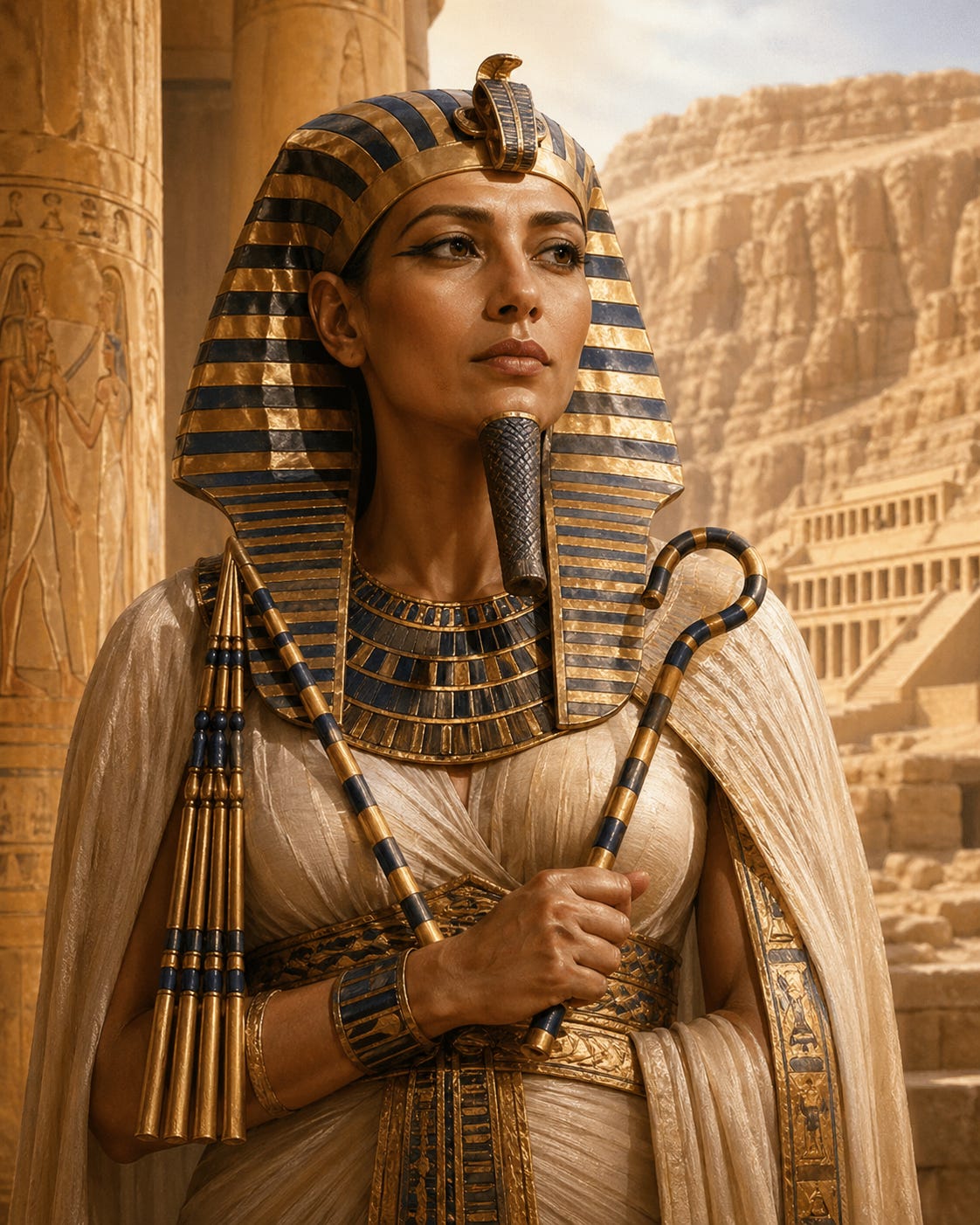
Hatshepsut ruled. She first acted as regent for the young Thutmose III, then assumed the full titles and regalia of a king. Ruling in her own right for roughly two decades during Egypt’s 18th Dynasty. She undertook major building works, including the great mortuary temple at Deir el-Bahri. Her reign is broadly associated with stability, prosperity, and ambitious statecraft.
That matters because Hatshepsut is not useful as an exception meant to rescue the system. She is useful because she exposes it. A woman reached the highest office. She exercised real power. She governed successfully enough to leave a monumental record.
And still, the terms of her rule reveal the limits around female legitimacy. Hatshepsut did not step into a throne prepared to receive a woman as woman. She stepped into kingship as an office already coded male. That is why her reign carries the contradiction so clearly.
To rule fully, she had to take on the titles, regalia, and visual language of kingship itself. In Egyptian art and monument, she was often depicted in the forms expected of a male king, even while some inscriptions used feminine grammar for her titles. That is the trap.
Hatshepsut did not prove that patriarchy was flexible and generous. She proved that female rule could be real, still having to negotiate an institution built around male form.
She could govern, build, command legitimacy, and occupy the throne, but the throne itself was not remade to fit her. She had to wear it on its own terms. That is what makes her so important.
Enheduanna showed that women could speak from inside one of civilization’s most powerful institutions. Merneith and Neithhotep showed that female authority appeared near the beginning of dynastic rule, even if the archive hesitated around it.
Hatshepsut takes the pattern further. She shows that even when a woman breaks through completely, the structure around her may still refuse to imagine power in female form. Her reign did not eliminate the contradiction. It forced it into view. And the afterlife of her memory makes that contradiction sharper still.
After Hatshepsut’s death, many of her statues and images were removed, broken, or recarved. Whether that was driven by Thutmose III directly, by later political needs, or by some combination of motives, the broader point holds.
Successful female rule still had to be made safer after the fact. Narrowed again, broken apart, or pushed back toward the edges of acceptable memory. This is one of the clearest lessons in the series.
The problem was never simply whether women were capable. Hatshepsut makes that question look foolish. The deeper problem was legitimacy.
Could a woman rule without being translated into male terms?
Could authority remain fully hers without being attached to masculine imagery, masculine office, and masculine precedent?
Could success protect her memory after death?
Hatshepsut’s life suggests the answer was only partly. She could rule. She could flourish. She could leave stone proof everywhere. But even then, kingship itself remained male enough that her presence strained against its boundaries.
So Hatshepsut should not be reduced to a triumphant first-woman story. That flattens her. She is more useful than that. She is a demonstration of female capacity at the highest level of rule, and, at the same time, a demonstration that female success does not automatically dissolve the structure that resists it.
She took the throne. But kingship stayed male. That is why her story matters. Not because she proves women were occasionally allowed through. Because her story shows what it cost to get through, what had to be worn to remain legible once there, and how quickly even successful female rule could be pressured back into uncertainty once it ended.
Hatshepsut did not merely reach power. She revealed the terms on which power was willing to recognize a woman at all.
She looks like Kim Kardashian lmao
Great piece though.