

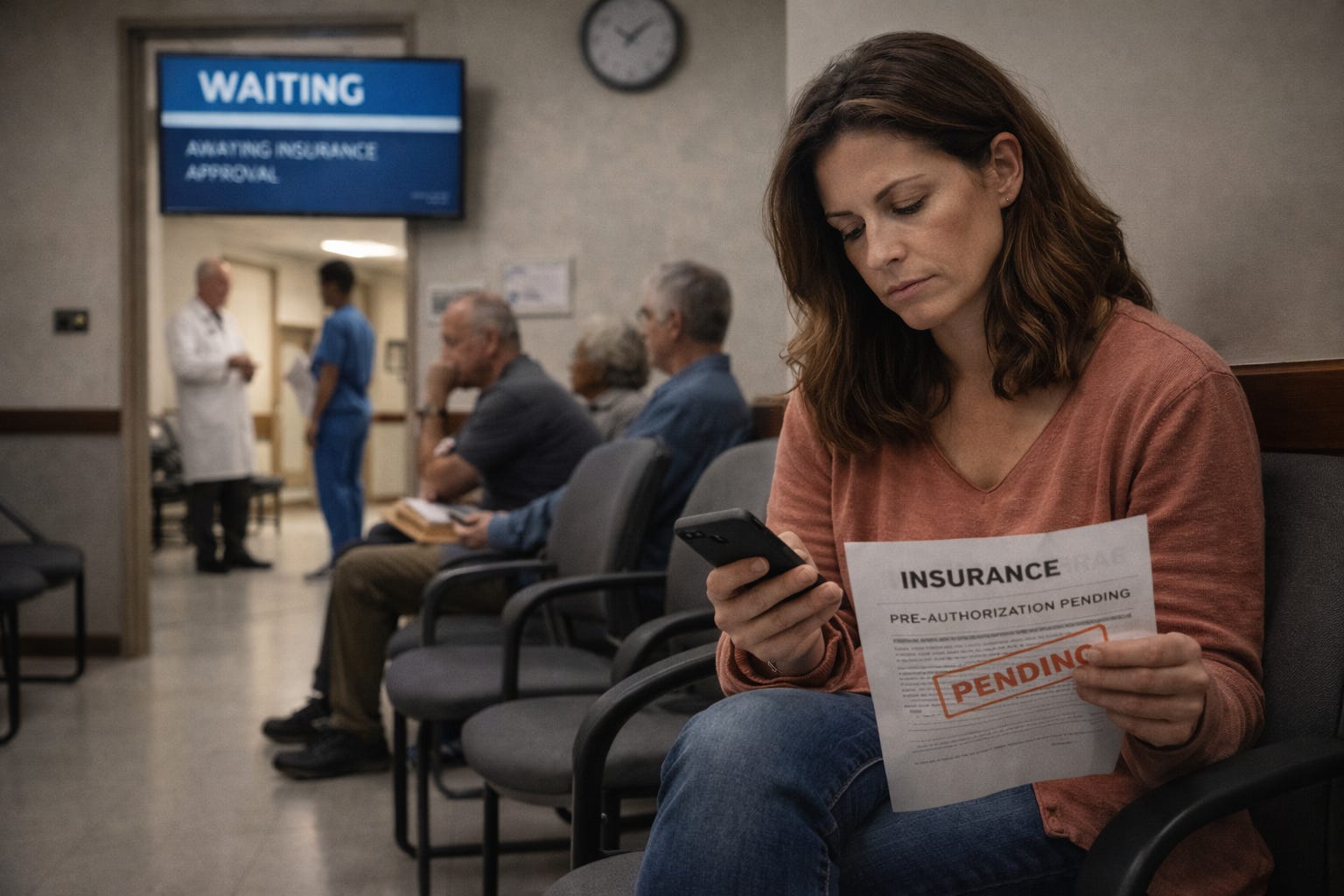
You make the appointment. You show up on time. You wait.
The room is calm in the way rooms become when waiting is expected. Chairs spaced carefully. A screen playing something neutral. Forms that ask you to summarize your body into boxes and codes.
Care is nearby. Access is not.
You’ve already paid for insurance. You pay monthly, reliably. You also pay the provider. Both are required. Neither is sufficient on its own.
The doctor listens. Tests are ordered. A plan is mentioned, cautiously. Then the language shifts. Authorization. Coverage. Review. Someone else will decide what happens next.
You wait.
The more serious the issue, the more steps appear. Additional forms. Additional documentation. Additional reviews. Urgency does not shorten the process; it multiplies it.
You are told to appeal. You are told to wait for a letter. You are told the decision has not been made yet.
Time becomes elastic. Pain is measured, but not prioritized. The body moves forward while permission lags behind. Care exists somewhere, but not yet here, not yet now.
If you call, you navigate menus. If you reach a person, they are polite and powerless. They read from the screen. They repeat what it says. They cannot tell you why.
Responsibility flows downward. Compliance is required. Miss a step and the process resets. The system is careful in ways that do not feel like care.
The waiting room teaches a rhythm: schedule, submit, wait, follow up, wait again.
Eventually, a decision arrives. Sometimes it is approval. Sometimes it is denial. Often, it is conditional. Approved if modified, approved if delayed, or approved if something else fails first.
By then, the body has already paid the cost. Healthcare is described as a service. What it often feels like is permission.