

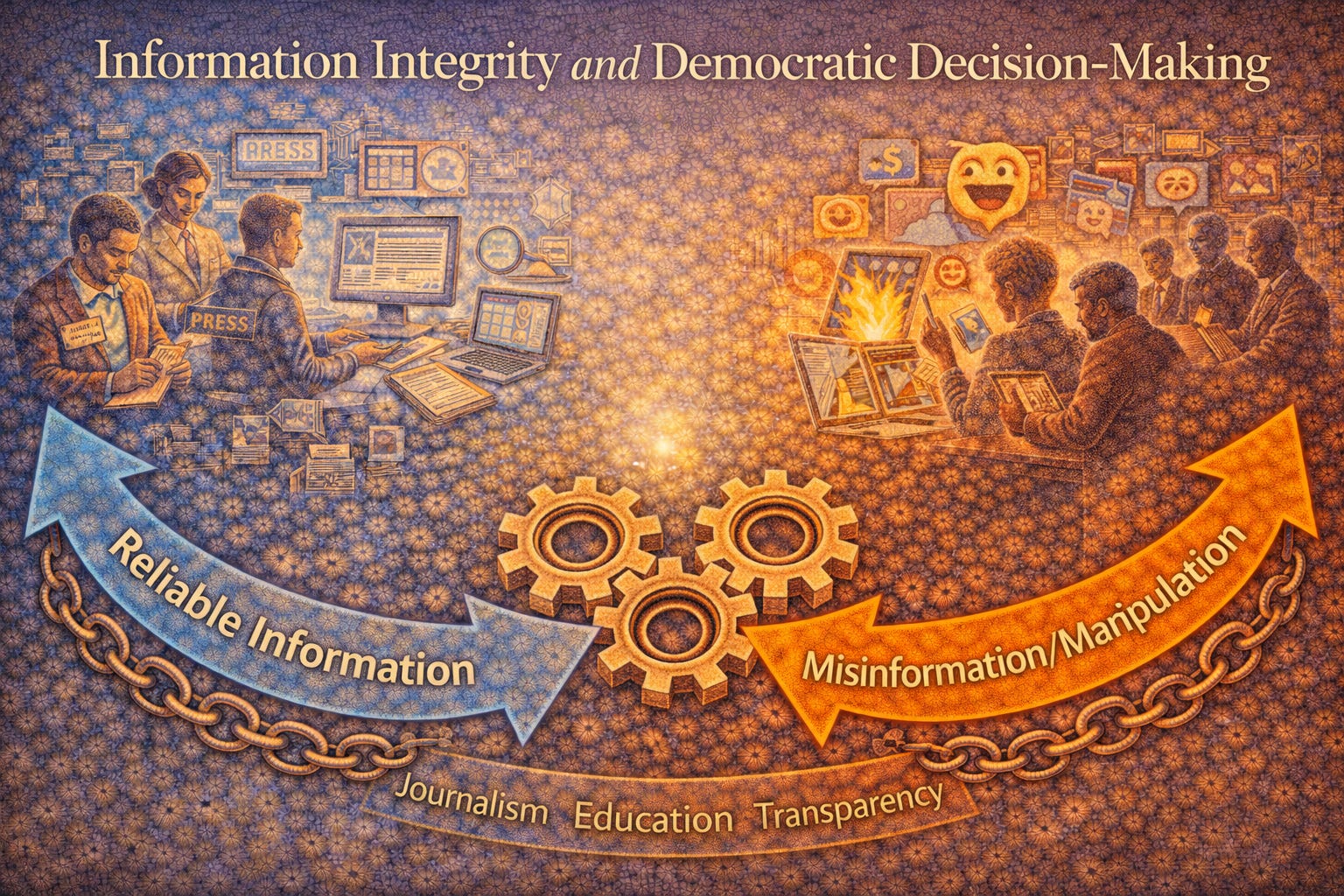
Democratic systems rely upon the ability of citizens to make informed decisions. Elections, public debate, policy deliberation, and institutional accountability all depend upon access to reliable information. When citizens possess the capacity to evaluate information and distinguish credible sources from misleading claims, democratic processes function more effectively.
Information integrity therefore represents an essential component of democratic stability.
Throughout history, societies have relied upon various institutions to help maintain the quality of public information. Journalism, academic research, public archives, and independent analysis have contributed to the circulation of verified knowledge that citizens can use when forming opinions and making civic choices.
These institutions do not eliminate disagreement. Democratic societies contain a wide range of perspectives and interpretations. However, healthy democratic discourse requires a shared foundation of factual understanding from which those disagreements can emerge.
The modern information environment presents new challenges to maintaining this foundation. Digital communication technologies allow information to circulate at unprecedented speed and scale. Individuals can access vast quantities of data, commentary, and opinion from sources across the globe.
While this expansion of access has many benefits, it also introduces complexity. False or misleading information can spread rapidly through digital networks. Algorithms designed to capture attention may amplify emotionally charged content, sometimes regardless of accuracy.
In such environments, citizens face the challenge of navigating large and often conflicting streams of information. The ability to assess credibility, identify bias, and evaluate evidence becomes increasingly important.
Education systems can support this capacity by strengthening media literacy, critical reasoning, and statistical understanding. Citizens equipped with these skills are better prepared to interpret information responsibly and to engage constructively in public debate.
Institutional transparency also contributes to information integrity. Governments and public agencies that communicate clearly about policies, decisions, and data help reduce uncertainty and speculation. Open access to public records allows journalists, researchers, and citizens to examine institutional actions directly.
At the same time, democratic societies must balance information integrity with the protection of free expression. Open debate and the exchange of diverse ideas are fundamental features of democratic life. Efforts to preserve accurate information must therefore respect constitutional protections for speech and inquiry.
The goal is not to eliminate disagreement or controversy. Instead, democratic systems seek to maintain conditions in which public dialogue can occur with sufficient shared understanding to allow meaningful deliberation.
When information systems function effectively, citizens are able to evaluate proposals, assess leadership, and participate thoughtfully in collective decision-making.
When information integrity weakens, democratic processes become more vulnerable to manipulation, confusion, and distrust.
Maintaining the quality of public information therefore represents an ongoing responsibility shared by educational institutions, journalists, public officials, technology platforms, and citizens themselves.
A democracy capable of sustaining informed public dialogue strengthens its capacity to navigate complex challenges and to guide its future through collective judgment rather than misinformation or confusion.