

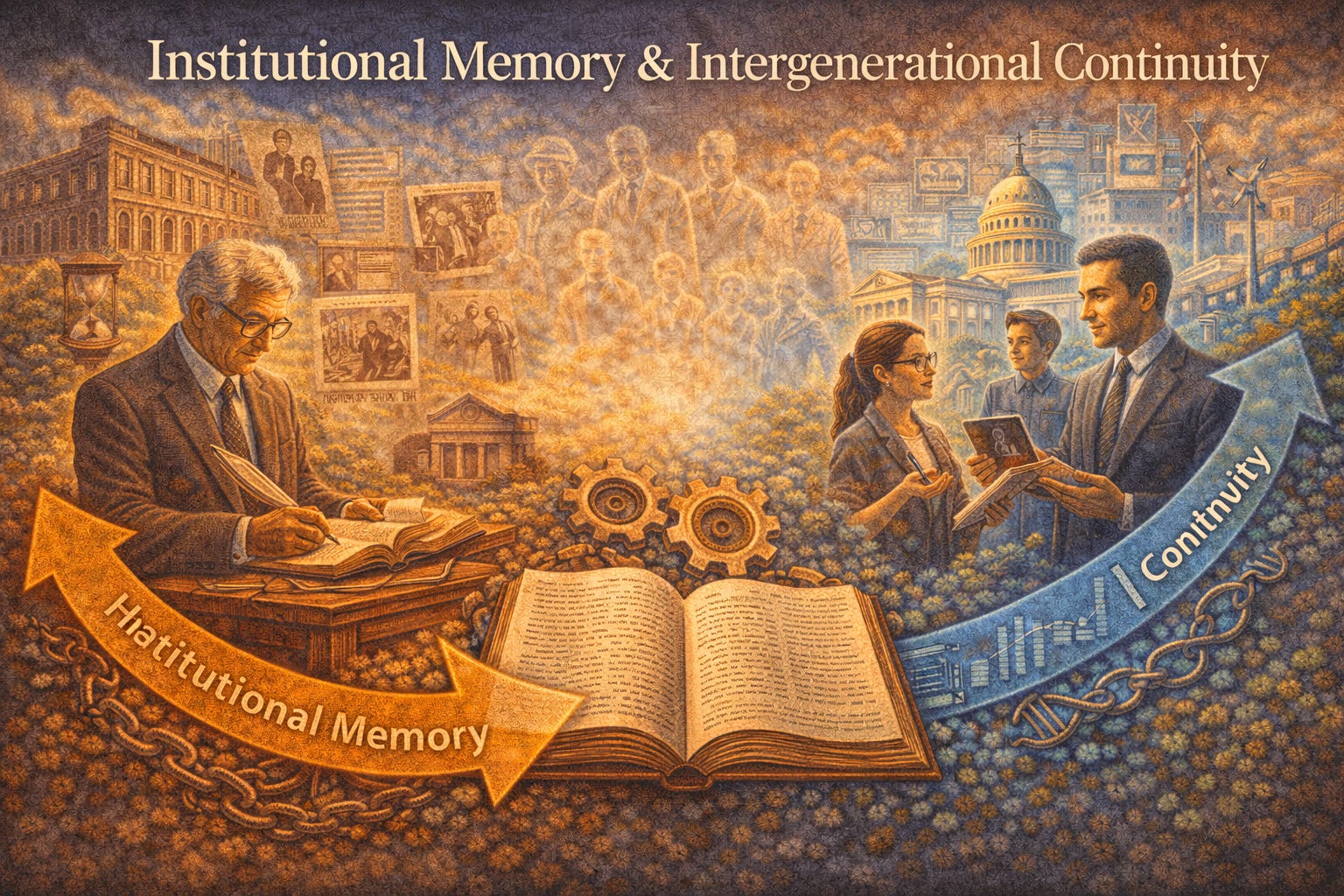
Stable societies depend upon more than laws and institutions in the present moment. They depend upon the ability to carry knowledge, experience, and lessons learned across generations. This transmission of understanding is often described as institutional memory.
Institutional memory allows societies to remember how systems function, why certain structures exist, and what consequences emerged from past decisions. Without this continuity, each generation risks repeating the same errors, relearning the same lessons, and rediscovering the same structural challenges without the benefit of accumulated experience.
Democratic systems are particularly dependent upon this form of continuity. Constitutions, legal frameworks, and public institutions develop over long periods of time through a process of experimentation, reform, and adjustment. Each generation inherits not only the structures themselves but also the historical understanding that explains their purpose.
When institutional memory is strong, societies retain a sense of historical perspective. Citizens and public officials can evaluate new proposals in light of past experience. They can recognize patterns, identify recurring risks, and build upon previous successes rather than beginning from uncertainty each time conditions change.
However, institutional memory is not self-sustaining. It requires active maintenance through education, historical scholarship, public archives, and civic culture. Without these systems, historical knowledge can gradually fade as generations pass.
Modern societies face particular challenges in maintaining this continuity. Rapid technological change, high mobility, fragmented information systems, and short political cycles can make it difficult to preserve long-term institutional understanding. Public attention often shifts quickly from one issue to the next, leaving little space for sustained reflection on historical experience.
When institutional memory weakens, democratic systems become more vulnerable to instability. Public debates may focus only on immediate circumstances without recognizing deeper patterns or long-term consequences. Policies may be implemented without full awareness of earlier attempts to address similar problems.
Intergenerational continuity also involves the transmission of civic responsibility. Each generation inherits institutions that were shaped by those who came before them. Maintaining those institutions, improving them, and passing them forward in stronger form becomes part of the ongoing civic project.
This process requires humility as well as innovation. New generations must adapt institutions to changing conditions, but they also benefit from understanding the reasoning and experience embedded within existing structures.
Constitutions serve as one of the primary mechanisms through which societies maintain this continuity. By recording foundational principles and institutional design choices, constitutional systems preserve the accumulated understanding of earlier generations while allowing for deliberate amendment and evolution.
Within this framework, institutional memory is not a barrier to progress. It is a foundation that allows progress to occur more wisely. By remembering what has been attempted before, societies can refine their approaches rather than repeating cycles of failure.
Intergenerational continuity also reinforces democratic legitimacy. Citizens are more likely to trust institutions that demonstrate awareness of their historical roots and the lessons learned through past experience.
The goal is not to preserve institutions unchanged forever. Conditions evolve, technologies transform societies, and new challenges emerge. What continuity provides is context. It allows societies to evolve deliberately rather than reactively.
When institutional memory is maintained and shared across generations, democratic systems gain resilience. They retain the ability to adapt while remaining anchored in the accumulated knowledge of the past.
In this way, continuity becomes one of the quiet foundations that allows democratic societies to endure across time.