

Many societies treat political systems as if they are designed once and then simply continue operating indefinitely. Constitutions are written, institutions are established, and laws are enacted. From that point forward, the system is often assumed to function largely on its own.
In practice, no complex system operates this way.
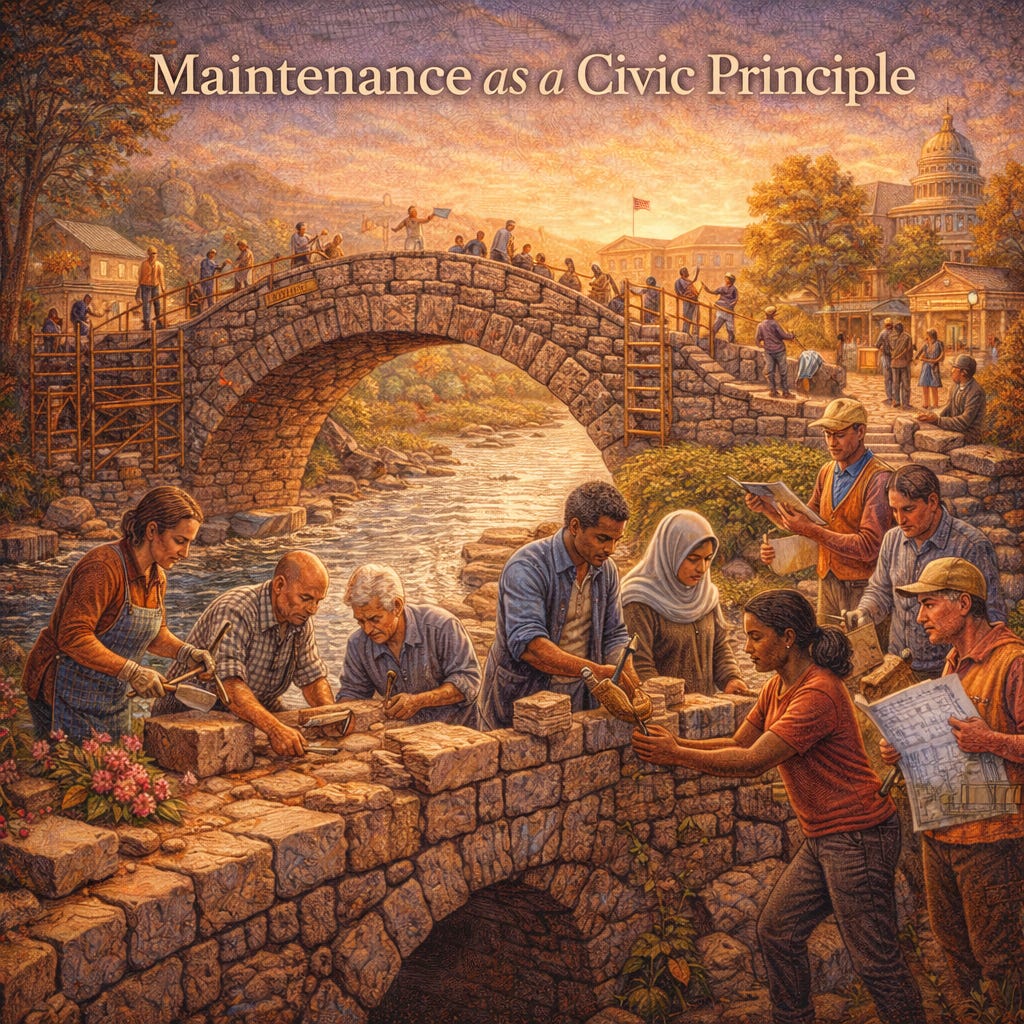
Physical infrastructure requires maintenance. Roads deteriorate, bridges weaken, and public utilities must be repaired or modernized as conditions change. Without routine care, even well-designed systems eventually fail.
Political systems follow the same principle.
Democratic institutions are not self-sustaining. They require ongoing maintenance through oversight, adaptation, and renewal. When this maintenance occurs regularly, institutions remain capable of responding to new conditions. When it is neglected, structural weaknesses accumulate.
Maintenance in democratic systems takes many forms. Laws may need revision when technological or social changes create circumstances that earlier frameworks did not anticipate. Administrative procedures may require adjustment to remain efficient and fair. Electoral systems may need periodic review to ensure accessibility and integrity.
Public oversight represents another essential component of civic maintenance. Citizens, journalists, researchers, and civil society organizations contribute to identifying problems that institutions themselves may overlook. Transparent review allows systems to correct errors before they grow into larger failures.
Constitutions often include formal mechanisms for this purpose. Amendments, judicial review, and legislative reform provide structured pathways through which democratic systems can evolve without abandoning their foundational principles.
Maintenance also occurs through cultural practices. Civic education, public dialogue, and ethical norms help preserve the habits necessary for democratic participation. These practices sustain the human environment in which institutions operate.
When maintenance is delayed for long periods, societies may experience sudden and disruptive attempts at reform. Structural pressures accumulate until institutions can no longer function as originally designed. At that point, change often arrives abruptly and under conditions of conflict.
Routine maintenance offers an alternative path. Incremental adjustments allow systems to adapt gradually while preserving stability. By addressing weaknesses early, democratic societies can avoid the more dramatic disruptions that occur when reform is postponed indefinitely.
Understanding democracy as a maintained system encourages a different relationship between citizens and institutions. Rather than viewing governance as a distant structure managed only by officials, civic maintenance recognizes that the health of democratic systems depends on continuous public attention.
In this sense, democracy is less a finished structure than an ongoing project. Institutions provide the framework, but their continued effectiveness depends on the willingness of each generation to examine, repair, and strengthen the systems they inherit.
Maintenance is therefore not a secondary task. It is one of the primary responsibilities of democratic life.