

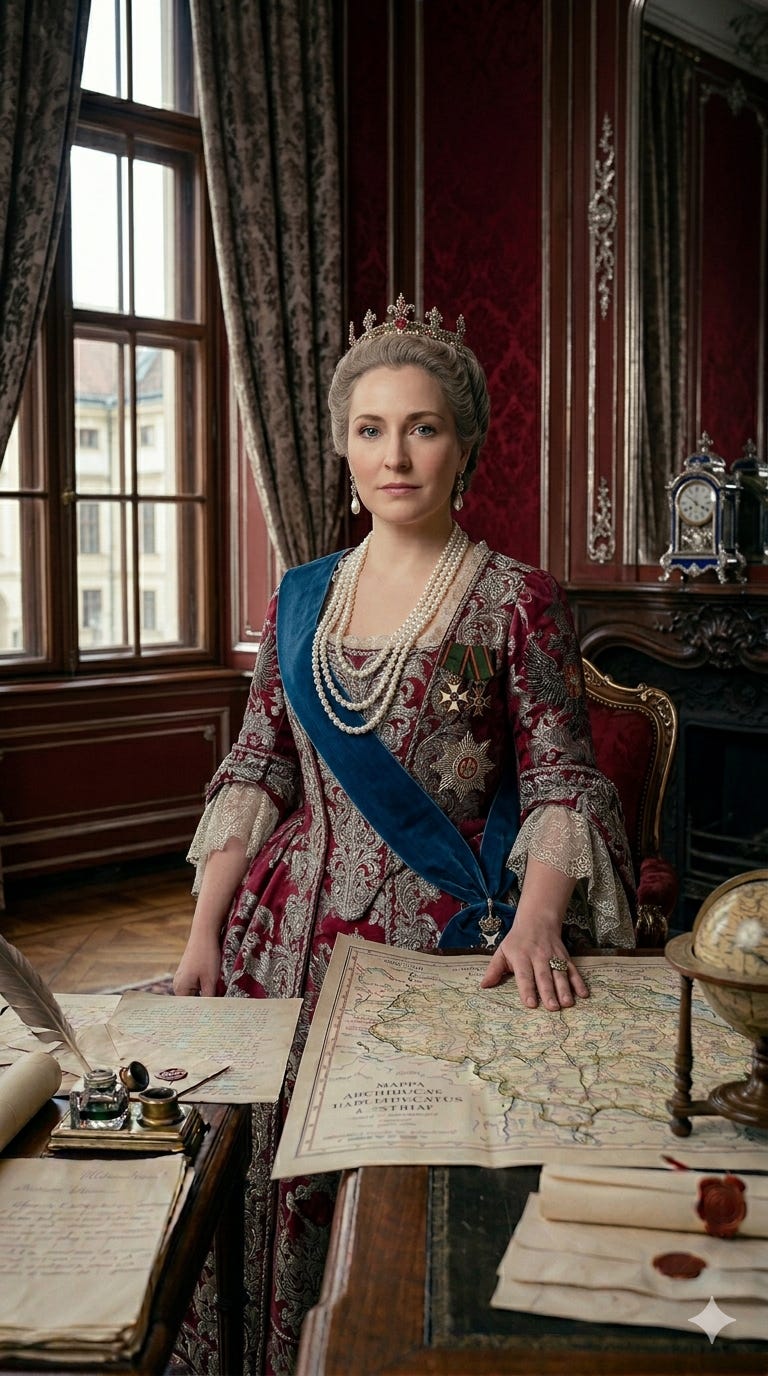
By the time Maria Theresa enters the record, monarchy has become increasingly bureaucratic, but the old assumptions remain. Women have ruled, inherited, and governed, but legitimacy still bends toward men.
The question becomes sharper. What happens when a woman inherits power legally, and the world still treats it as negotiable?
Maria Theresa became ruler of the Habsburg dominions in 1740 after the death of her father, Emperor Charles VI. He had spent years securing the Pragmatic Sanction, a legal arrangement intended to guarantee that she could inherit his lands.
The succession was prepared. The law was clear. That should have settled it. It did not.
Almost immediately, European powers challenged her claim, triggering the War of the Austrian Succession. The argument was not only territorial. It was legitimacy itself. Her inheritance was treated not as fact, but as opportunity for dispute. That is the mechanism.
A woman can be the lawful heir and still be forced to defend legality as though it were preference. Recognition becomes conditional. Law becomes negotiable the moment a woman stands inside it. Maria Theresa did not retreat.
She fought politically, militarily, and administratively to hold what was hers. She restructured finances, strengthened the state, and governed across an enormous and unstable empire. She was not ceremonial. She ruled.
And still, the framing narrows. She is often remembered first as mother, wife, and dynastic figure. Her sixteen children dominate the public memory. Her governance becomes background to maternity, as though producing heirs were her central political function rather than one part of a much larger reign.
That is familiar. A male ruler with sixteen children is remembered for empire. A female ruler is remembered for motherhood. That framing softens authority by domesticating it.
Maria Theresa’s reforms, military decisions, and political durability matter because they show competence under direct structural challenge. She was not tolerated. She was tested. And she held.
She should not be remembered as remarkable because she ruled while female, but because she governed one of Europe’s largest powers while the continent actively tried to prove she should not.
She did not inherit acceptance. She inherited opposition. And she turned survival into rule.