

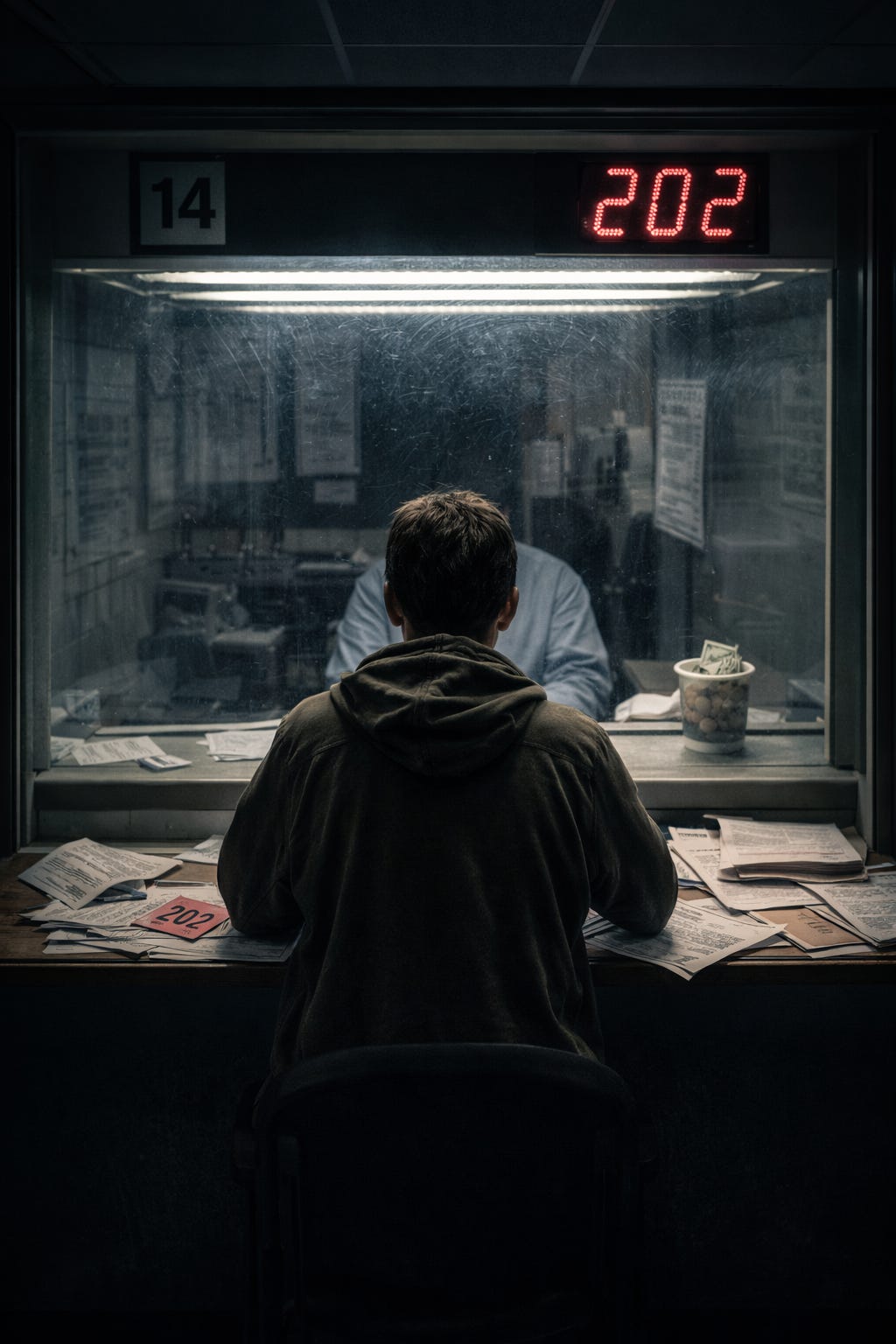
A support system should exist to stabilize life when people fall into hardship. It should keep people fed, housed, treated, and upright long enough to recover their footing. It should reduce harm early, fully, and without turning survival into a performance.
That is not what we built.
In the United States, welfare too often functions less like support and more like a ritual of disbelief. People come forward in need and are met with suspicion, scrutiny, delay, paperwork, conditions, and too little help too late. The message is clear from the start. We do not believe you. We do not trust you. Here is a crumb for the moment. It is all you get, so be careful.
That is the failure.
The public is expected to degrade itself in exchange for under-delivery. Need must be documented, recounted, re-proven, and performed in the approved language. Suffering that is already obvious must be translated into forms, deadlines, interviews, verifications, and compliance rituals, all to access support that often does not cover the basics anyway.
A person can be hungry, unstable, exhausted, underhoused, sick, and one bad week from collapse, and still be forced to navigate a maze that seems built less to help than to filter, delay, and discourage. That is not aid. That is hardship management through humiliation.
And it is defended in the ugliest possible way. The system is framed as generous even when it underdelivers. The people using it are framed as suspect even when their need is plain. The benefits are framed as excessive even when they do not cover enough to live with dignity.
The blame is always ready. If the aid fails, the person is irresponsible. If the process breaks them, they were not compliant enough. If the amount is not enough, they should have stretched it better. If the structure leaves them hungry, unstable, and one shock from collapse, the problem somehow remains them.
That is the racket.
A system that costs this much, monitors this much, moralizes this much, and still fails this often is not functioning as support. It is functioning as punishment with paperwork. The insult is not only that it does too little. The insult is that it does too little after demanding so much.
And it is not cheaper this way. That lie needs to be buried. A dignified support floor would cost less than this churn of delay, collapse, emergency response, administrative overhead, repeated crisis, and long-tail damage.
It is cheaper to keep people fed than to manage starvation. Cheaper to keep people housed than to manage displacement. Cheaper to meet need early than to process the fallout later through hospitals, shelters, schools, courts, and broken family systems. What we have now is not the efficient option. It is the punitive one.
That is why baselines matter.
In a functioning country, there should be a guaranteed floor beneath human life, and it should rise with the economy, not fall beneath it. It should reflect the actual cost of existing. It should cover enough to prevent collapse. Enough food. Enough shelter. Enough care. Enough stability to breathe, think, recover, and make the next move.
Not luxury. Not indulgence. Not a reward for virtue. Just enough to keep a human being alive without grinding them into dust first. Instead, we ration survival downward and call it discipline.
We create support levels that do not meet reality, then act shocked when people remain in crisis. We offer too little, deliver it through a degrading maze, and then use the continued suffering as proof that aid does not work.
Of course it does not work when it is structured to fail. Of course it does not stabilize when it is intentionally set below the level of actual need. Of course people remain desperate when the system gives them just enough to prolong the emergency and then blames them for not escaping it.
That is means-tested misery.
And it shifts with the political weather. In one season, hardship is framed as tragedy. In the next, as dependency. In one moment, support is sold as necessary. In the next, it is treated like theft. The floor beneath survival rises and falls not with human need, but with ideology, donor appetite, election-year posturing, and public resentment aimed downward.
That alone tells the truth. A support system that can be politically starved that easily was never treated as a sacred obligation in the first place. Which is obscene, because life is supposed to be sacred.
Instead, people are asked to stand in line and degrade themselves for aid that still leaves them hungry, still leaves them unstable, still leaves them trying to survive on numbers so low they make death feel closer than recovery. A country this wealthy should never produce that sentence. And yet it does, every day, with a straight face.
That is where the fury belongs.
Not only with the officials who gut aid and posture about responsibility. Not only with the institutions that build these systems to distrust the poor. But with the culture that participates in it, votes for it, repeats it, and trains itself to see the suffering person as the problem rather than the structure starving them. A society that votes to harm itself so the already powerful can keep more is not confused. It is conditioned.
And conditioning can kill.
We have seen this kind of elite cruelty before. We know what happens when people are pushed past endurance while wealth concentrates above them. We know what happens when the public is denied the means to live while being told to remain patient and obedient. The lesson should have been learned already. If the floor is stripped low enough, eventually the people holding the system up cannot hold it anymore.
That is the Failure Point.
The failure is not merely that welfare falls short. The failure is that it has been designed to degrade dignity, underdeliver, and still absorb enormous cost, all while the people forced to rely on it are blamed for the system’s refusal to function. It does not meet hardship with stabilization. It meets hardship with disbelief, humiliation, and rationed survival.
That is not support. When survival is rationed through humiliation, the cruelty is not incidental. It is the point.
The one and only time I screwed up the courage to apply for SNAP, I was denied — because I made $1.71 too much a month.