

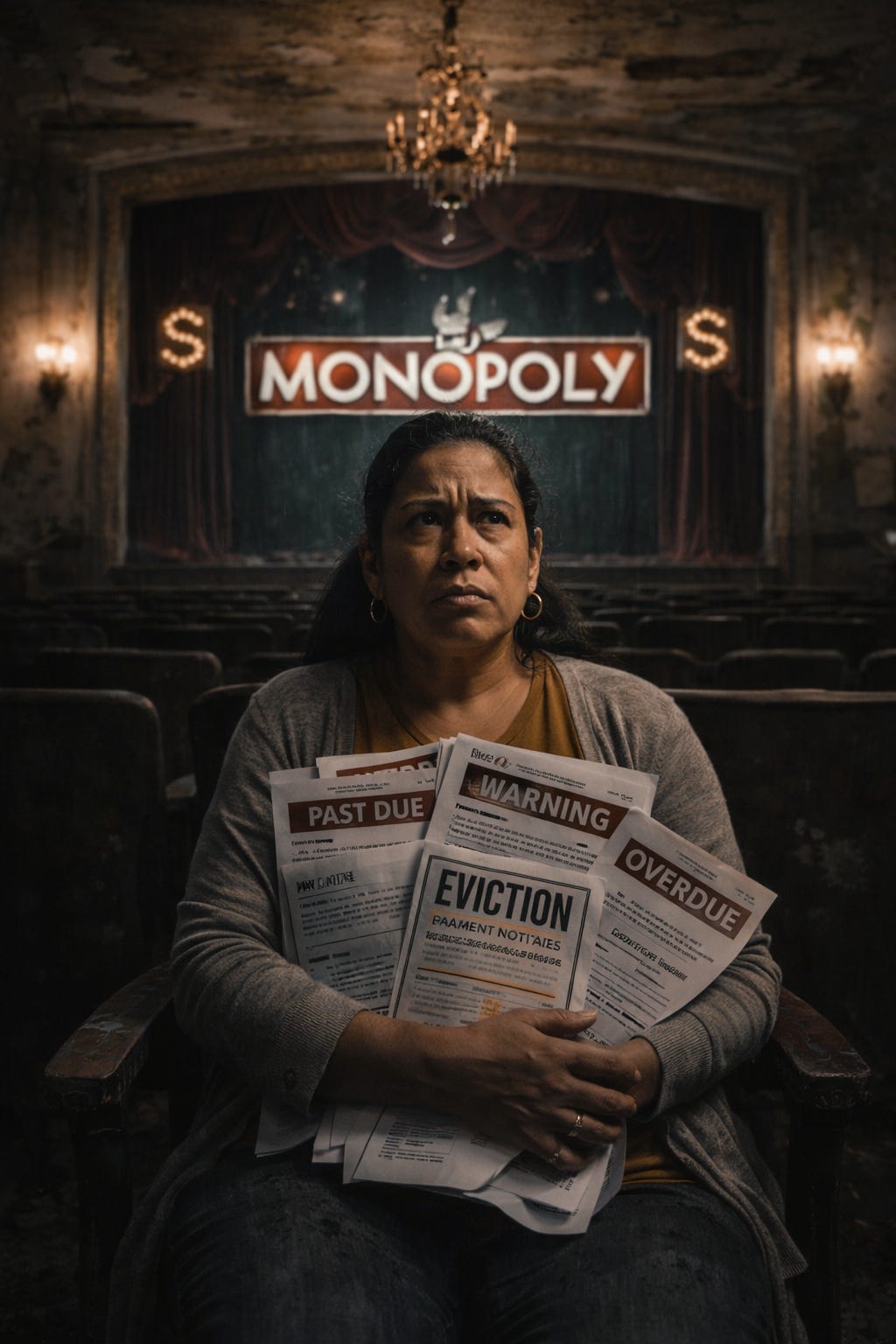
Americans are still told to believe in competition. We are told the market disciplines excess, rewards innovation, expands choice, lowers costs, and prevents any one actor from gaining too much power. That story survives long after the conditions that could make it true have been stripped away.
What remains is theater.
More and more of American life is shaped by concentrated private power pretending to be competition. The labels change. The branding changes. The storefronts change. The interfaces multiply. But underneath them, fewer and fewer firms control more and more of what people buy, use, watch, learn from, work for, and depend on. The language of freedom remains. The reality is narrowing control.
That is the failure.
A real competitive system should widen options. It should distribute power. It should make abuse harder, alternatives easier, and public dependence less dangerous. Monopoly power does the opposite. It closes doors, sets terms, narrows access, buries challengers, absorbs smaller players, and conditions people to accept whatever they are given as the only realistic option left.
That harm is not only economic.
It reaches into information, knowledge, education, and perspective. When power concentrates high enough, people are no longer choosing freely among many real alternatives. They are being fed a smaller set of options filtered through the interests of whoever owns the gate. What they read, what they hear, what they can afford to access, what narratives get repeated, what expertise gets platformed, what truths get softened, what lies get familiar, all of it becomes easier to shape when fewer hands hold more of the channels.
And repetition has power of its own. Say something often enough, place it everywhere enough, make it familiar enough, and people begin to absorb it whether it is thoughtful, true, shallow, manipulative, or simply profitable to someone. That is one of the ugliest functions of concentrated power. It does not just control price. It starts to control atmosphere. It narrows what feels normal, credible, or worth questioning.
That is not a functioning public sphere. That is managed perception inside concentrated ownership.
And when people are forced to live inside that narrowing, the harm compounds. Their choices shrink. Their understanding shrinks. The perspectives available to them shrink. Small businesses get squeezed out. Workers lose leverage. Consumers lose alternatives. Citizens lose informational independence. And then the same concentrated powers turn around and insist the market is still working because there are logos on the shelf and search results on the screen.
That is the theater.
Choice is not real because ten products sit in front of you if the same concentrated interests control the market behind them. Competition is not real because apps look different if the structure beneath them leads back to the same giants, the same mergers, the same pricing power, the same ownership webs, and the same bought influence. Freedom is not real because information is abundant if access, visibility, legitimacy, and distribution are increasingly shaped by concentrated private power with something to gain.
This is where monopoly becomes more dangerous than a simple price problem. It becomes a democracy problem, a labor problem, a knowledge problem, and a country problem. Because when you harm the people this way, you harm the country. You do not just take more money from their pockets. You strike at their ability to think clearly, choose freely, organize collectively, and push back effectively. A fatter bottom line does not change that. It only makes the damage more deliberate.
And someone always pays for that damage.
A worker pays when there are too few employers to bargain against. A small business pays when it is buried, bought, undercut, or shut out. A family pays when essential goods or services become expensive and unavoidable. A citizen pays when information is flattened, filtered, or repeated into false common sense. A community pays when local institutions are replaced by distant concentrated power with no real stake in the public life beneath it.
That is not market strength. That is private control wearing the language of freedom.
And like every other Failure Point, the lie is maintained through repetition. We are still told monopolies are rare, or efficient, or necessary, or merely the reward for success. We are told consumers can simply choose differently, as if meaningful alternatives have not already been bought, buried, merged away, or starved out. We are told innovation will solve the problem, even while concentrated power uses its scale to acquire, suppress, outlast, or wall off the very challengers that might have changed the field.
The result is a country increasingly governed by gatekeepers while still pretending to worship open competition. That is the contradiction.
The market was supposed to disperse power. Instead, concentrated power now hides inside market language and uses it as cover. It promises choice while shrinking it. It promises competition while killing it. It promises freedom while narrowing the ground people can stand on.
That is the Failure Point.
The failure is not merely that some firms got too large. The failure is that the country kept defending the mythology of competition even after real competition began collapsing in plain sight. It allowed concentrated private power to become gatekeeper over markets, labor, information, and access, then kept calling the arrangement free.
It is not free. It is monopoly theater. Monopoly does not just take options off the table. It narrows reality itself.