

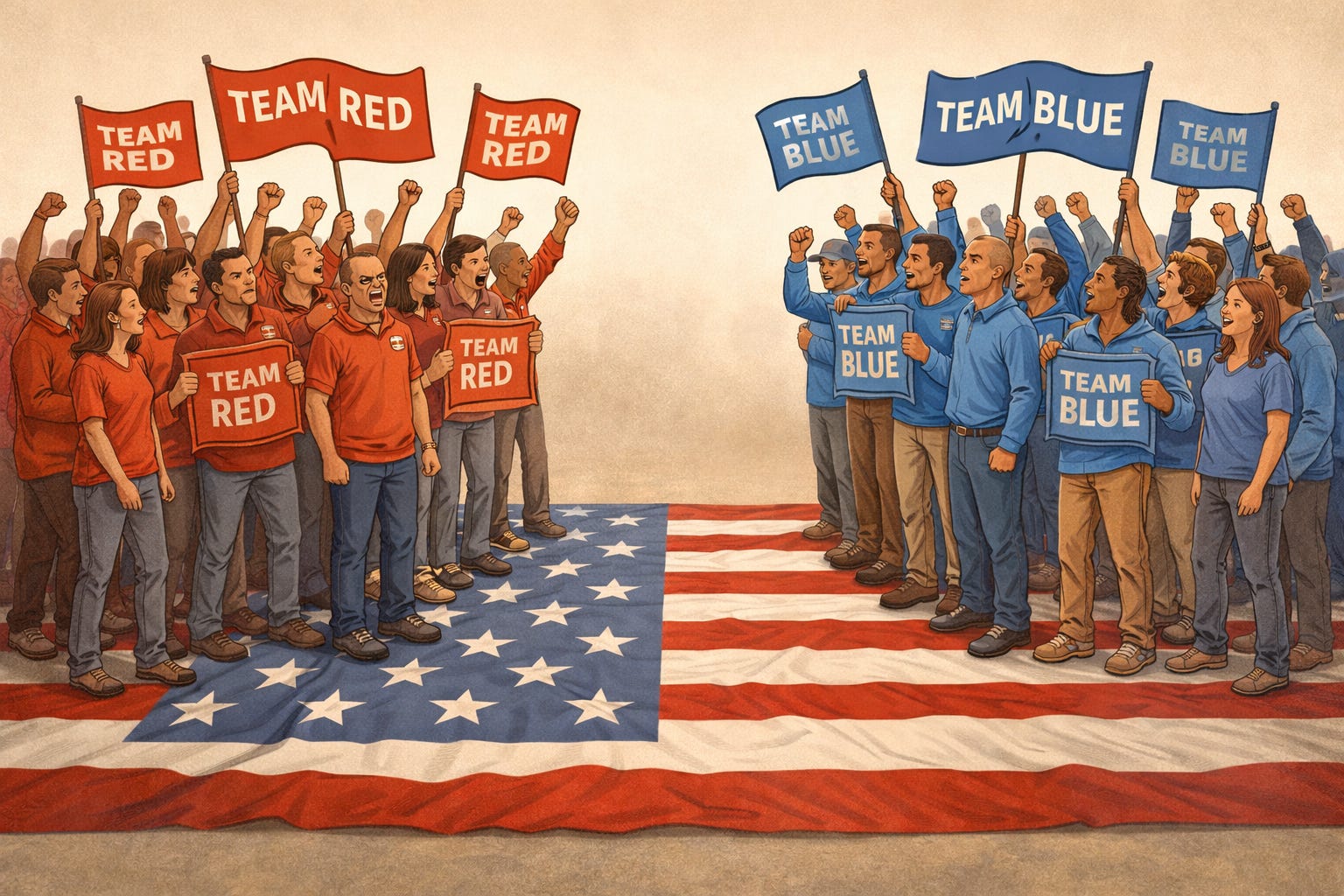
Nations are built on shared responsibility. Tribes are built on shared identity. When loyalty shifts from civic standards to group identity, democracy weakens.
Nationalism does not begin as love of country. It begins as devotion to a group. A group defined by culture, belief, race, religion, or ideology. Once that identity becomes sacred, everything outside it becomes suspect.
In civic systems, leaders serve institutions. In nationalist systems, leaders become symbols. Criticism stops being accountability. It becomes betrayal.
This is how standards collapse. Actions are no longer judged by harm or legality. They are judged by whether they benefit the group. The same behavior is excused in allies and condemned in opponents. Morality becomes conditional.
Nationalist loyalty feels powerful because it offers belonging. It simplifies complexity. It transforms uncertainty into certainty. It turns politics into survival. But it carries a cost.
Once identity becomes the moral filter, compromise disappears. Compromise feels like surrender. Cooperation feels like weakness. Pluralism feels like threat. Every disagreement becomes existential.
This is why nationalist movements drift toward authoritarianism. They cannot tolerate dissent. Dissent threatens unity. Unity sustains power. So loyalty is enforced. Institutions bend to protect the group.
Democracy requires what nationalism cannot provide. Shared rules. Equal accountability. Loyalty to standards rather than to people. Nationalism replaces these with allegiance. History shows the pattern clearly.
When identity overtakes institutions:
• courts are undermined
• elections are questioned
• laws are selectively enforced
• opponents become enemies
The nation stops being a shared project. It becomes a possession.
Nationalist movements often claim to defend freedom. But freedom depends on limits to power. Nationalism concentrates it. Freedom depends on pluralism. Nationalism erases it.
When party becomes country, the country shrinks. Citizens become factions. Truth becomes strategy. Power becomes the prize.
A nation can survive disagreement. It cannot survive when loyalty replaces law. Because once loyalty becomes supreme, abuse becomes justifiable. And once abuse is justified, democracy becomes theater.
Nationalism does not protect a country. It consumes it. It trades shared responsibility for tribal dominance. It replaces citizenship with allegiance. And allegiance always demands enemies.
If democracies are to endure, loyalty must return to principles. Not parties. Not personalities. Not identities.
Standards.
Because only shared standards allow diverse people to govern together. Without them, fracture is inevitable.