

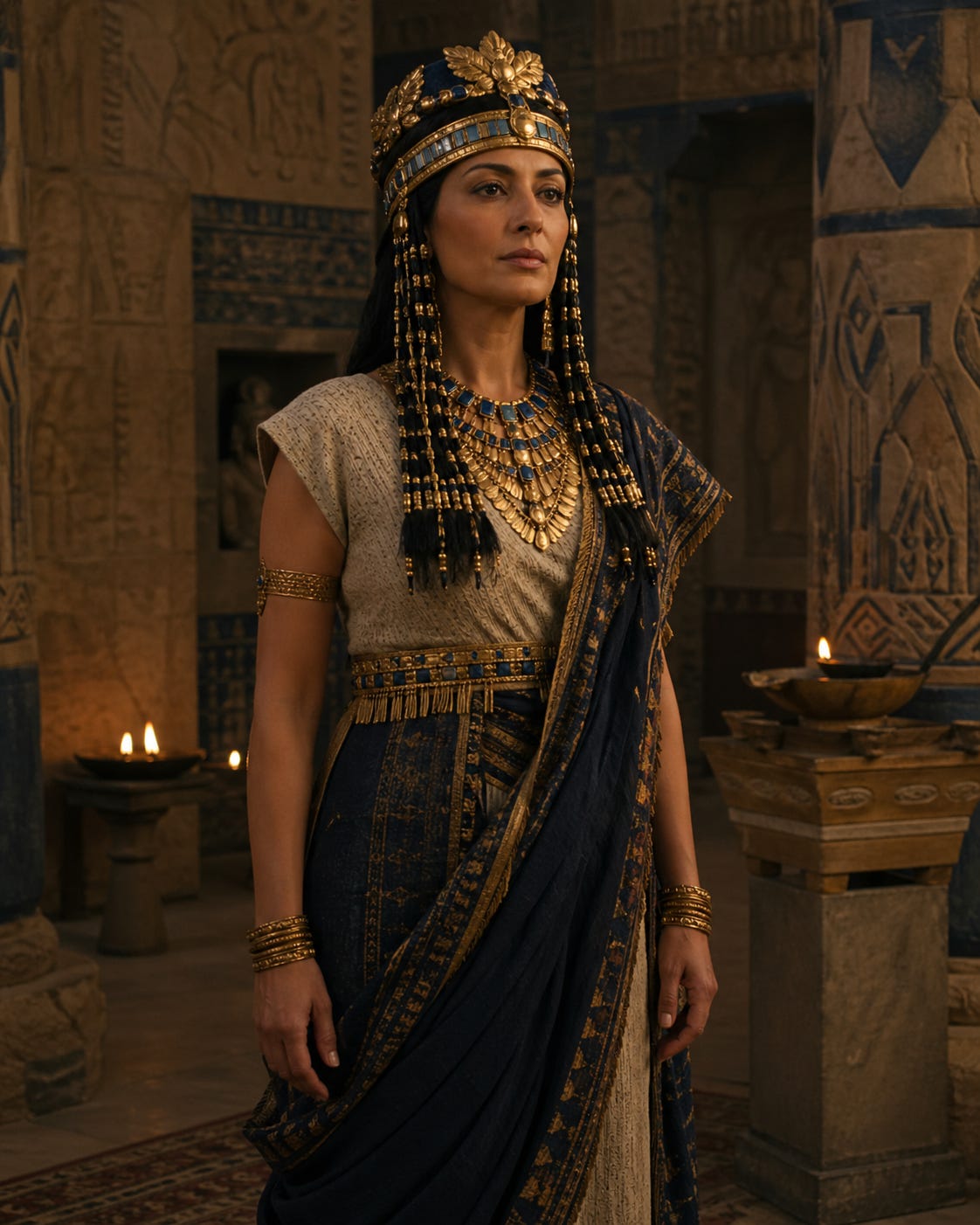
By the time Puabi enters the record, we are still at the beginning. Power exists. Structure exists. But explanation is thin. The record has not yet learned how to tell us what women were allowed to be. So it shows us instead what they were buried with.
Puabi was a Sumerian queen, buried in the Royal Cemetery of Ur around 2600 BCE. Unlike many early figures, her name survives clearly, inscribed on a cylinder seal found in her tomb. She is not anonymous. She is not inferred.
She is named. That matters. Because so many women at this distance in time are not.
Her tomb was not modest. It was elaborate, filled with gold, lapis lazuli, intricate jewelry, and attendants who appear to have been sacrificed to accompany her into death. The scale of the burial indicates status, authority, and recognition.
She was not peripheral. She was central enough to be buried as power. And yet, almost everything about her authority remains unclear.
We do not know precisely how she ruled, or what decisions she made, or how her power functioned within the structure of Sumerian society. The record preserves her presence, but not her voice.
That is the mechanism. A woman can be visibly powerful and still be historically silent.
Puabi is not denied in the way later women are denied. She is not rewritten into myth, not reduced to scandal, not erased through narrative conflict. Instead, she is left incomplete.
She is known, but not explained. That absence creates its own distortion.
Because when there is no detailed record of action, interpretation fills the space. Her wealth becomes the story. Her burial becomes the focus. The material evidence stands in for the life. That narrows her.
She becomes what was found, rather than what was done. That is an early form of containment. Not through accusation or reduction, but through silence.
The structure does not need to argue against her authority. It simply fails to preserve it in full. And over time, that absence becomes normal.
Puabi matters because she shows how early female authority can exist without narrative continuity. She was clearly powerful enough to be marked, named, and buried with extraordinary care. But the system that preserved her did not preserve her in motion.
We see the result. We see the status. We do not see the decisions. She stands at the edge of recorded history as proof that women held power before the record learned how to carry them forward.
She was not hidden. She was not denied. She was left unfinished. And that is its own kind of loss.
There is a form of presence that is not denied, but left without continuity, as if what was recognized could not be carried through its full movement. In that suspension, what remains visible is not the action but the trace, and the trace ends up replacing what was never transmitted. It is not a declared absence, but a space that is not crossed, where something exists without becoming narrative, and it is precisely there that one sees how power can be preserved and interrupted at the same time.
🙏thank you, Bri