

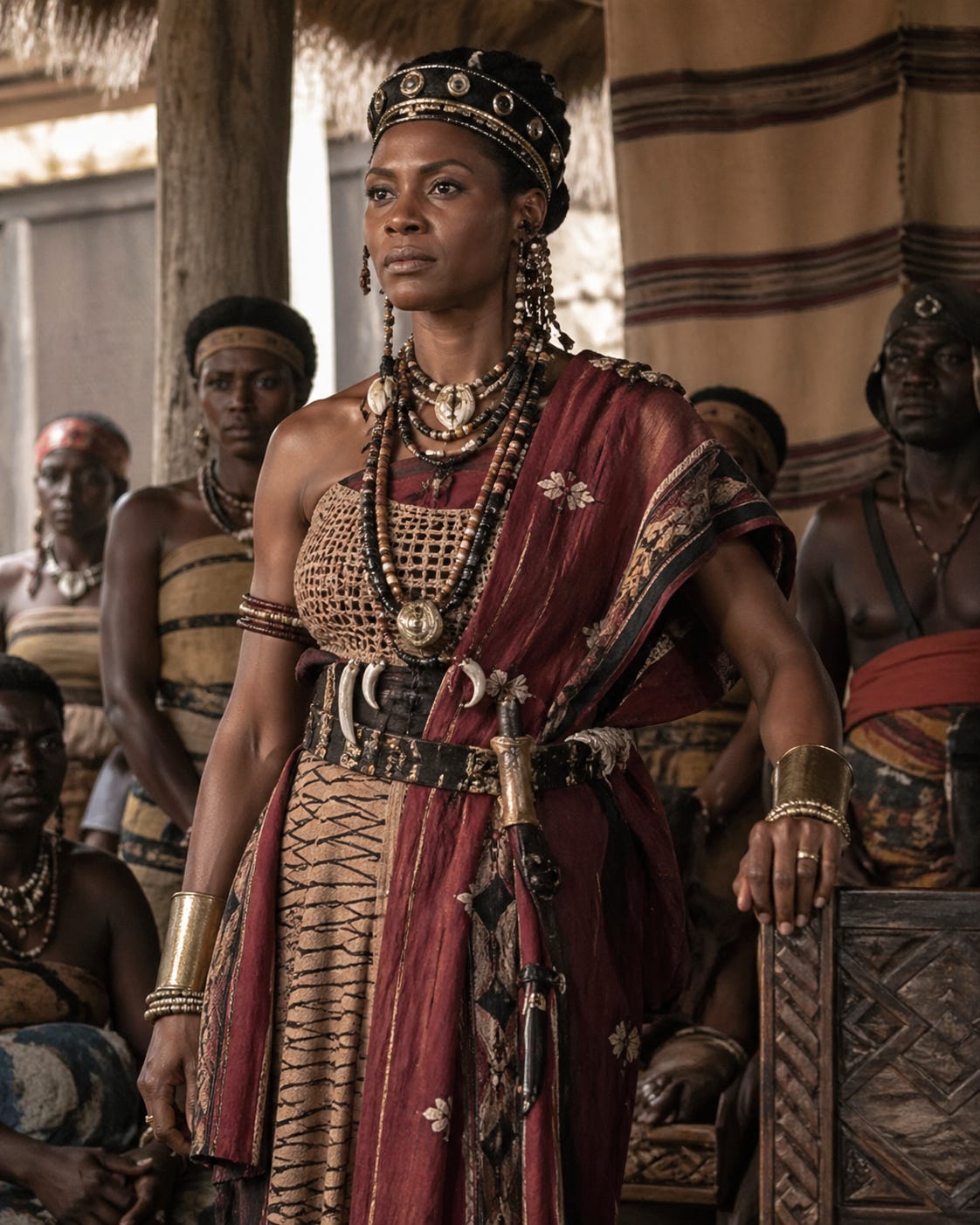
By the time Nzinga enters the record, the pattern has crossed into empire. Women have ruled, resisted, inherited, and been reframed. But now the structure itself is expanding outward. Power is no longer only dynastic or domestic. It is colonial.
The question shifts again. What happens when a woman must defend sovereignty against a system that intends to erase it entirely?
Nzinga of Ndongo and Matamba ruled in seventeenth-century Central Africa during the height of Portuguese expansion. Amid the violence of the Atlantic slave trade. She was not navigating court rivalry alone.
She was confronting a foreign imperial structure built on extraction, conquest, and human sale. That matters because the stakes are different. This is not succession. It is survival.
Nzinga entered power through diplomacy first. She negotiated directly with the Portuguese, She understood clearly that recognition and delay could be as powerful as open war. The famous account of her refusing to sit on the floor during negotiations, instead using the back of an attendant as her own seat, survives because it captures the larger truth.
She understood symbolism. She understood power. She refused humiliation as policy. That is the shift.
Nzinga did not rely on one form of authority. She moved through diplomacy, military resistance, strategic alliances, and political adaptation. She converted when useful, negotiated when necessary, fought when required, and shifted between methods without surrendering the central objective.
Preservation. That flexibility is often used against her. She is frequently framed as ruthless, manipulative, excessive. The language of ambition becomes accusation. Her strategic decisions are treated as moral distortion rather than political necessity. That is the mechanism.
When a woman survives within violent systems, especially colonial ones, survival itself is rewritten as personal corruption. The brutality of the structure recedes. The focus turns to her methods.
But rulers facing existential threat are rarely judged by purity when they are men. Nzinga’s alliances, military campaigns, and negotiations are read through a moral lens that often ignores the world she was operating inside. Portugal was not offering coexistence. It was building domination.
Her choices were not between good and bad. They were between survival and disappearance. That distinction matters.
Nzinga held power across decades. She defended territory, built resistance, and maintained sovereignty in conditions designed to make that impossible. She was not symbolic resistance. She was governance under siege.
And still, history often prefers the spectacle. She becomes legend. She becomes anecdote. She becomes the dramatic queen of confrontation rather than the disciplined ruler of sustained statecraft.
That is containment through exoticism. Her authority is not denied, but it is made theatrical. She is remembered as extraordinary enough to be distant, rather than political enough to be understood.
Nzinga matters because she shows what female authority looks like when the threat is not only patriarchy, but empire itself. She ruled in a world where defeat meant not diminished status, but erasure of people, land, and future.
She did not inherit stability. She defended existence. And the record still works to make her seem exceptional for doing what sovereignty required.