

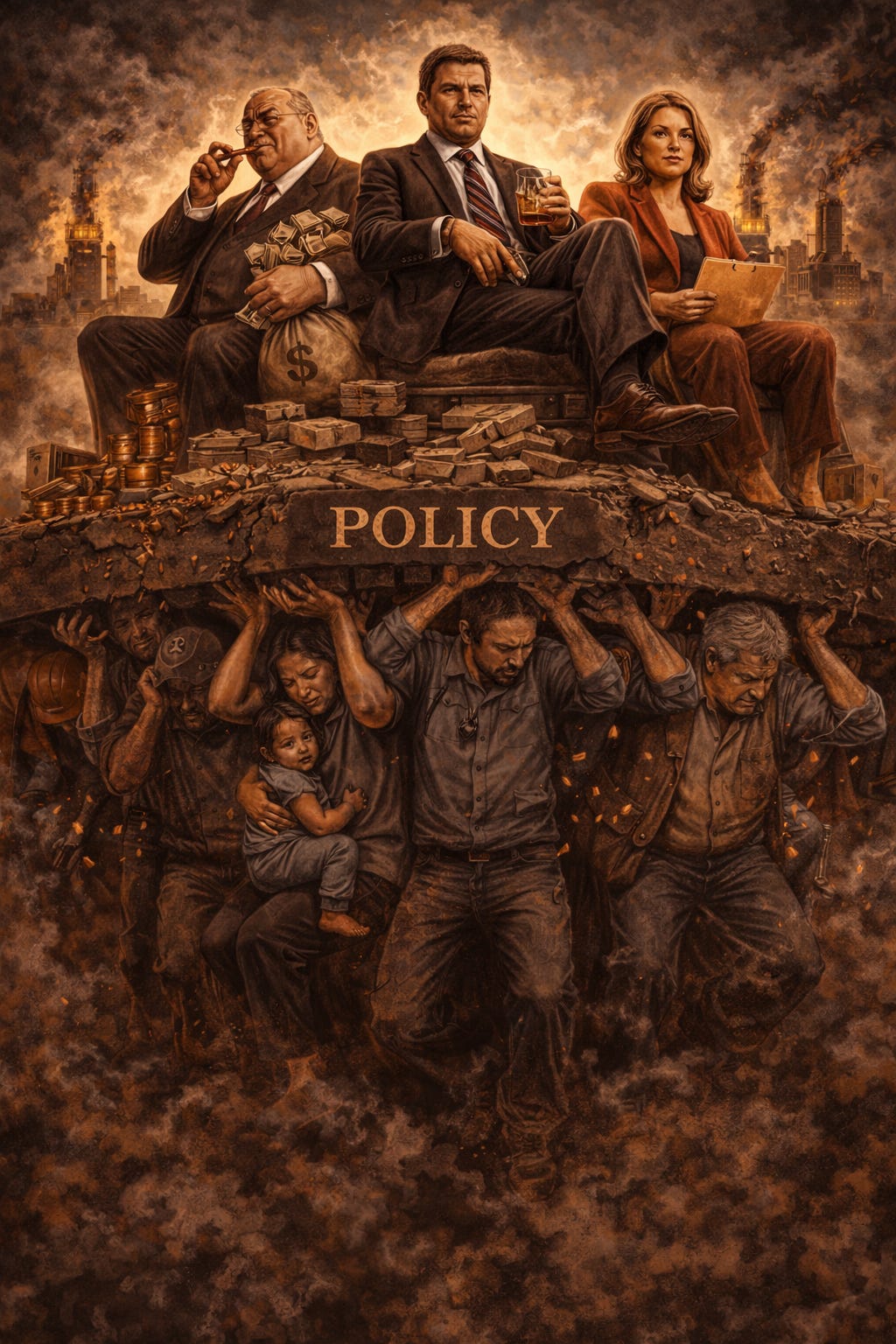
Modern policy increasingly operates on a simple principle. Risk flows downward. Protection flows upward.
Individuals are exposed to volatility in employment, healthcare, housing, and debt. Corporations are insulated through bailouts, subsidies, regulatory forbearance, and emergency intervention. Governments stabilize markets while leaving households to absorb consequences.
This is not an accident of crisis management. It is a design choice.
When failure is removed as a consequence for large actors, risk concentrates at the bottom. People are told to be flexible, resilient, and adaptive. Institutions are told to be preserved.
The language used to justify this arrangement is stability. The reality is asymmetry.
Risk transfer undermines trust. It teaches citizens that responsibility is individualized while protection is conditional on scale. Over time, this erodes social cohesion and democratic legitimacy.
A system that privatizes gain and socializes loss does not reward prudence. It rewards leverage.
Risk cannot be eliminated. It can only be distributed. When distribution becomes unjust, instability is guaranteed.