

What this is: A public-facing Rowanheart blueprint written to stand on its own without charts, tables, or embedded graphics. It is meant to be readable as a direct post or page.
1. What Rowanheart is
Rowanheart is an inter-generational community model built around three linked functions: care, connection, and creation.
It is designed to reduce isolation, strengthen neighborhood bonds, support practical needs, and create shared spaces where people can gather, learn, make, and belong.
The model can begin in a lean form through borrowed or shared spaces and volunteer-supported programming. It can also scale over time into a fuller community campus.
2. What problem it addresses
Social isolation among elders, youth, adults navigating instability, and families without welcoming places to gather.
Loss of inter-generational connection, practical skill-sharing, and low-barrier community participation.
A shortage of dignified spaces that combine basic support, creative activity, and relationship-building in one coherent model.
3. Who it serves
Elders experiencing isolation or loss of role.
Youth seeking mentorship, safe activity, and inter-generational connection.
Adults and families who need belonging, practical support, and welcoming community space.
Artists, makers, gardeners, musicians, volunteers, and neighbors who want to contribute skills or participate.
4. Core model
Roots - Foundational Care: Care Closet, dignity supports, hospitality, and immediate practical care delivered without stigma.
This Substack is reader-supported. To receive new posts and support my work, consider becoming a free or paid subscriber.
Trunk - Gathering & Community Life: Shared events, story circles, music, creative gatherings, and welcoming public presence.
Branches - Learning & Inter-generational Exchange: Elder-led skill sharing, youth-elder companionship, maker sessions, gardening, and practical teaching.
Canopy - Wellness & Leadership: Reflection circles, workshops, volunteer pathways, youth and elder mentors, and long-term stewardship.
5. Transferable components
The full Rowanheart framework can travel as a bundle, but each component can also stand on its own.
Care Closet: A no-barrier distribution model for clothing, food, hygiene items, books, and supplies.
The Hearth: A welcome-centered hospitality hub for orientation, conversation, tea or coffee, and low-pressure gathering.
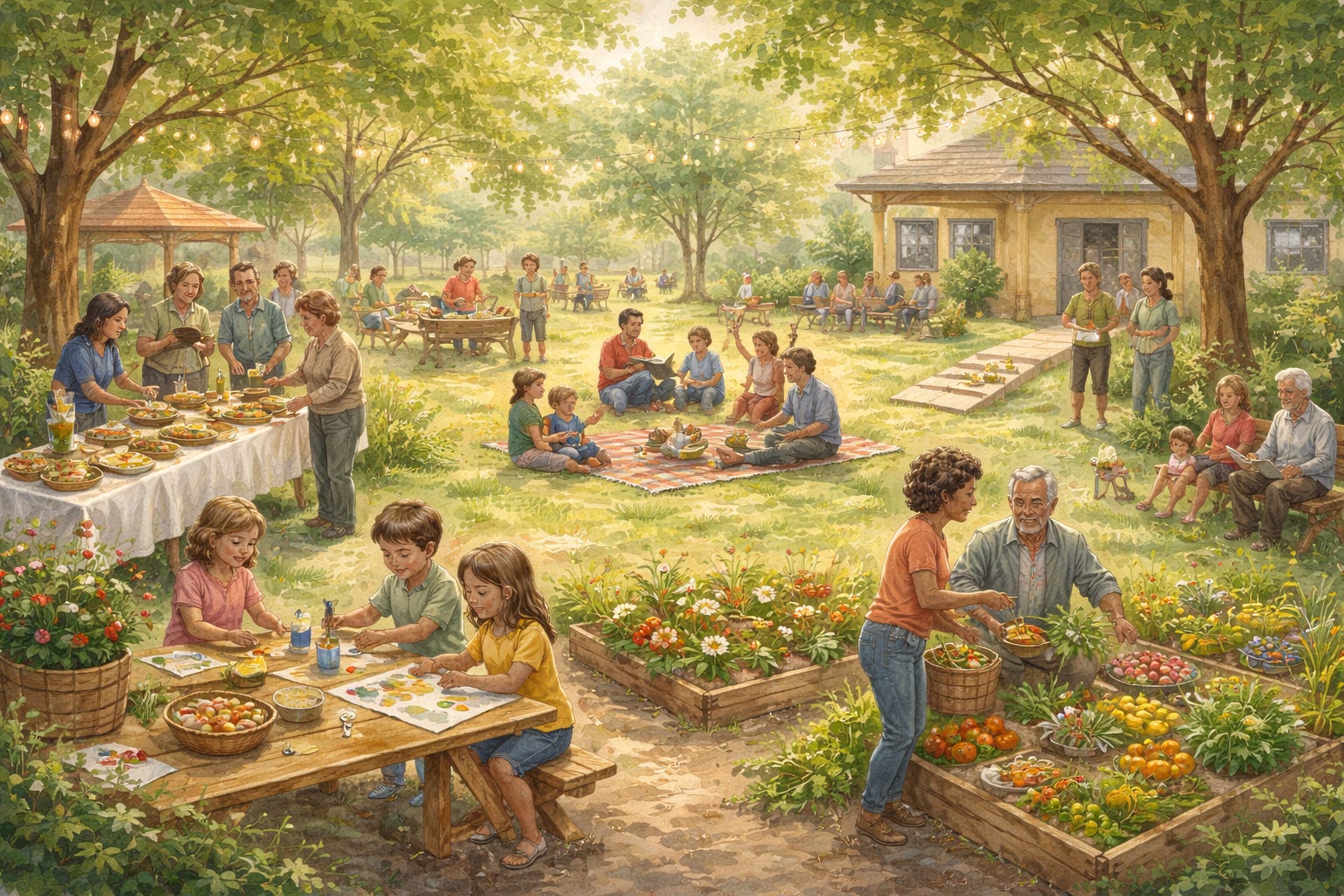
The Grove: An outdoor gathering green for potlucks, celebrations, play, and neighborhood events.
Maker Barn: A repair, craft, woodworking, textile, and skill-learning hub with volunteer-led instruction.
Elderhouse: A calm inter-generational space for elder teaching, companionship, storytelling, and rest.
Sound Circle: A music and rhythm space for drumming, open mic, songwriting, and communal expression.
Garden and Greenhouse: Nature-based programming focused on food growing, flowers, healing, and stewardship.
Companion Program: Structured elder-youth pairings or small groups for reading, crafts, games, gardening, and connection.
6. How a lean launch works
Rowanheart does not require a permanent building to begin. The lean launch model starts with borrowed or low-cost spaces, pilot programming, volunteer coordination, small grants, community partnerships, and documentation of early outcomes.
Weeks 1-6: Neighborhood listening, relationship-building, volunteer interest, simple public presence, and identification of free or low-cost spaces.
Weeks 4-10: Pilot programs such as an arts and story circle, an elder-youth meet and greet, and a small Care Closet distribution event.
Months 2-6: Recurring rhythm, small grants, local partnerships, volunteer training, seasonal gathering, and continued community feedback.
Months 6-12: Evaluation, refinement, fundraising, and exploration of longer-term space options if the pilot is working.
7. Budget scenarios
Rowanheart can be presented in two honest scenarios rather than one blurred number set.
Option A - Lean launch: Volunteer-supported start-up model with borrowed or modest space. Year 1 operating profile centered on supplies, insurance, stipend support, outreach, and low-overhead program delivery. Approximate Year 1 expenses: $77,000.
Option B - Full community campus: Dedicated site and stronger staffing structure. Expanded facilities, operations, programming depth, and longer-range infrastructure with a larger multi-year operating and capital profile.
8. What a host, partner, or city could do with it
Adopt one program element such as a Care Closet, elder-youth companion model, maker hub, or community music circle.
Use the framework as a planning model for a broader neighborhood community center or campus.
Pilot a small Rowanheart-style program family in shared spaces before considering a permanent site.
Combine selected components with existing local programs, libraries, schools, parks, senior centers, or faith-based spaces.
9. What success looks like
More people participating consistently in neighborhood life.
Reduced isolation and stronger inter-generational relationships.
Increased access to practical resources, creative expression, and shared skills.
A visible culture of dignity, warmth, and repeat participation.
A local model that can grow, replicate, or adapt without losing its human focus.
10. Why this is being shared openly
This framework is being offered so it can be used. It may be adopted as a whole model, adapted in pieces, or used as a starting point for a local community project.
The goal is practical usefulness, not exclusivity.
11. Supporting materials available
Organizational overview, structure, and summary.
Program map, logic model, launch plan, and launch timeline.
Volunteer handbook and activities and methods summary.
One-page overviews for major spaces and programs.
Lean Year 1 budget and broader campus budget scenarios.
Public brochure, roadmap, and master planning packet.
12. Attribution
Created by Suzanne Helfman. Shared as an open community blueprint for adaptation, pilot use, and local implementation.
For distribution, this front-door blueprint should lead. Detailed planning documents should sit behind it as supporting materials rather than serving as the first point of entry.
It's very interesting. Something I've been thinking a lot about for a long time. But, this is mature and well-structured.