

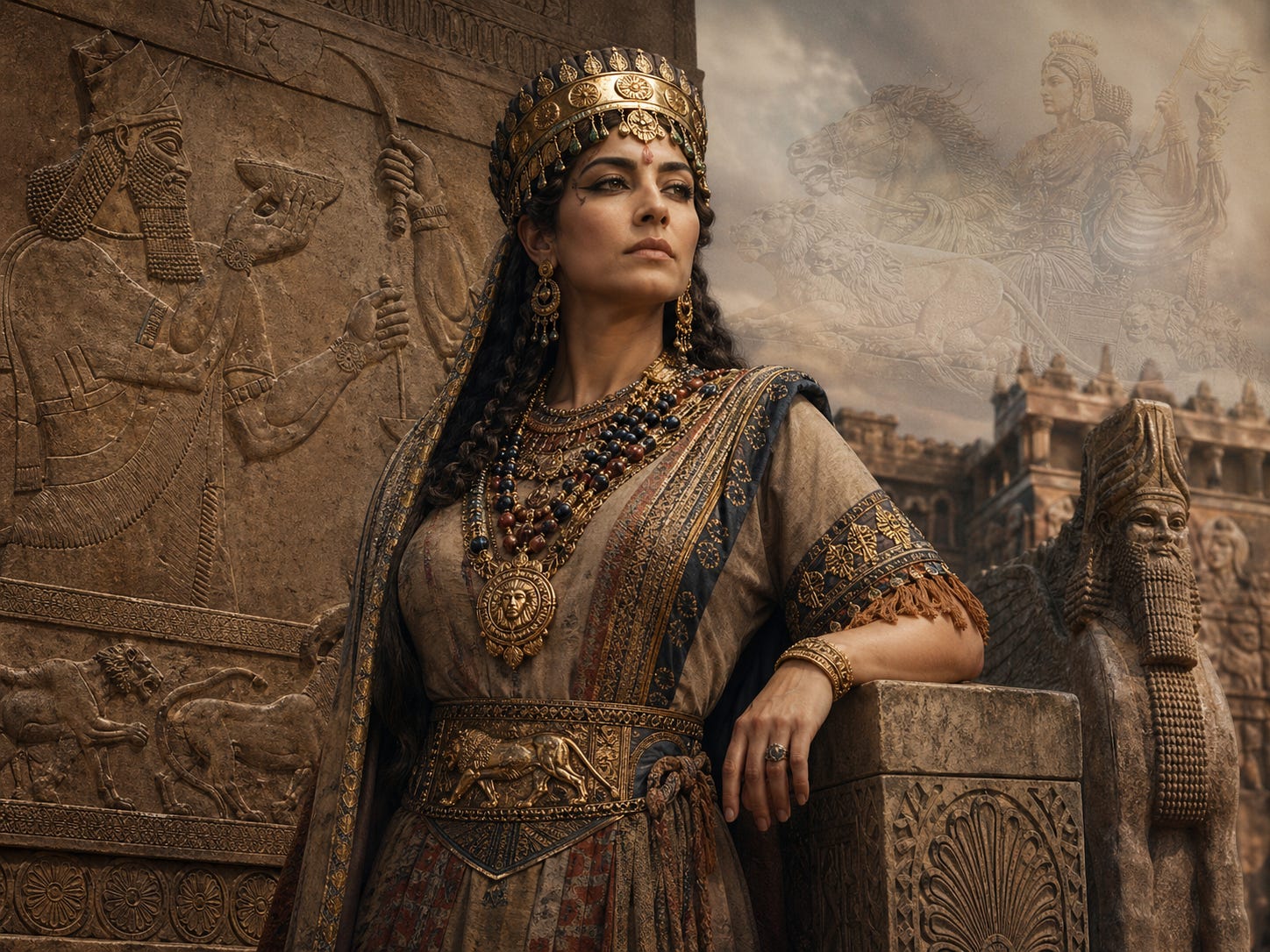
By the time Sammu-ramat enters the record, the pattern has already deepened. Women have appeared in sacred office, near dynastic beginnings. They were even on the throne itself.
The question is no longer whether female authority could exist. The question is what history does when it cannot comfortably hold that authority in plain form. Sammu-ramat gives one of the clearest early answers.
She was a real Assyrian queen, the wife of Shamshi-Adad V and the mother of Adad-nirari III. After her husband’s death, she appears to have held unusual prominence during her son’s early reign, likely as regent, or at minimum as a political force powerful enough to leave a visible mark in the record.
Sammu-ramat is not a fantasy figure accidentally mistaken for history. She begins as a real woman, near real power, in one of the ancient world’s most formidable states. That matters because what happens next is familiar.
A woman whose authority is too visible to erase cleanly becomes easier to distort than to name. Over time, Sammu-ramat is drawn into the larger, more extravagant tradition of Semiramis, a figure shaped by legend, embellishment, conquest, desire, excess, and mythic scale.
The woman does not vanish. She becomes harder to recover. That is one of patriarchy’s more elegant evasions. A woman’s authority can be denied outright. It can be narrowed into wifehood, motherhood, regency, or service.
If a woman’s authority remains too large to dismiss, it can also be pushed sideways into story. Not removed, exactly. Transformed. Inflated beyond use.
Made so grand, so sensual, so improbable, so half-fictional that the real political fact beneath it begins to blur. Sammu-ramat sits right at that edge. What survives suggests that she exercised power unusual enough to command attention.
Her name appears in inscriptions. Her position after her husband’s death was prominent enough that later memory did not let her go. But that same prominence seems to have made her vulnerable to a second kind of containment.
If female power could not be fully denied, it could be mythologized until it became easier to marvel at than to reckon with. That is the trap in her case.
A real woman stood near rule, perhaps held it in meaningful measure. Her mark left a lasting impression on imperial memory. But instead of remaining clearly legible as a political actor, she was gradually absorbed into a legendary figure whose scale made the historical woman harder to see.
The result is not simple erasure. It is something slipperier. The archive keeps her, but in unstable form. And that instability is part of the lesson.
Sammu-ramat reveals that the problem is not only whether women are remembered. It is how they are remembered. A woman can survive in the historical imagination and still be displaced from history proper.
A woman can become too adorned, too eroticized, too exaggerated, too mythic to function as straightforward evidence of female authority. Once that happens, memory remains, but clarity weakens. This is not an accident at the edge of the record. It is one of the ways power protects itself.
A real male ruler may be brutal, erratic, or grandiose and still remain legible as political fact. A woman near comparable power is more vulnerable to being turned into spectacle, legend, temptation, excess, or warning. Her authority becomes narratively unstable. The facts around her start to slide.
The result is not that she disappears, but that she becomes less usable as proof that women held real power in the first place. That is what makes Sammu-ramat so important.
She stands as one of the early examples of female political authority becoming easier for history to absorb as myth than to preserve as governance. Her case widens the series.
Hatshepsut showed what it cost for a woman to rule inside a male-coded institution. Sammu-ramat shows what can happen after female power enters memory and becomes vulnerable to transformation.
The woman is still there. But she is harder to reach through the story built around her. So she should not be treated simply as “the real Semiramis,” as though the only point is to strip legend away and recover a hidden original.
The deeper point is the mechanism itself. A woman near imperial power became easier to handle once she was made larger than life, less historically precise, and more available to fantasy than to political understanding.
That is not nothing. But neither is it justice. Sammu-ramat reminds us that one of the oldest ways to weaken female authority is not only to deny it, but to mythologize it until the woman herself becomes difficult to hold.
That too is a form of narrowing.
You make a great point here. By mythologizing the figure it doesn't have to erase her. She simply becomes unbelievable.