

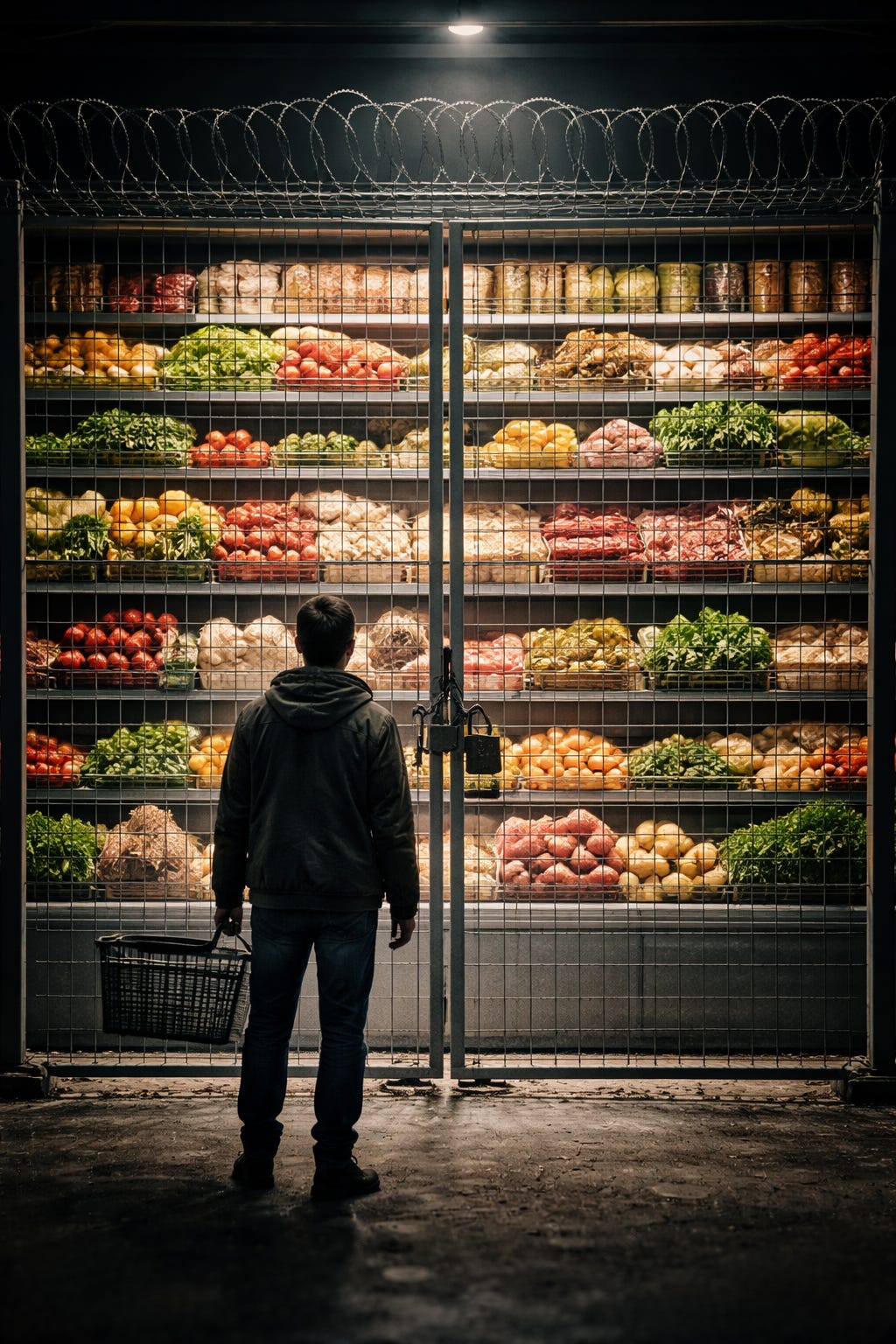
A country like this is not supposed to produce this much preventable desperation.
We are told scarcity is just part of life, one of those hard truths nobody can escape, as if want and instability simply blow in like weather. That story does not hold in the United States. This is not a country defined mainly by lack. It is a country defined by abundance that has been captured, gated, priced, hoarded, and rerouted away from the people who sustain it.
We produce enormous wealth. We produce more than enough food. We have the labor, the land, the infrastructure, the technology, and the knowledge to prevent much of the instability people are forced to live inside. The deprivation is real. The suffering is real. The lack beneath it often is not. What is missing is access. What is missing is distribution. What is missing is a system still organized around public good instead of private extraction.
That is the failure.
The structure was meant to protect the people who support it. Instead, it has been redirected to protect those who extract from it. Corporate interests, political convenience, elite insulation, and the comfort of those least exposed have bent the machinery away from broad stability and toward controlled access. The result is a country where abundance sits in plain view, while millions of the people whose work keeps the whole arrangement standing are told they have not earned the right to reach it.
That is why so many forms of scarcity in American life feel false even while their consequences are crushing. Housing scarcity in a country full of homes, land, vacant property, and speculative ownership. Food scarcity in a country capable of extraordinary agricultural output. Healthcare scarcity in a country with immense medical infrastructure and profit-heavy systems. Time scarcity in a country that drains people so completely through work, commuting, bureaucracy, and instability that rest itself starts to look indulgent. None of this reads like natural shortage. It reads like access being managed for someone else’s benefit.
Then comes the second failure.
Once people are trapped inside this designed instability, they are blamed for not escaping it. They are told to work harder, budget better, choose smarter, move faster, sacrifice more, and somehow reach a standard of stability that keeps shifting by the hand of the same interests profiting from their exhaustion. The public is kept so busy chasing the carrot that many do not notice who keeps moving it, or who is emptying their pockets while they run.
That blame is one of the country’s most reliable maintenance systems. It turns structural failure into personal inadequacy. It turns policy choices into character judgments against the people forced to live under them. It protects institutions from scrutiny by telling the struggling their suffering is proof of poor choices, instead of proof that the game was tilted long before they entered it.
And this is where the cruelty stops pretending to be anything else.
The country does not simply allow deprivation inside abundance. It organizes around it. It profits from it. Then, once the consequences become visible, it spends additional money to make them harder to witness and harder to survive.
That is the logic beneath hostile design. Benches built to prevent rest. Public spaces designed to repel the poor. Anti-homeless architecture. Sweeps that destroy what little people have left. Barriers to water, bathrooms, shelter, shade, and sleep. Money appears when the goal is discomfort. Resources can be found when the purpose is deterrence. Funds are available when the aim is to push suffering out of sight. But let the question be housing, treatment, relief, stability, dignity, or repair, and suddenly this country rediscovers the language of limits.
That tells the truth more clearly than any speech ever will. The issue is not whether resources exist. The issue is what this system has chosen to do with them.
None of this requires a grand conspiracy. It only requires repeated decisions by institutions and powerful interests that benefit from keeping access gated, labor cheap, housing unstable, care conditional, and public anger pointed downward instead of upward. A thousand smaller choices can build the same cage as one master plan. The outcome does not become less deliberate simply because it was assembled through profit, cowardice, convenience, and self-protection instead of written down in one neat document.
Scarcity in abundance is not a natural condition. It is a managed one.
That is what makes it a Failure Point. The country had the capacity to organize abundance toward public stability and chose not to. It had the means to reduce suffering and instead preserved the arrangements that monetize it. It had the resources to support the people who make the system possible and instead normalized a structure in which those people are forced to compete for what should never have been so difficult to reach in the first place.
The human cost is material, civic, and moral. People adapt downward. They lower their expectations of what a functioning society owes its members. They stop asking why essentials are unstable and begin asking only how much instability they are expected to survive without complaint. They learn to distrust one another rather than the arrangement that keeps them in competition. They absorb shame for barriers designed above their heads. They internalize failure where they should have recognized theft.
A society with this much capacity should not look like this. A country with this much wealth should not produce this much preventable desperation. When scarcity shows up on this scale in the middle of so much abundance, the shortage is not resources.
It is permission.