

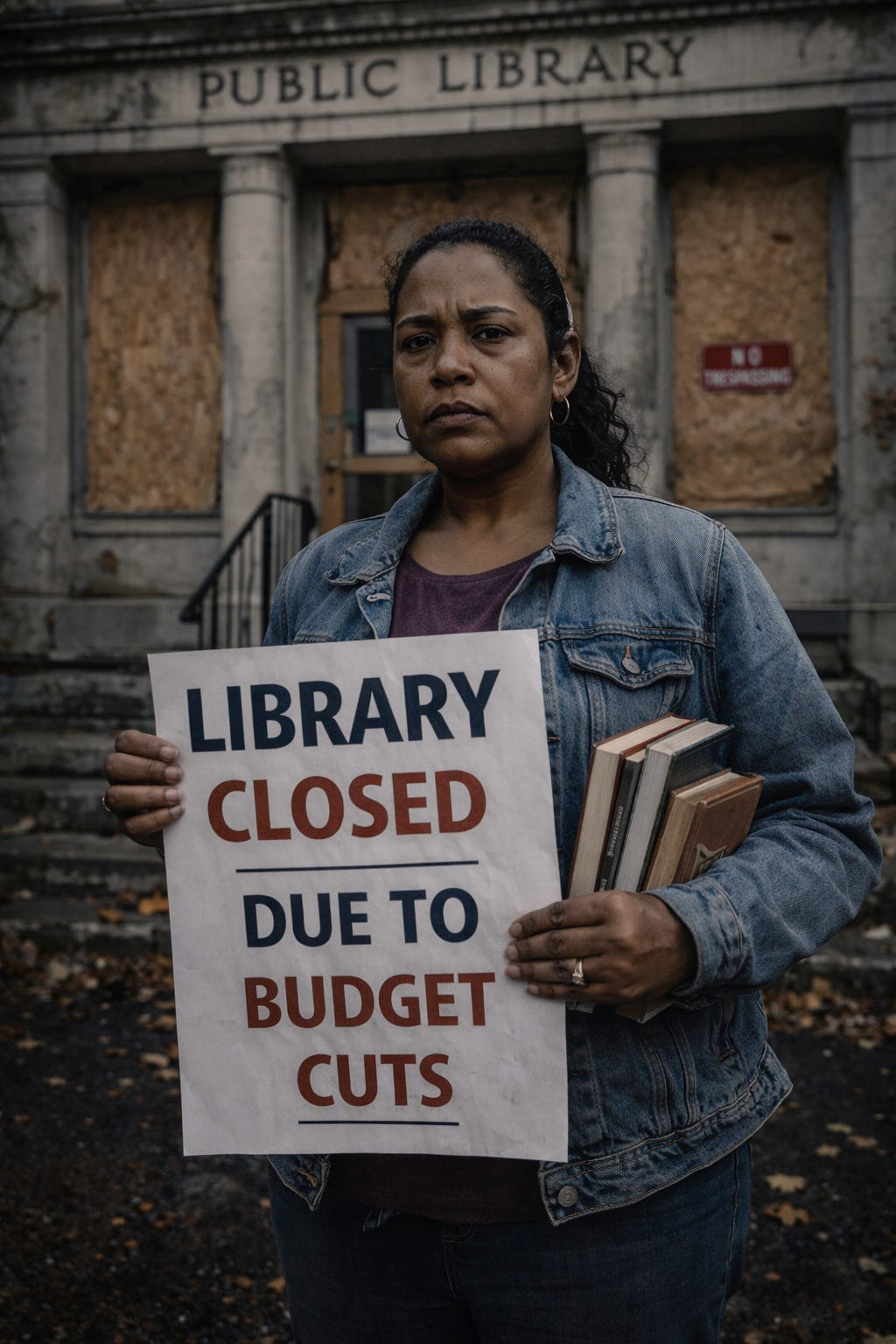
Community is often talked about as though it simply faded. As though people got colder, busier, more distracted, or less interested in one another, and shared life just thinned out on its own.
That framing is too easy.
Community does not exist because people vaguely want it to. It requires conditions. It requires time, place, trust, safety, continuity, and enough stability for people to keep showing up in one another’s lives. When those conditions are weakened or removed, community does not disappear by accident. It is starved.
That is the failure.
In the United States, the breakdown of community is too often treated like a cultural mystery when it is, in large part, a structural outcome. Government withdrew funding. Public spaces disappeared or decayed. Shared local events dwindled. Informal gathering points thinned out. Safe places to simply be around one another without paying, performing, or proving anything became harder to find.
At the same time, people were given less time, less stability, and less reason to trust that anyone would still be there when they reached outward. Then the country turned around and acted confused about loneliness, distrust, isolation, and fragmentation. That is not confusion. That is consequence.
People need to become involved with each other. They need to talk. They need to break bread together. They need safe public spaces where shared life can happen naturally, not only through crisis, institutions, or commerce.
Community is not an indoor town hall with a microphone and a grievance queue. It is an open park, strolling around, eating ice cream, talking with your neighbor, letting children run, recognizing faces, building comfort through repetition, and learning each other in low-stakes human ways.
That kind of life does not happen by magic. It is supported, or it is not. And too often, it is not.
Government picks and chooses when public gathering matters. Major holidays get the banner treatment. Formal celebrations get approved. Branded civic moments get staged. But the ordinary, ongoing infrastructure of community life is treated like fluff, or nostalgia, or something people should organize privately if they care enough. That is the mistake.
Community is not extra. It is part of the public health of a place. It is one of the ways people build trust, recognize each other, lower fear, widen belonging, and become harder to divide. When that is neglected, the damage is not sentimental. It is structural.
People stop knowing each other. Public trust thins out. Isolation deepens. The unfamiliar becomes easier to fear. Difference becomes easier to manipulate. Social life gets pushed indoors, behind paywalls, inside institutions, onto screens, or into private circles that do not easily touch one another.
The public loses the habit of being together. And once that habit weakens, everything else gets harder. Organizing gets harder. Solidarity gets harder. Conflict gets sharper. Loneliness gets deeper.
Even ordinary generosity becomes less likely when people no longer experience themselves as part of a shared human field. That is not just sad. It is destabilizing.
And it is especially ugly because people need each other now more than ever, while the structure leaves less and less room to actually show up for each other. Overwork drains time. Economic pressure drains energy. Instability drains reliability. Distrust drains openness.
Even when people want to connect, the conditions beneath them keep failing. Fewer places to gather. Fewer recurring public rituals. Fewer common spaces that feel welcoming instead of monitored, commercialized, or neglected. Less confidence that the people around you will still be there next month, next season, next year.
The result is a population asked to survive together while being structurally discouraged from actually being together. That is a country undermining one of its own survival tools.
And as always, the blame gets pushed downward. People are told to join more, volunteer more, try harder, reach out more, care more. But community is not built from moral lectures alone. It needs somewhere to land. It needs public room. It needs support. It needs visible invitation. It needs time. It needs stability. It needs enough trust for people to risk showing up in the first place.
If a town has no life left in its commons, no rhythm of gathering, no shared spaces worth lingering in, and no social floor sturdy enough to let people participate, then telling them to be more communal is just another way of blaming them for the absence of structure. That is the lie.
The truth is simpler. Community requires cultivation. It requires public choices. It requires resources, design, repetition, time, and room.
If government can fund control, surveillance, deterrence, clearance, and enforcement, it can fund local life. If it can make room for extraction, it can make room for gathering. If it can understand the economic value of development, it can understand the civic value of a park, a public event, a local festival, a maintained square, a safe library, a recurring market, a walkable commons, or any other place where people can keep becoming known to one another.
That is what has been missed. Or worse, discarded. Community is not a side benefit of society. It is one of the things that makes society possible. Without it, people become easier to isolate, easier to exhaust, easier to sort, easier to manipulate, and easier to leave behind. The erosion of community is not only about loneliness. It is about the weakening of one of the last soft protections ordinary people have against atomization and powerlessness.
That is the Failure Point.
The failure is not merely that people feel less connected. The failure is that the structures, spaces, funding, time, trust, and stability that make connection possible have been neglected, removed, or allowed to die off, and the resulting fragmentation has been treated like a personal or cultural defect instead of a predictable public outcome.
Community did not simply disappear. It was deprived of the conditions it needed to live.