

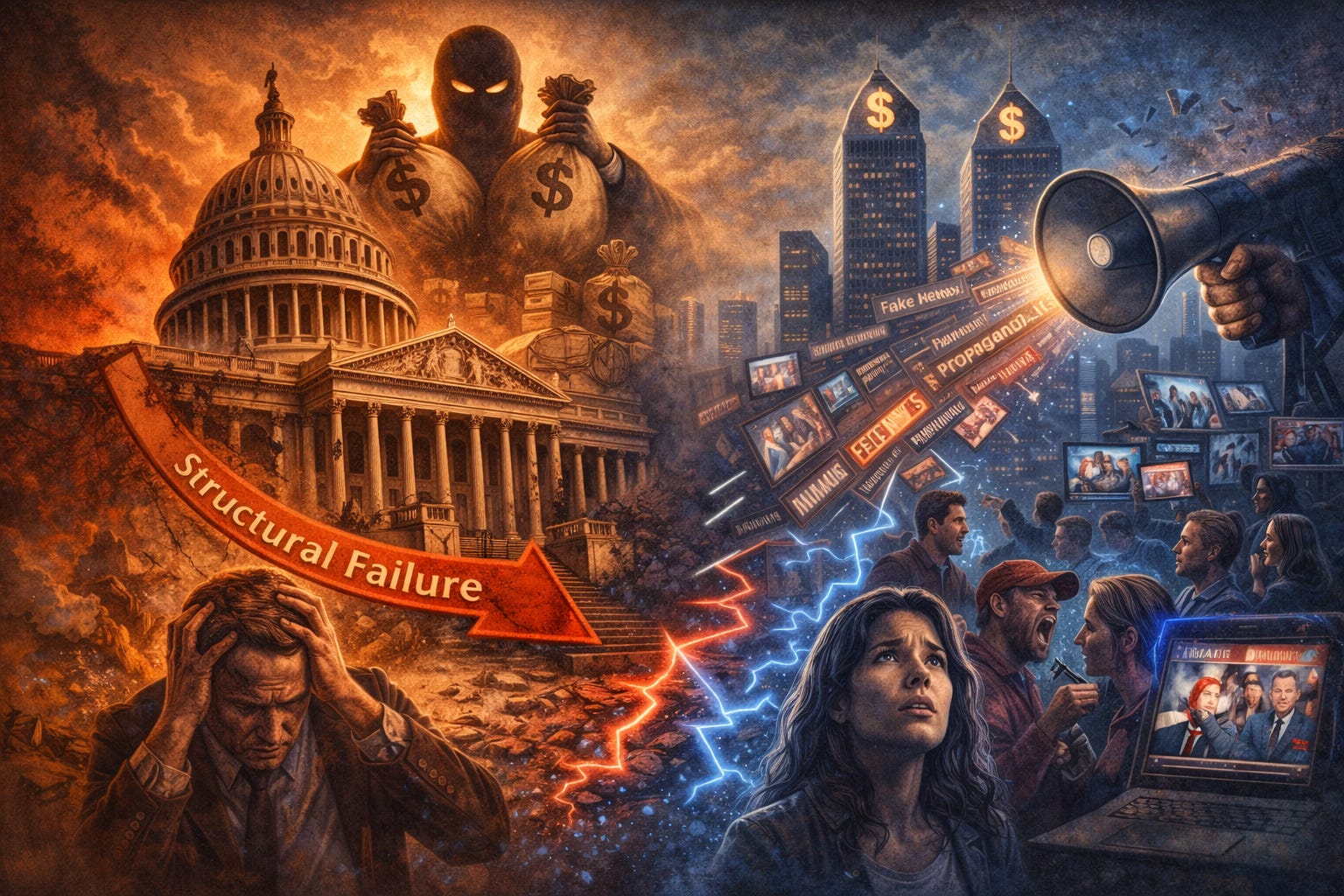
Democratic systems rarely fail all at once. More often, failure develops gradually as structural pressures accumulate faster than institutions adapt.
The institutions of the United States continue to function formally. Elections occur, laws are passed, courts operate, and public administration continues across multiple levels of government. Procedural continuity remains visible.
However, procedural continuity alone does not guarantee systemic health. Democratic systems depend not only on procedures but on the conditions that allow meaningful participation, accountability, and legitimacy to exist.
When those conditions weaken, the system may remain operational while the foundations that sustain it erode.
Several structural pressures have emerged over time that increasingly challenge the capacity of existing constitutional arrangements to maintain those conditions.
One of the most significant pressures is the concentration of economic power. Economic systems that allow wealth and productive assets to accumulate without effective limits can gradually distort democratic participation. When economic influence becomes sufficiently concentrated, the capacity of institutions to operate independently of that influence diminishes.
A second pressure emerges through institutional capture. Institutions created to regulate power can become dependent on or aligned with the very forces they were designed to oversee. Over time, regulatory, legislative, and administrative systems may begin to reflect the interests of concentrated power rather than the broader public.
Information systems present an additional structural challenge. Modern societies rely on information networks that shape perception, understanding, and decision-making. When those systems become fragmented, manipulated, or distorted, the capacity of individuals to evaluate public questions collectively becomes significantly more difficult.
These pressures interact with one another. Economic concentration can amplify influence over political systems. Political influence can weaken institutional oversight. Distorted information environments can obscure both developments from public understanding.
The result is not necessarily immediate collapse. Instead, democratic systems can enter a condition in which institutions continue to function procedurally while substantive accountability becomes increasingly difficult to maintain.
In such conditions, public frustration often grows. Individuals may attempt to fill gaps left by weakening institutions through informal mechanisms of accountability, public pressure, or political polarization. While these responses reflect a desire for correction, they can also intensify instability when structural causes remain unaddressed.
Structural failure therefore differs from individual misconduct. It describes conditions in which the system itself begins to produce outcomes inconsistent with its intended purpose.
Addressing structural failure requires attention to the design of institutions rather than solely to the behavior of individuals operating within them.
Constitutional evolution offers one mechanism through which societies can respond to such conditions. By clarifying protections, strengthening accountability, and addressing forms of power that earlier frameworks did not anticipate, constitutional systems can restore alignment between structure and purpose.
The goal of structural repair is not disruption for its own sake. It is the restoration of conditions that allow democratic participation, institutional legitimacy, and public accountability to function as intended.
When structural pressures are acknowledged and addressed, democratic systems can renew their capacity to serve the societies that depend upon them.