

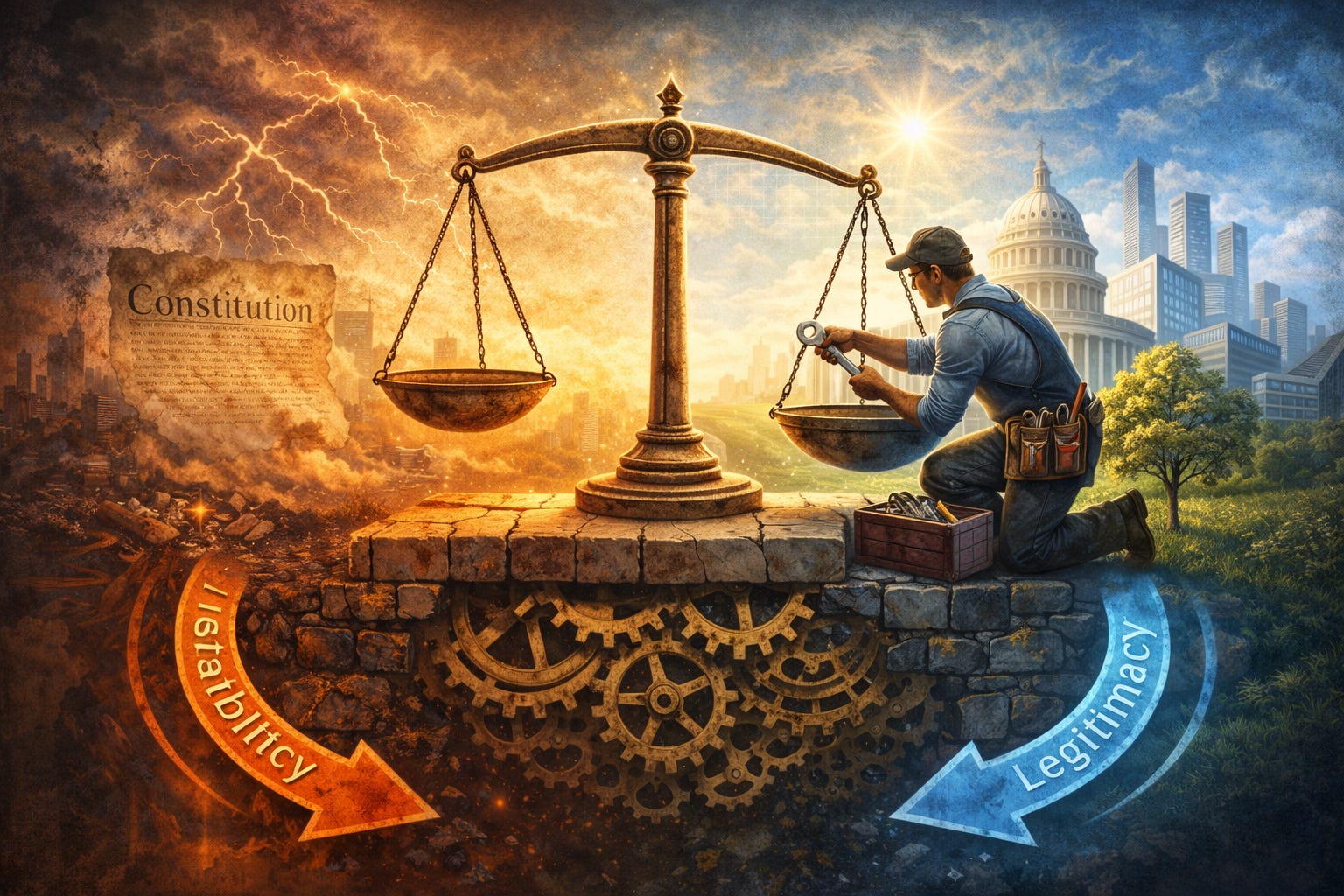
All complex systems require maintenance.
Natural systems, mechanical systems, and social systems share a common characteristic: without periodic correction and renewal, small imbalances accumulate until the system no longer functions as intended.
Constitutions are not exempt from this reality. They establish structures of authority, accountability, and participation intended to sustain a society across time. Yet the conditions surrounding those structures inevitably change. Population grows. Institutions expand. Economic systems evolve. Technologies reshape communication, production, and power.
As these changes occur, pressures develop that the original structure did not anticipate. When those pressures are not addressed through deliberate maintenance, they begin to distort the system itself.
In governance, this distortion often appears gradually. Rules remain in place, institutions continue to operate, and formal procedures persist. However, the relationship between institutions and the people they serve begins to shift. Systems designed to distribute power may begin to concentrate it. Structures intended to support participation may instead create distance between decision-making and those affected by it.
These developments rarely occur through a single dramatic failure. They accumulate slowly through structural drift.
Structural drift describes the process by which institutions gradually move away from their founding purpose while retaining the appearance of continuity. Policies change, incentives shift, and new forms of power emerge. Over time, the system may continue to function procedurally while failing to sustain the conditions it was created to protect.
Maintenance is the process by which such drift is recognized and corrected.
Effective maintenance does not require constant reconstruction. It requires periodic examination of whether systems still fulfill their intended purpose. When they do not, correction becomes necessary in order to restore alignment between structure and function.
In democratic systems, maintenance carries particular importance. Democracies depend upon the continued participation of the people governed by them. When institutions cease to support meaningful participation, legitimacy begins to erode even if legal structures remain unchanged.
Maintenance therefore serves two roles. It protects the stability of institutions, and it protects the legitimacy that allows those institutions to operate.
Historically, societies that recognized the necessity of maintenance developed mechanisms to correct imbalances before they became catastrophic. Legal reforms, constitutional amendments, and institutional restructuring have served this purpose at different moments in history.
Where maintenance mechanisms are absent or neglected, correction tends to occur through crisis rather than design. Economic collapse, political upheaval, and social fragmentation often represent the delayed consequences of structural problems that were allowed to accumulate unchecked.
The purpose of constitutional evolution within this framework is to restore the principle of maintenance as a deliberate civic practice.
Rather than waiting for failure to force change, systems of governance should incorporate the capacity to recognize drift, address imbalance, and renew the conditions necessary for democratic participation.
Maintenance does not weaken constitutional systems. It preserves them.
A system capable of reflection, correction, and renewal is more durable than one that attempts to preserve stability by resisting adaptation.
The goal of constitutional maintenance is therefore continuity through renewal. By recognizing the need for periodic structural correction, societies protect both the stability of their institutions and the dignity of the people those institutions exist to serve.