

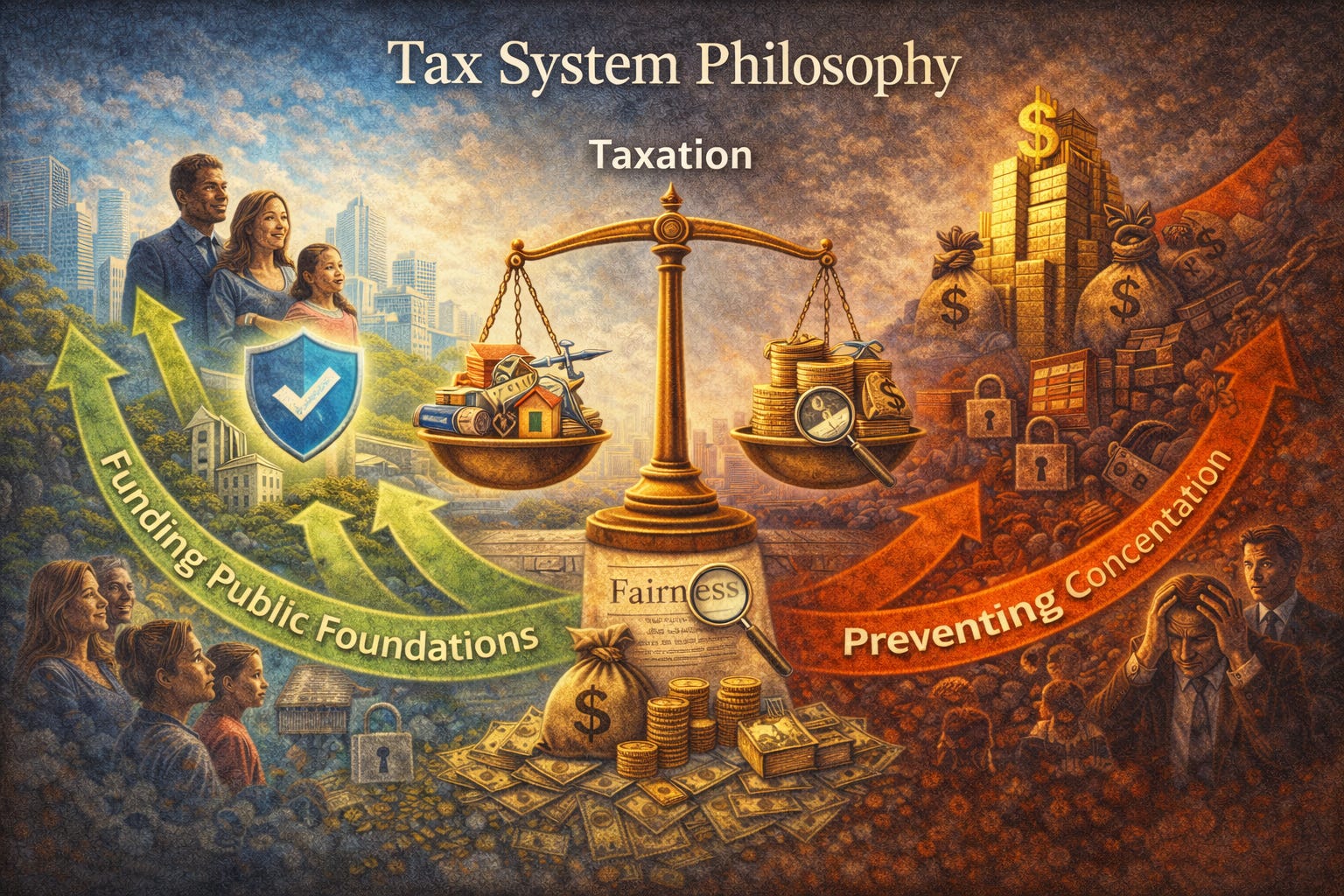
Tax systems are one of the primary mechanisms through which societies organize shared responsibility for the conditions that make civic life possible. Roads, public health systems, courts, infrastructure, education, emergency services, and the basic administrative functions of government all require sustained resources. Taxation is the method through which those resources are collectively maintained.
The purpose of taxation within a constitutional framework is not punishment, extraction, or social engineering. Its purpose is maintenance. Tax systems exist to sustain the shared foundations that allow economic and civic life to function.
Markets depend upon public infrastructure. Property rights require courts and legal systems. Trade requires transportation networks, regulatory structures, and public stability. Even the most private forms of economic activity operate within conditions created and maintained through collective investment.
Tax systems therefore reflect an exchange. Individuals and organizations benefit from the stability, infrastructure, and protections created by society. In return, they contribute a portion of their resources to sustain those shared systems.
A well-designed tax system balances several goals. It must generate sufficient resources to maintain public institutions and infrastructure. It must distribute responsibility in ways perceived as legitimate and understandable. It must operate transparently so that citizens can see how public resources are collected and used.
At the same time, taxation must avoid distorting economic activity unnecessarily. Systems that are excessively complex, opaque, or unpredictable undermine public confidence and create incentives for avoidance rather than participation.
One of the central challenges in tax policy is the relationship between economic power and civic responsibility. As wealth accumulates within economic systems, the capacity of individuals or institutions to benefit from public infrastructure often grows as well. Larger economic actors depend heavily on stable financial systems, transportation networks, legal enforcement, educated workforces, and public stability.
For this reason, many democratic systems recognize that tax responsibility may increase alongside economic capacity. This principle does not exist to penalize success but to reflect the differing levels of benefit and systemic reliance present across economic scales.
Tax systems also serve a stabilizing function within economic life. By contributing to public investment in infrastructure, education, health, and social stability, taxation supports the conditions under which markets can continue operating productively over long periods.
When tax systems are perceived as fair, transparent, and proportionate, they strengthen civic legitimacy. Citizens are more willing to participate in collective systems when they believe contributions are distributed responsibly and used to maintain shared foundations.
Conversely, when tax systems appear captured by narrow interests, overly complex, or detached from public needs, trust declines. People may begin to view taxation not as civic maintenance but as extraction, weakening the legitimacy of institutions responsible for administering it.
A constitutional approach to taxation therefore focuses on principles rather than temporary policy choices. The goal is to establish clear expectations that taxation will remain oriented toward sustaining shared infrastructure, maintaining democratic institutions, and supporting the material conditions necessary for participation in civic life.
Tax systems must evolve alongside economic realities, but their purpose remains consistent. They exist to maintain the foundations upon which both economic activity and democratic governance depend.
When taxation fulfills this role transparently and proportionately, it strengthens the systems that allow societies to function across generations.