

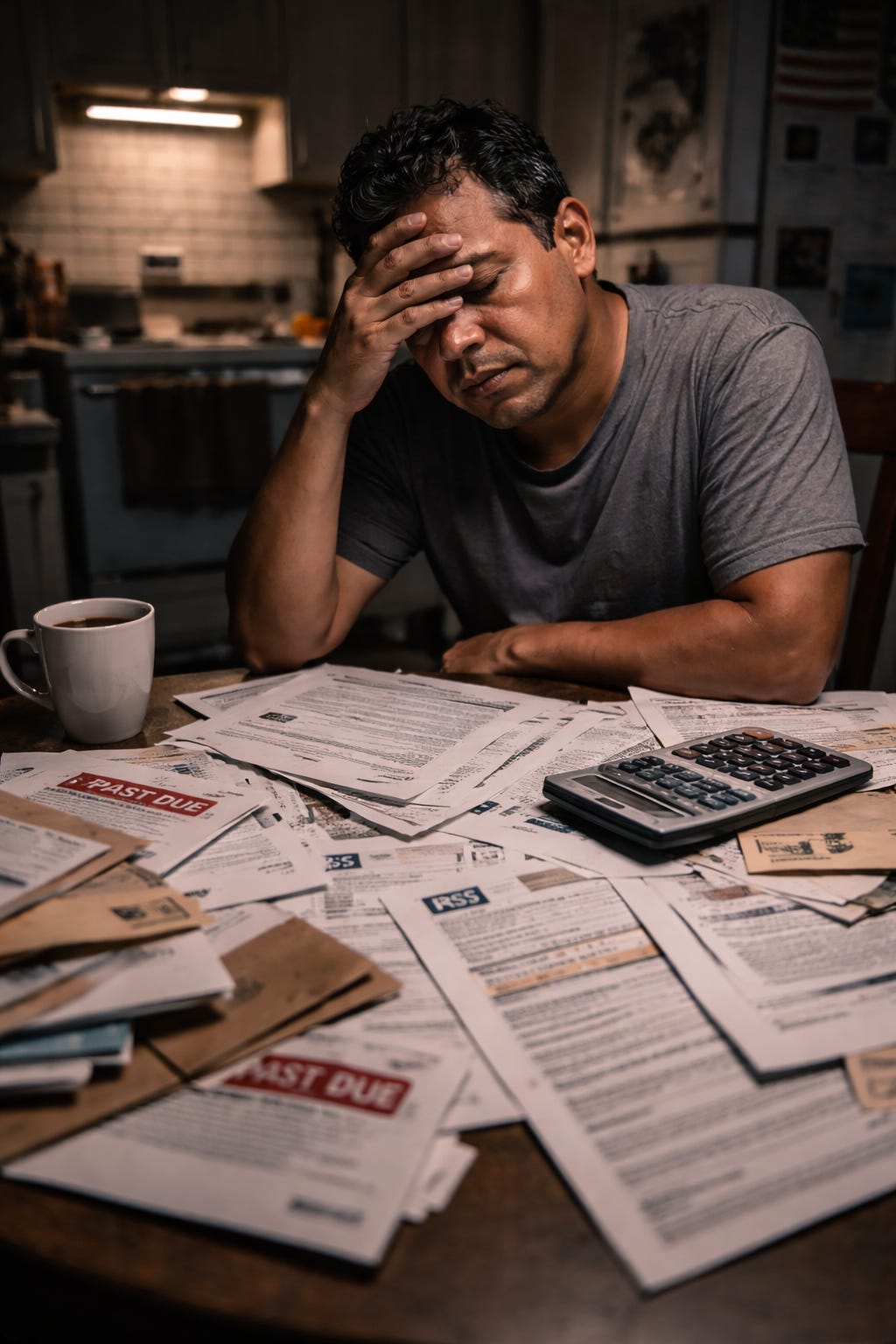
Taxation is supposed to mean something.
It is supposed to be the mechanism by which a society pools responsibility, maintains public systems, and returns stability to the people who fund it. Roads, schools, infrastructure, safety, care, continuity, civic life. That is the bargain. People contribute because there is a shared structure worth maintaining, and because the burden is supposed to be distributed in a way that reflects both responsibility and return.
That is not what this feels like anymore.
In the United States, ordinary people are taxed again and again and again, while the social return grows thinner, the private burden grows heavier, and those with the most money, power, and structural advantage keep finding new ways to pay less, shield more, and offload the cost downward.
That is the failure.
Tax the wages. Tax the spending. Tax the property. Tax the registration. Tax the sale. Tax the death. Tax the estate. Tax the transaction. Tax the basic act of moving through life.
Every stage of existence seems to come with its own point of extraction, while the public is left asking the obvious question. What exactly are we maintaining with all this money, and why does so much of the burden keep landing on the people least able to absorb it.
That is what makes the whole thing feel rotten. Most people understand the idea of taxation. There is a responsibility to the structure that protects us. That part is not hard.
What becomes obscene is repeated extraction without proportionate public return. What becomes obscene is watching workers fund a society they increasingly have to privately rebuild piece by piece because the public floor is no longer sturdy enough to carry ordinary life.
That is the racket.
People pay taxes as though they are participating in a functioning social contract. Then they pay again for healthcare. Again for childcare. Again for safe housing. Again for education. Again for transportation. Again for retirement insecurity. Again for every private patch required to replace the public stability that was supposed to be there in the first place.
At some point, taxation stops reading like shared maintenance and starts reading like an endless tollbooth attached to a declining society. And still the burden keeps shifting downward.
Workers get taxed on labor. Families get taxed on spending. Households get taxed simply for holding property in a place they already paid for. Retirees continue to face tax burdens long after the labor that built their lives is done, as though contribution never ends and release never arrives.
Meanwhile, the wealthy and the corporate class keep collecting exemptions, loopholes, shelters, credits, influence, carve-outs, and legislated escape hatches that turn the public burden into someone else’s problem.
That is not a shared system. That is extraction arranged by class.
And the insult is not only economic. It is moral. Ordinary people are told to be responsible, patriotic, realistic, and grateful while paying at every turn into a structure that increasingly does not show up for them in return.
The people keep picking up more and more of the burden, and then get blamed when they can no longer carry it. The worker is told to tighten the belt. The household is told to budget better. The struggling are told everyone has to do their part. But somehow “everyone” keeps meaning the people whose money is easiest to reach and whose leverage is weakest.
That is not fairness. That is a system teaching the public that obligation flows one way. And it does not have to be this way. The country could choose a cleaner tax structure. A simpler one. A fairer one. A structure where ordinary people are not hit at every stage of life while elite wealth and corporate gain move through cleaner channels.
A flat state structure. A flat federal structure. Higher real obligation at the top. Fewer escape routes for the people and institutions who extract most from the country while returning the least to it. The issue is not whether money should be pooled. The issue is who keeps being made to carry the pool, and who keeps being allowed to stand beside it with dry hands.
That is the truth buried under all the rhetoric.
This is not just about disliking taxes. It is about the collapse of public trust when taxation no longer feels tethered to public return. If the schools are strained, the roads are failing, the infrastructure is fraying, the care systems are unstable, the safety net is degrading, and the basic conditions of life keep getting more expensive to maintain privately, then people are not wrong to ask what exactly their repeated extraction is buying.
That question matters.
Because a society cannot keep taxing ordinary people as though it is maintaining a broad public good while actually delivering thinning services, rising private burdens, and a tax structure full of engineered exits for the people with the most. At that point, the system stops functioning like contribution and starts functioning like churn.
That is the Failure Point.
The failure is not that taxes exist. The failure is that ordinary people are taxed repeatedly inside a structure that returns too little, asks too much, and still gives the wealthy and the corporate class more room to escape their fair share. The public keeps paying into the system. The system keeps asking for more. And the people who already have the most keep getting one more legislated break to hollow it out further.
That is not civic responsibility. That is public extraction without public return.