

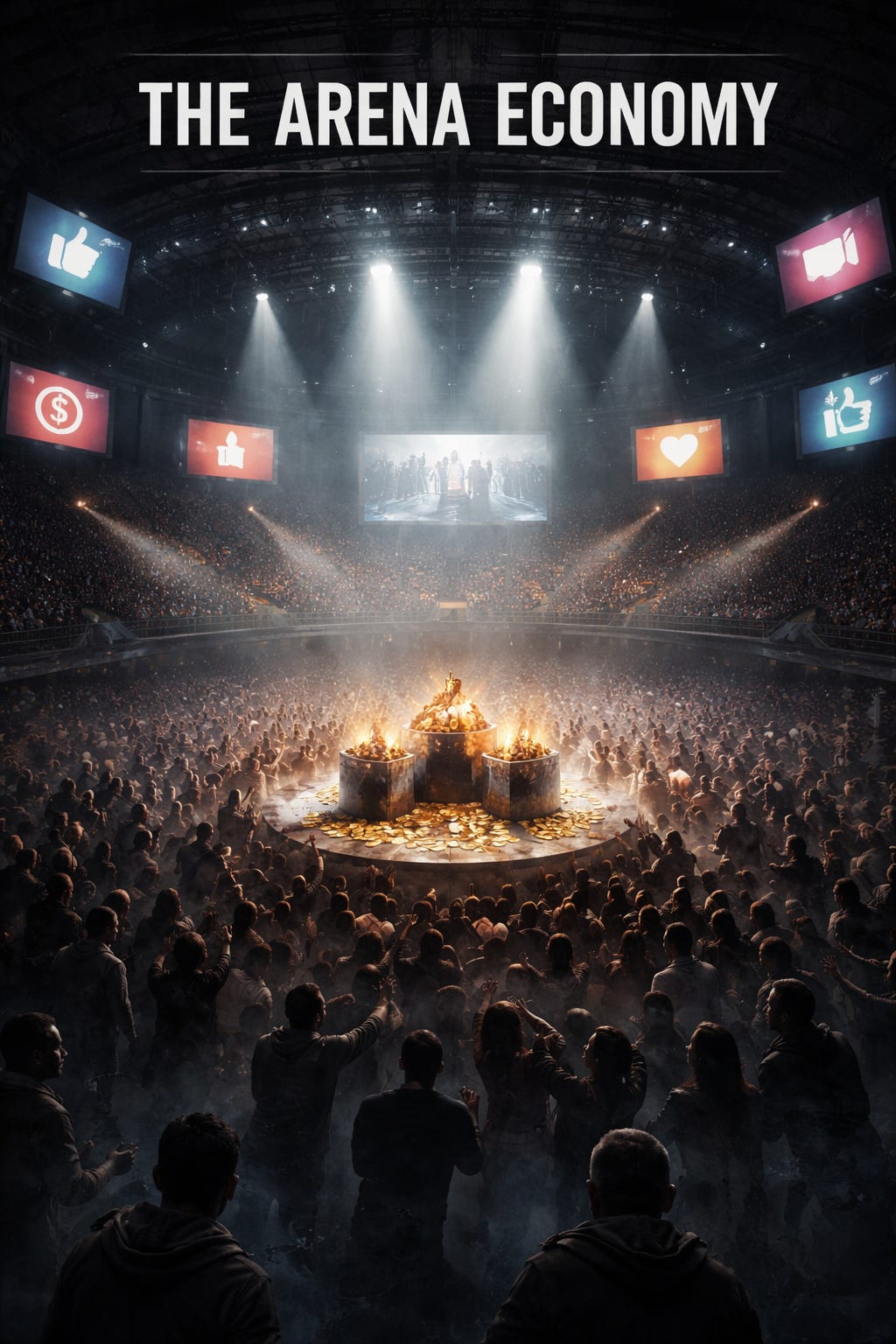
Are we going to keep playing a game rigged against us, or are we going to change the rules?
The economy is narrowing. Stable work is harder to find, harder to keep, and less able to support a life with dignity. In its place, we were sold flexibility, hustle, personal brands, side income, creator freedom, and endless digital possibility. But a market flooded with people chasing visibility is not freedom. It is overflow. It is what happens when too many people are pushed toward too few viable ways to survive.
So we built an arena.
We scattered a few rewards inside it, made the payouts uneven, hid most of the exits, and turned people loose. Then we told them to be innovative, authentic, vulnerable, consistent, and grateful while they searched.
A few find enough to live on. Most do not. Most keep moving. They adjust. They sharpen hooks. They offer more access, more personality, more emotion, more of themselves, because in a crowded market where attention sits closer to money than dignity does, response starts to look like survival.
That is not a cultural failure. That is an economic one.
The creator economy was never going to sustain the number of people being pushed into it. It was never a serious replacement for a shrinking job market. It was a pressure valve dressed up as opportunity, a place to redirect strain while calling it empowerment.
We are watching economic failure get repackaged as personal opportunity. We are watching labor collapse turn into self-exposure for scraps. We are watching people asked to survive by monetizing identity, intimacy, distress, consistency, and presence in markets that cannot pay most of them enough to live. Then we blame the people inside the arena for acting like the arena trained them to act.
That is the part people keep refusing to say plainly. This is not just about technology, culture, vanity, or bad taste. It is about the conditions people are adapting to.
When decent jobs shrink, people do not stop needing rent money. When wages fail, people do not stop needing groceries. When traditional work no longer offers enough stability or future, people go where there is still movement. Right now, much of that movement is online.
But online movement is not material security. Visibility is not income. Followers are not stability. Engagement is not rent, health care, or a future. A crowded digital marketplace cannot carry the weight of a labor market that no longer works for millions of people.
Still, people are sent there anyway. Make content. Build your brand. Find your niche. Be relatable. Be disciplined. Be available. Be personal, but not too personal. Be vulnerable, but in a useful way. Be human, but marketable. Be consistent, because if you disappear, so does the little bit of attention you fought to gather.
This is not freedom in any meaningful sense. It is behavioral adaptation inside scarcity. And scarcity changes people.
It changes what they reveal, what they hide, what they sharpen, and what they learn to perform. In an environment where response is inconsistent, people start tracking what gets reaction, sympathy, praise, circulation, and what gets ignored. Over time, expression bends toward reward. Not always consciously, and not always cynically, but predictably. That is how a system trains behavior without ever admitting it is doing so.
The result is a culture where emotion becomes labor, intimacy becomes product, and access becomes currency. People are not only creating things. More and more, they are offering themselves. Their grief, their personalities, their wounds, their opinions, their availability, their private lives. The line between person and product gets thinner every year.
Then the same culture that built those conditions turns around and mocks the outcome. It sneers at oversharing, desperation, attention-seeking, soft manipulation, performance, and emotional spectacle, as if those behaviors appeared from nowhere. As if they were detached from economics. As if a society can strip away stable paths to survival, funnel people into crowded digital markets, reward reaction over substance, and expect no behavioral consequences.
Of course there are consequences.
A system built on intermittent reward does not produce stability. It produces chasing. It produces repetition, escalation, overexposure, and dependence on the next response. A few pieces land. Most do not. A few people break through. Most do not. But the possibility remains visible enough to keep the arena full.
That is the trick. Not a hidden villain, and not a secret conspiracy. Just a structure that keeps enough hope in circulation to maintain participation, while withholding enough stability to keep everyone competing.
This is why the conversation has to move past personal branding and digital entrepreneurship fantasies. Those are not solutions at scale. They are coping mechanisms inside a distorted economy. They may work for some. They will never work for most. Any system that depends on most people failing so a few can survive is not an opportunity model. It is an extraction model.
And it is shaping more than income. It is shaping human behavior, relationships, self-concept, and attention itself.
People raised in media-rich environments learned early that visibility has value. Digital life did not invent that lesson. It intensified it, refined it, and tied it to economic survival. Now adulthood arrives with a brutal message. If stable work will not hold you, attention might. If skill alone will not carry you, self-presentation might. If substance is not enough, try access. If access is not enough, try emotion. Keep going. Keep offering. Keep adapting. Keep performing.
That is not a dignified social contract. That is a rigged arena.
So the question is not whether people online are becoming too performative, too emotional, too revealing, or too desperate. The question is what kind of economy keeps producing those conditions, then shames people for surviving inside them.
If we want a healthier culture, we are going to need a healthier material foundation. Better work. Better wages. More security. More paths to stability that do not require turning the self into a storefront. We are going to need to stop pretending that platform survival is a substitute for economic design.
Because this is the truth beneath all of it. We did not build a future people could stand on. We built an arena, hid a few rewards inside it, and called the scramble opportunity.
So again, are we going to keep playing a game rigged against us, or are we going to change the rules?
Great work!