

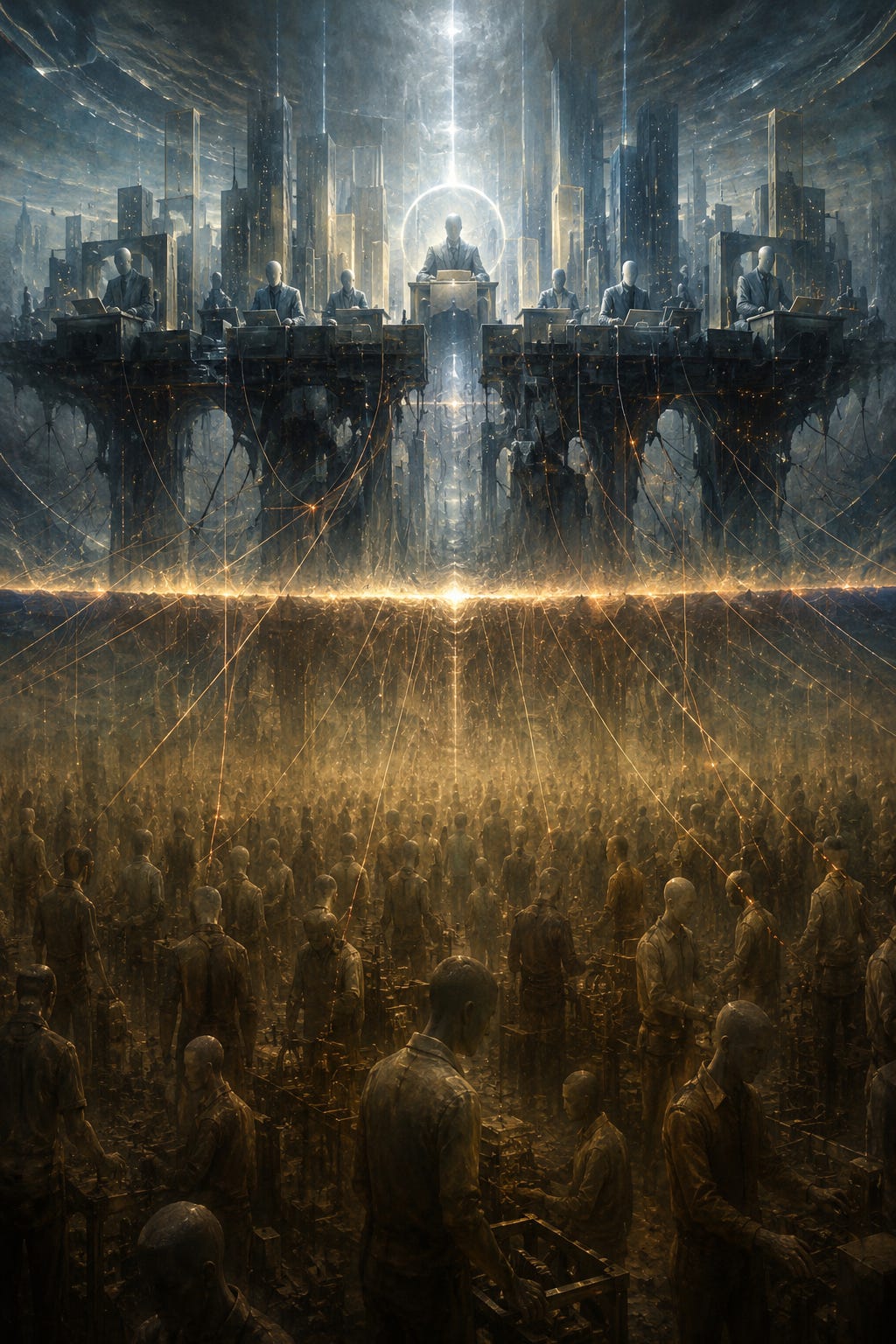
Most societies do not collapse because people suddenly become violent. They collapse because too many people eventually conclude that the cost of obedience has become higher than the cost of resistance.
That is the distinction between a tipping point and a boiling point. A tipping point is political. A boiling point is biological.
Human beings can endure extraordinary hardship when they believe the suffering is temporary, shared, or meaningful. They can survive poverty, rationing, war, corruption, and instability for astonishing lengths of time if they still believe there is a path forward.
But history shows something changes when deprivation becomes visibly engineered. The French Revolution was not caused by philosophy alone. Enlightenment ideals provided language, but bread prices provided ignition.
The monarchy protected aristocratic excess while the public starved beneath taxation designed to shield wealth and extract from labor. The issue was not merely hunger. It was the realization that the suffering was structured.
The Russian Revolution followed the same pattern. Millions were sacrificed in war while those at home faced shortages, inflation, and collapse. The Romanovs were not seen as guardians of the nation anymore. They were seen as parasites feeding on it.
Political scientists call this relative deprivation.
People often do not revolt at their absolute weakest. They revolt when the contrast becomes unbearable. When they can see the distance between sacrifice and reward. When they understand the system is not malfunctioning, but functioning exactly as designed.
That realization creates the moral inflection point. Not, “We have nothing.” But, “They took everything while demanding obedience.” This is where social contracts begin to fail.
Every functioning society depends on a basic agreement. Work that leads somewhere, sacrifice that means something, rules applied equally up and down, and survival is not a luxury product.
Once enough people stop believing those things, order begins decaying from within. Because law without legitimacy is eventually experienced as organized coercion.
Slavery itself proved that legality and morality are not the same thing. It was legal. It was regulated. It was state protected. The law defended the property rights of the owner while denying the humanity of the enslaved.
Legality did not make it ethical. It merely made the extraction enforceable. Modern systems repeat this pattern in cleaner clothing.
When people work full time and cannot afford housing, healthcare, or stability while wealth concentrates upward at historic levels, the public begins interpreting the system differently. Not as a society. As an extraction machine.
That is the modern crisis. Not simply inflation. Not simply debt. Not simply partisan politics. Extraction.
Housing becomes extraction when institutional investors consume residential property while younger generations are locked permanently out of ownership.
Healthcare becomes extraction when illness becomes a profitable recurring revenue model instead of a human obligation.
Labor becomes extraction when productivity rises, profits rise, executive compensation rises, and the worker still falls behind.
The result is not merely economic pressure. It is humiliation. And humiliation is historically combustible. This is why visible inequality matters more than statistics alone. A population can tolerate hardship far longer than contempt.
The billionaire telling exhausted workers to “hustle harder.” The corporation posting record profits during mass layoffs. The financial elite purchasing bunkers and fortified compounds while publicly insisting the economy is healthy. The constant demand for sacrifice from people who own everything and risk nothing.
These are not isolated optics failures. They are signals. Signals that the social contract has become asymmetrical.
Some within the elite class appear to understand this, now. Some advocate wealth taxes, redistribution, or structural reform. This does not necessarily come from a moral awakening, but from pattern recognition.
History is full of ruling classes that believed security forces, legal systems, and accumulated wealth could permanently suppress public collapse. Until the police could no longer afford food. Until the soldiers stopped believing in the regime. Until the public stopped recognizing the legitimacy of the rules entirely.
That is the true danger point for any society. Not protest. Not criticism. Not even unrest. The danger arrives when enough people conclude there is no longer a future available within the rules they were told to follow.
Because once survival, dignity, and hope disappear simultaneously, fear loses its power. And when fear stops functioning, systems built primarily on extraction begin discovering how fragile they really are.
The original version of Monopoly was designed as a warning, not a celebration. Its purpose was to demonstrate that systems based entirely on accumulation inevitably end with one player owning everything while everyone else is trapped in debt or exclusion.
The game eventually stops being playable. Real societies are no different. People will tolerate unfairness for a very long time if they believe tomorrow can improve. But once enough people realize the path itself has been intentionally closed, the issue is no longer economic management. It becomes legitimacy.
That is the boiling point.