

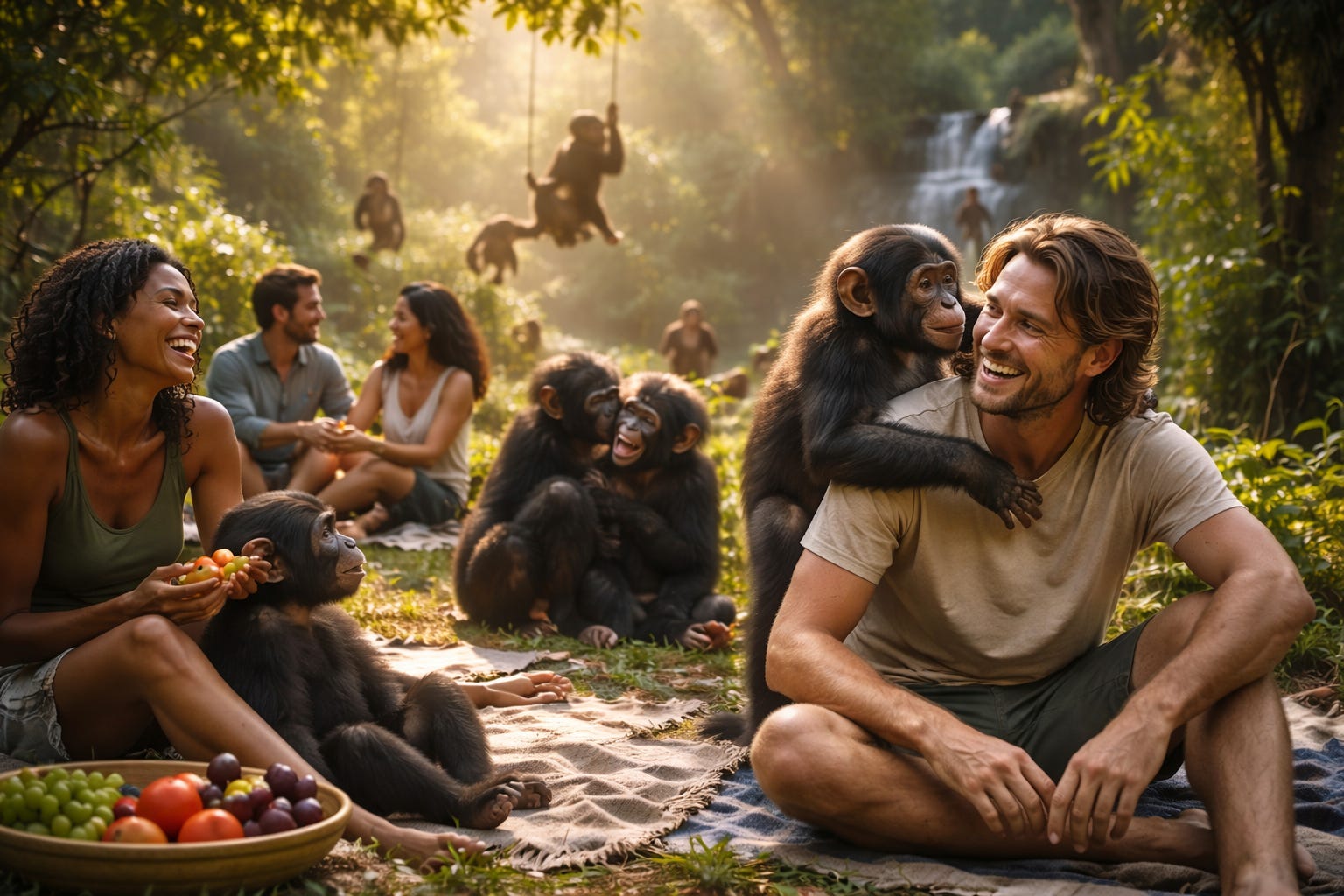
If fear shaped much of human behavior, then safety quietly reveals something else.
When threat is low and basic needs are met, humans change. We soften. We share. We cooperate. We listen. We become more curious than defensive. This is not idealism. It is observable.
Communities with stability have less violence. Children raised in secure environments show more empathy and emotional regulation. Trauma healing reduces aggression. Poverty reduction lowers crime.
Same species. Different conditions. Which raises a powerful thought. What if much of what we call “human nature” is not fixed at all? What if it is simply the shape we take under pressure? In nature, there are primates who evolved along a different solution to conflict.
Instead of dominance and aggression, they regulate tension through connection. Instead of hierarchy through fear, they organize through cooperation. Instead of reacting to stress with violence, they dissolve it socially.
Their communities are calmer. Outsiders are tolerated more easily. Resources are shared. Vulnerable members are protected.
Not because they are smarter. Not because they are weaker. Because their environments rewarded cooperation over threat. They evolved around safety. And what emerges is striking.
Less violence. More stability. Stronger social bonds. Lower stress. Not chaos. Not stagnation. Thriving.
It forces an uncomfortable question. How much of what we attribute to greed, cruelty, and division is actually fear wearing a personality? How much of our aggression is not who we are, but how we were shaped? When humans feel secure, we don’t suddenly become lazy or reckless.
We become more generous. More creative. More trusting. More future oriented. We invest in relationships. We solve problems collaboratively. We think long term instead of reacting short term.
Safety expands the mind. Fear narrows it. Scarcity shrinks our world into survival. Security opens it into possibility.
This is why crisis produces authoritarianism. Why instability fuels extremism. Why threat makes people rigid and tribal. And it is why peace and prosperity allow art, science, cooperation, and innovation to flourish.
Not because people suddenly became better. Because their nervous systems finally had room to breathe. The story we often tell is that humans must be controlled to behave.
But history keeps showing something else. Humans become dangerous when they feel unsafe. They become collaborative when they feel secure. Which quietly flips many of our assumptions upside down.
Maybe we don’t need harsher systems to keep people in line. Maybe we need safer systems to let people be who they already are beneath fear. What would a society look like if it was designed around emotional safety as seriously as physical infrastructure?
If community care mattered as much as economic growth? If conflict was met first with regulation and mediation instead of punishment? If children grew up buffered by stable relationships instead of constant stress?
Would we still be so divided? So reactive? So willing to harm one another? Or would we begin to look less like a species fighting its way through the jungle and more like one finally learning how to live together?
This does not mean conflict disappears. It means conflict no longer has to turn into destruction. It does not mean instincts vanish. It means awareness and safety guide them instead of fear.
Perhaps the future of humanity is not becoming tougher. Perhaps it is becoming secure enough to be cooperative. Not naïve. Not passive. Just regulated. Just connected. Just free from constant survival mode.
If fear built the world we live in, then safety may be what finally transforms it. So the Mirror might ask us something simple but profound. Are humans meant to be this divided and violent?
Or have we simply never built a world that lets us become what we look like when we feel safe?