

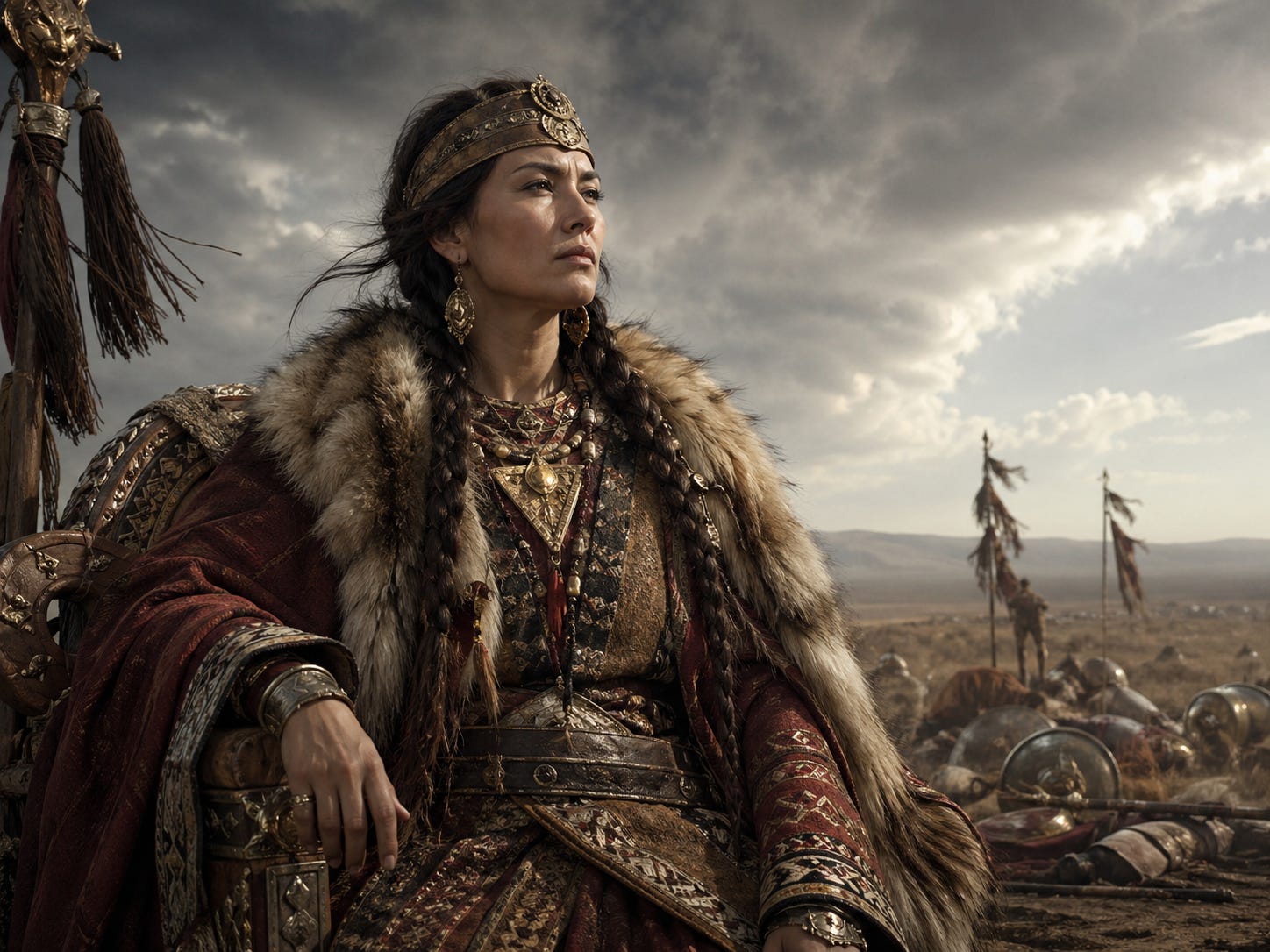
By the time Tomyris enters the story, the pattern has shifted again. We are no longer looking at female authority preserved through priesthood, dynastic continuity, or the unstable edge between rule and regency. With Tomyris, the archive gives us something harder, sharper, and less easily domesticated.
A woman facing empire in open refusal. Tomyris is remembered as the queen of the Massagetae, a people living east of the Caspian. Her name comes down to us most famously through Herodotus.
That matters immediately, because it means the story reaches us through a Greek historian writing about the defeat of Cyrus the Great, founder of the Persian Empire. The record is not neutral. It is already shaped by distance, interpretation, narrative purpose, and the ancient appetite for turning power into lesson.
But even with that filter in place, one fact remains difficult to smooth away. Tomyris stands in the record as a woman who did not merely inherit position. She confronted imperial expansion and refused submission. That is what makes her important.
Tomyris is not remembered because she fit comfortably into the expected forms of female authority. She is not a priestess, not a regent, not a dynastic placeholder, not a woman whose power is easiest to explain through the men around her.
She appears instead as a ruler whose authority becomes visible in war, defense, and political refusal. That alone changes the mechanism. And it changes the discomfort.
Female rule can sometimes be tolerated when it looks maternal, stabilizing, sacred, or transitional. Tomyris is remembered in a different posture. She is remembered as a woman who answered empire with force. A woman who did not legitimize male conquest by absorbing it, softening it, or negotiating herself downward into symbolic safety.
Tomyris is a woman who stood in the path of imperial appetite. She became most legible to history when that appetite failed. That is why her story survives.
According to the most famous version, Cyrus sought to draw her into submission. First through proposal, then through strategy, and then through deceit. When conflict followed, Tomyris ultimately defeated him, and later tradition fixes on the image of her confronting the dead conqueror with the blood he had sought.
Whether every detail of that scene is literal matters less than what the story preserves beneath it. A woman ruler became the instrument through which one of the ancient world’s greatest imperial figures met his limit. That is not a small memory.
And still, the way Tomyris survives tells us something about the archive. Her authority is preserved not as ordinary governance, not as administration, not as the daily substance of rule, but as dramatic resistance. She becomes visible at the point of collision.
That is another old pattern. Women are often easiest for history to keep when they appear in heightened form, at moments of rupture, extremity, or symbolic reversal. The ordinary fact of a woman ruling may draw less attention than the spectacle of a woman defying a great man.
That does not make Tomyris less real. It makes the record more revealing. What we receive is not a calm political profile of a ruler among rulers. We receive a woman sharpened by conflict, almost forced into mythic proportion by the scale of the man and empire placed opposite her.
The result is that Tomyris can be remembered as fierce while still being kept at a certain distance from ordinary legitimacy. She is honored, but through exception. Preserved, but through confrontation. Recognized, but not made comfortably normal.
That is the trap again, in another form. A woman who rules successfully in continuity may be narrowed into dynasty or ritual. A woman whose authority cannot be denied may be mythologized into excess. A woman who defeats empire may be preserved as spectacle.
In each case, the record keeps her, but rarely on the same plain where male authority is allowed to remain matter-of-fact. Tomyris matters because she tears through that comfort.
She reminds us that women were not only present near power or folded into systems already built by men. They could also stand in direct opposition to imperial ambition and force it to reckon with them.
Her story does not ask whether a woman could be equal to power. It asks what happens when power meets a woman who refuses to yield. That answer, in her case, was defeat.
So Tomyris should not be reduced to a colorful ancient anecdote about a queen and a dead king. She should be read as a woman whose authority became undeniable at the exact point empire expected to pass through her.
She stands in the series as another mechanism exposed. Not denial through erasure. Not narrowing through office. Not containment through myth alone. Recognition through conflict, and distance through spectacle.
She was remembered because conquest failed. That is one of the oldest ways history has allowed some women to remain.
What stayed with me was the idea that history often allows certain women to remain visible only at the moment of rupture.
Not through the ordinary continuity granted to male power, but through collision, resistance, spectacle.
The piece keeps returning to that mechanism with real clarity, and Tomyris begins to feel less like an isolated figure and more like a pressure point inside the archive itself.