

I was taught that my rights ended at the tip of my nose.
That freedom required awareness. Awareness of where my body ended and someone else’s began. That restraint was not a loss of liberty. Simply part and parcel of living alongside others.
I do not hear that language much anymore.
What I notice instead is how responsibility is distributed unevenly. How restraint, compliance, and consequence are demanded from some while flexibility and exemption are granted to others. The imbalance is not always loud. Most of the time, it is procedural
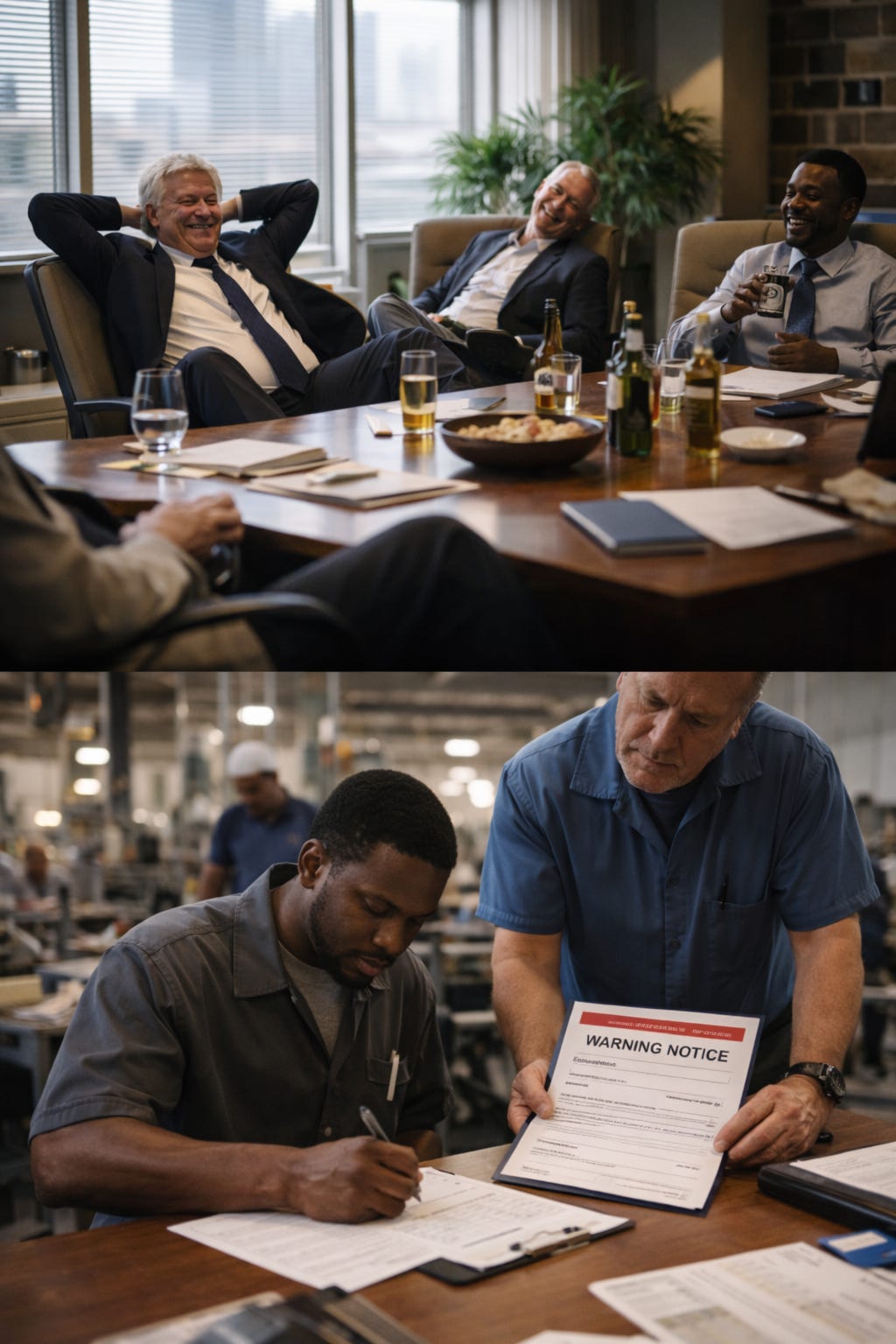
At work, responsibility often exceeds authority. People are held accountable for outcomes they did not design. They are measured against standards they did not participate in creating. Expected to adapt without having the room to decide.
Control moved upward.
Consequences move downward.
In systems meant to provide support, the imbalance sharpens. Assistance requires proof, documentation, and compliance. Often without meeting the actual need it claims to address. Dignity becomes conditional. Help exists, but only if it can be repeatedly earned.
Unemployment reveals a quieter version of the same pattern. People pay into it directly. They are told its to safeguard moments of economic disruption or job loss.
Yet access narrows precisely when need increases. What was framed as insurance begins functioning as if it were charity. It becomes revocable, limited, and treated as if it was not already earned and paid for.
During the pandemic, certain jobs were declared essential. The word carried weight. It implied necessity, reliance, and importance. For a time, that language held.
When the crisis passed it was forgotten. Yet, the functions of the roles did not change. Wages stayed low. Conditions stayed unchanged. The labor continued while the obligation dissolved.
I felt the imbalance most clearly in an ordinary moment. Leaving a store I joined the line to have my receipt checked against the items I was leaving with. When it was my turn the employee waved me through and stated I did not fit the profile. I stopped and asked him to repeat that. He did. I stepped aside and told those behind me to go ahead and exit as I was going to be speaking with the employee for a minute.
It was not the interaction itself that stayed with me. It was the sorting of humans with no discernment beyond “look”. Done casually, with explanation, and enforced by someone paid too little to care about their actions or a judgement they did not create but had to make. Some people were scrutinized. Others exempt. The responsibility was outsourced and the burden was carried unevenly.
None of these moments are extreme on their own. That is what makes them easy to accept. It must be a one-off. Forgive, forget, and move on. Together they form a pattern. Obligation without authority. Consequence without control. Restraint demanded selectively.
I was taught that freedom came with limits. What I am less sure of now is who those limits apply to. And who gets to live beyond them.