

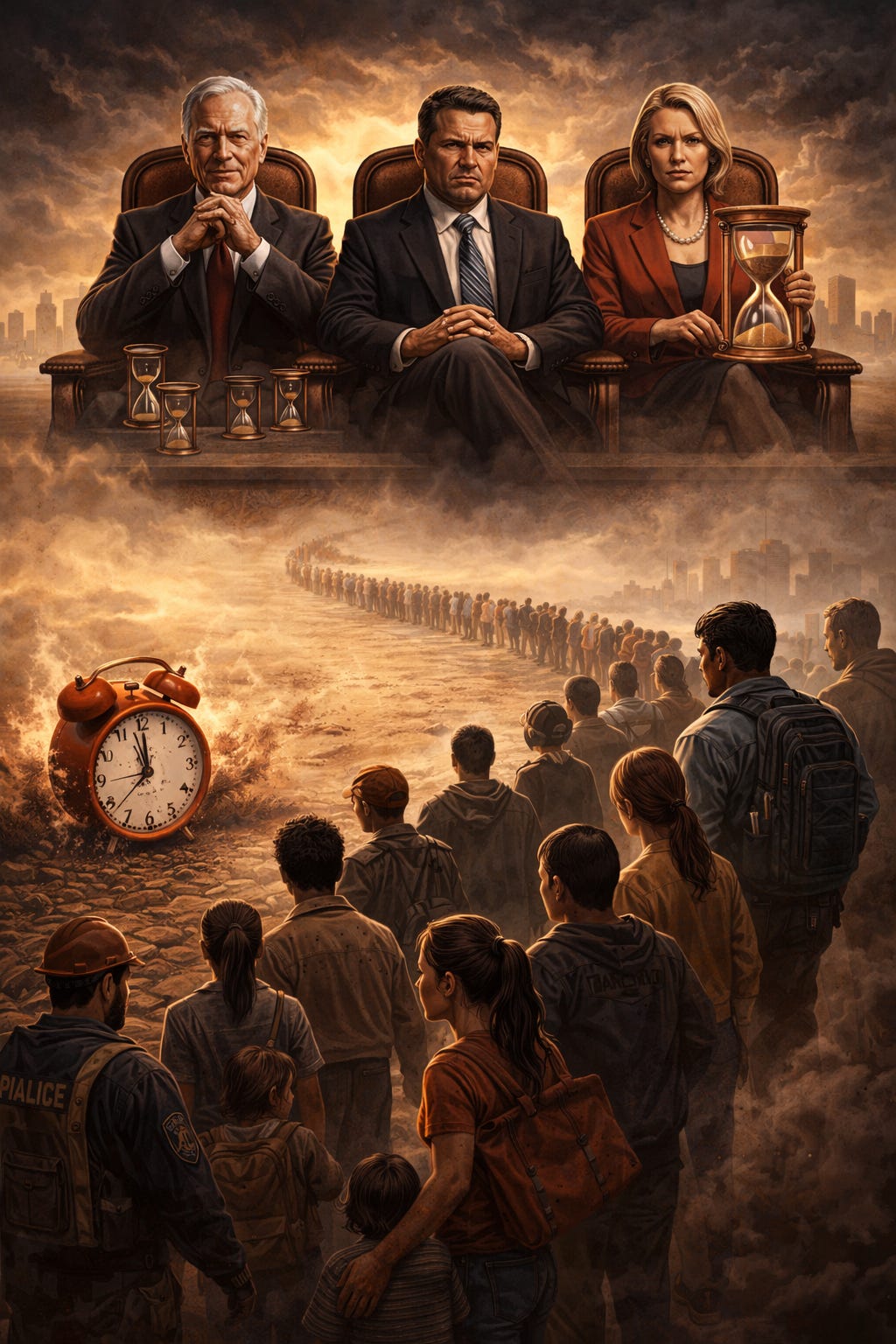
There is a dangerous fiction at the center of public life: that inaction is neutral.
It is not.
Waiting is not a pause between decisions. It is a decision in itself, with predictable consequences. When institutions fail, when power consolidates, and when harm becomes visible, choosing to wait is not restraint. It is participation.
We already know what is happening. Economic concentration is accelerating. Executive authority is expanding beyond lawful bounds. Public safeguards are being eroded while risk is transferred downward. These are not disputed facts. They are observable conditions.
What remains contested is responsibility.
Many people behave as though awareness alone absolves them. As though noticing decline without responding to it is a form of dissent. It is not. Awareness without action changes nothing. It merely delays accountability.
History does not turn on surprise. It turns on tolerance.
Major breakdowns do not occur because outcomes are unpredictable. They occur because known trajectories are allowed to continue until reversal becomes costly or impossible. By the time consequences feel unavoidable, the decisions that made them inevitable are long past.
Waiting feels reasonable because it distributes blame. No single person causes the outcome. No single moment demands response. Harm accumulates incrementally, normalized by repetition and exhaustion. This is how responsibility dissolves.
Institutions depend on this passivity. Concentrated power does not require universal approval. It requires only enough compliance to function. Silence fills the gaps where resistance should be.
Waiting is often defended as prudence. People tell themselves they need more information, more consensus, or better timing. In reality, the information is sufficient. The patterns are clear. What is missing is willingness to absorb discomfort before crisis forces it.
The cost of waiting is not abstract. It is paid in narrowed choices. Each delay reduces the range of available responses. Each deferred correction increases the scale of eventual intervention required. Problems that could have been addressed through reform metastasize into emergencies that demand force.
By the time action feels unavoidable, humane options are gone. Waiting also creates moral distance. It allows people to believe that harm is unfortunate rather than produced. That outcomes are tragic rather than chosen. This framing is comforting, and it is false.
No system sustains itself without participation. No concentration of power persists without tolerance. No erosion of rights occurs without repeated permission.
Waiting is permission.
This does not require dramatic gestures or heroic acts. It requires refusing to pretend that time is neutral. It requires recognizing that systems move continuously, whether or not anyone intervenes.
Those who benefit from delay understand this well. Delay protects incumbents. Delay preserves advantage. Delay allows damage to be framed as inevitability rather than consequence. That is why waiting is encouraged. It is politically useful.
At some point, the consequences of inaction become impossible to ignore. When that moment arrives, people often ask how things went so far, so fast. The answer is simple. They did not go fast at all. They moved steadily, while most people waited.
Waiting is not patience. It is surrender dressed as caution.
The future is not decided by those who predict collapse. It is decided by those who treat preventable outcomes as acceptable risks. It is decided by people who see what is happening and choose not to interrupt it.
There will always be reasons to wait. There will always be arguments for delay. There will always be assurances that intervention is premature or disruptive. Those assurances have a consistent purpose. They protect the present distribution of power.
The question is not whether consequences are coming. The question is whether they will arrive by design or by default.
Waiting answers that question.