

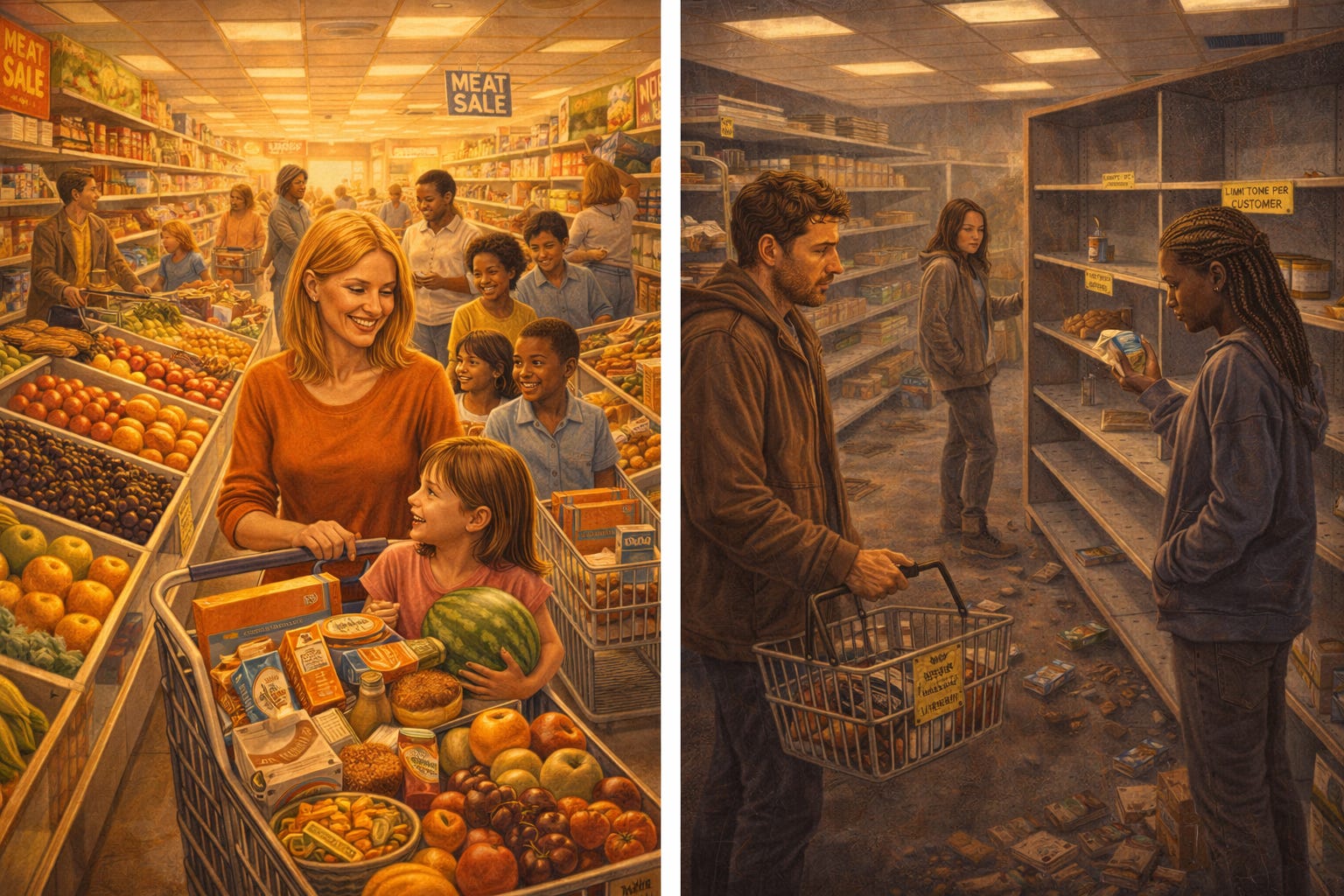
When a town has stable work, it does something subtle.
It reduces the daily panic. It creates room for people to be more than their survival. It does not eliminate hardship. Nothing does. But it changes the texture of life.
That texture is easy to miss when you are living inside it. You notice it most clearly after it is gone.
Stable work does not mean everyone thrives. It means fewer people are constantly bracing. It means decisions are made with a little air in the lungs. It means parents are not calculating catastrophe every month. It means kids grow up assuming continuity instead of collapse.
Stability does not guarantee happiness. It makes humanity sustainable.
For a long time, many American towns had just enough of it. Not abundance. Not ease. Enough. Enough for people to plan. Enough for institutions to matter. Enough for community to be the default rather than the reward for exceptional luck.
We were closer than we like to admit.
When work is stable, people can afford to be patient with each other. Disagreements do not immediately feel existential. A job loss is a problem, not a free fall. Illness is frightening, but not instantly ruinous.
The future is uncertain, but not hostile. That buffer is not luxury. It is infrastructure. When it disappears, everything tightens.
People become sharper, faster to judge, quicker to retreat. Politics turns punitive. Identity hardens. Community fragments into transactions. Every interaction carries an undertone of risk.
This is not because people became worse. It is because the margin vanished.
The loss of stable work did not just hollow out economies. It hollowed out nervous systems. It trained people to live on edge and call it normal. It made survival the primary occupation of daily life.
In that environment, long-term thinking feels irresponsible. Care feels expensive. Solidarity feels naïve. Trust feels dangerous.
We explain this away with abstractions. Globalization. Efficiency. Innovation. Market forces. But beneath the language is a simpler truth. We dismantled the conditions that allowed ordinary people to remain whole.
And we told ourselves it was progress. The tragedy is not that perfection was lost. It is that viability was.
We were close to a society where most people did not wake up already behind. Where the future was something you approached, not something you defended against. Where community did not require heroism.
That proximity is what makes the loss hurt. Not because the past was perfect, but because it showed what was possible.
This is why nostalgia keeps resurfacing, even among people who know better. It is not longing for a decade or a place. It is grief for a level of stability that made decency easier.
The answer is not to go back. The answer is to be honest about what we dismantled.
Stable work was never just about wages. It was about tempo. About predictability. About giving people enough footing to remain human under pressure.
We told ourselves we could remove that footing and replace it with hustle, flexibility, and personal resilience. We were wrong.
Resilience without stability is just endurance.
We were closer than we think to a society that worked for most people most of the time. Not because it was generous, but because it was steady.
Losing that did not make us tougher. It made us smaller.
And if we are serious about rebuilding community, dignity, and trust, we will have to start by admitting this:
What we lost was not comfort.
It was room to breathe.