

Economic systems naturally generate differences in income, ownership, and wealth. Variations in skill, effort, innovation, and circumstance all contribute to differences in economic outcomes. These differences are not inherently problematic and can reflect the dynamism of a functioning market society.
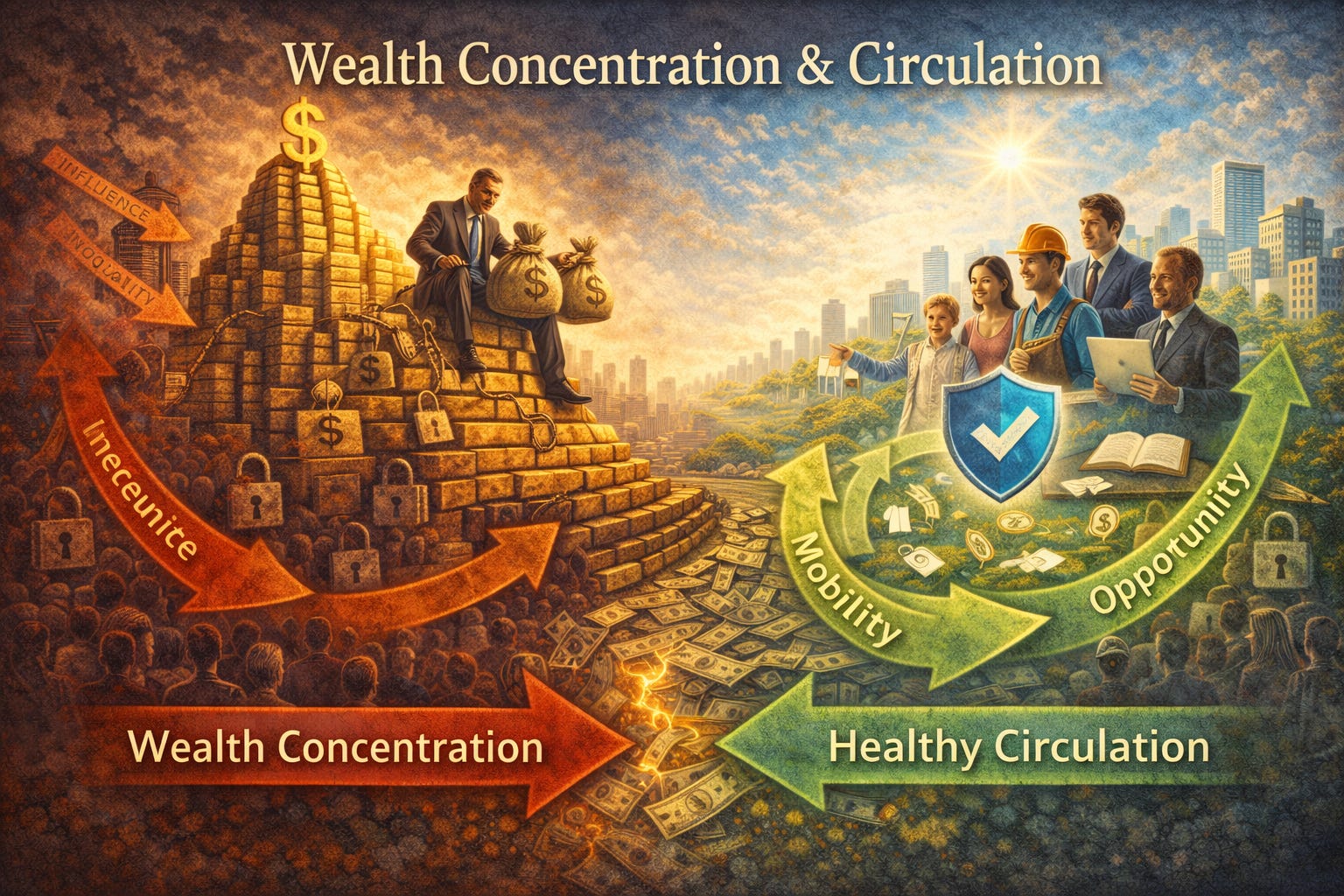
However, without structural limits, economic systems also tend toward concentration. Wealth generates influence, influence shapes opportunity, and opportunity can reinforce existing concentrations of ownership and control. Over time, this process can produce levels of concentration that extend beyond economic inequality and begin to affect the functioning of democratic institutions.
When wealth becomes highly concentrated, the ability to influence political, informational, and institutional systems often becomes concentrated as well. Economic resources can shape public debate, influence policy formation, and affect the priorities of institutions that depend upon funding, lobbying, or political support.
These dynamics create a feedback loop. Economic power influences political systems, political systems shape economic rules, and those rules can further reinforce existing concentrations of wealth and influence.
In such conditions, the principle of equal civic standing becomes increasingly difficult to maintain. Even when formal political rights remain intact, the practical ability of individuals to influence decisions affecting their lives may diverge significantly depending on economic position.
The long-term stability of democratic societies therefore depends upon maintaining circulation within economic systems. Circulation refers to the continued movement of resources, opportunity, and ownership throughout society rather than their indefinite accumulation within narrow structures of control.
Healthy circulation allows new participants to enter economic life, supports mobility across generations, and preserves the capacity of individuals and communities to pursue opportunity. When circulation slows, economic mobility declines and structural inequality becomes increasingly difficult to reverse.
Historically, societies have employed a variety of mechanisms to preserve circulation and prevent extreme concentration. These mechanisms have included taxation, inheritance structures, public investment, antitrust regulation, and periodic economic restructuring.
The specific forms of these mechanisms have varied across time and place. Their shared purpose has been to maintain the conditions under which economic systems remain compatible with broad civic participation.
In modern economies, the scale and complexity of financial systems, corporate structures, and global capital flows can accelerate the dynamics of concentration. Without structural safeguards, these dynamics may gradually undermine both economic mobility and democratic governance.
Constitutional systems can play a role in addressing this challenge by establishing boundaries that prevent forms of concentration capable of distorting democratic institutions. Such boundaries do not eliminate markets, wealth creation, or individual success. Instead, they protect the conditions necessary for continued participation and circulation across society.
The goal is not to impose uniform outcomes but to preserve an economic environment in which opportunity remains accessible and power does not accumulate to the point that democratic institutions lose their independence.
When economic circulation remains healthy, societies retain the capacity for innovation, mobility, and participation. When circulation collapses into concentration, both economic dynamism and democratic governance become increasingly difficult to sustain.
Maintaining circulation is therefore not only an economic concern but a civic one. By protecting the flow of opportunity and preventing structural concentration, societies help ensure that economic systems continue to support rather than undermine democratic life.