

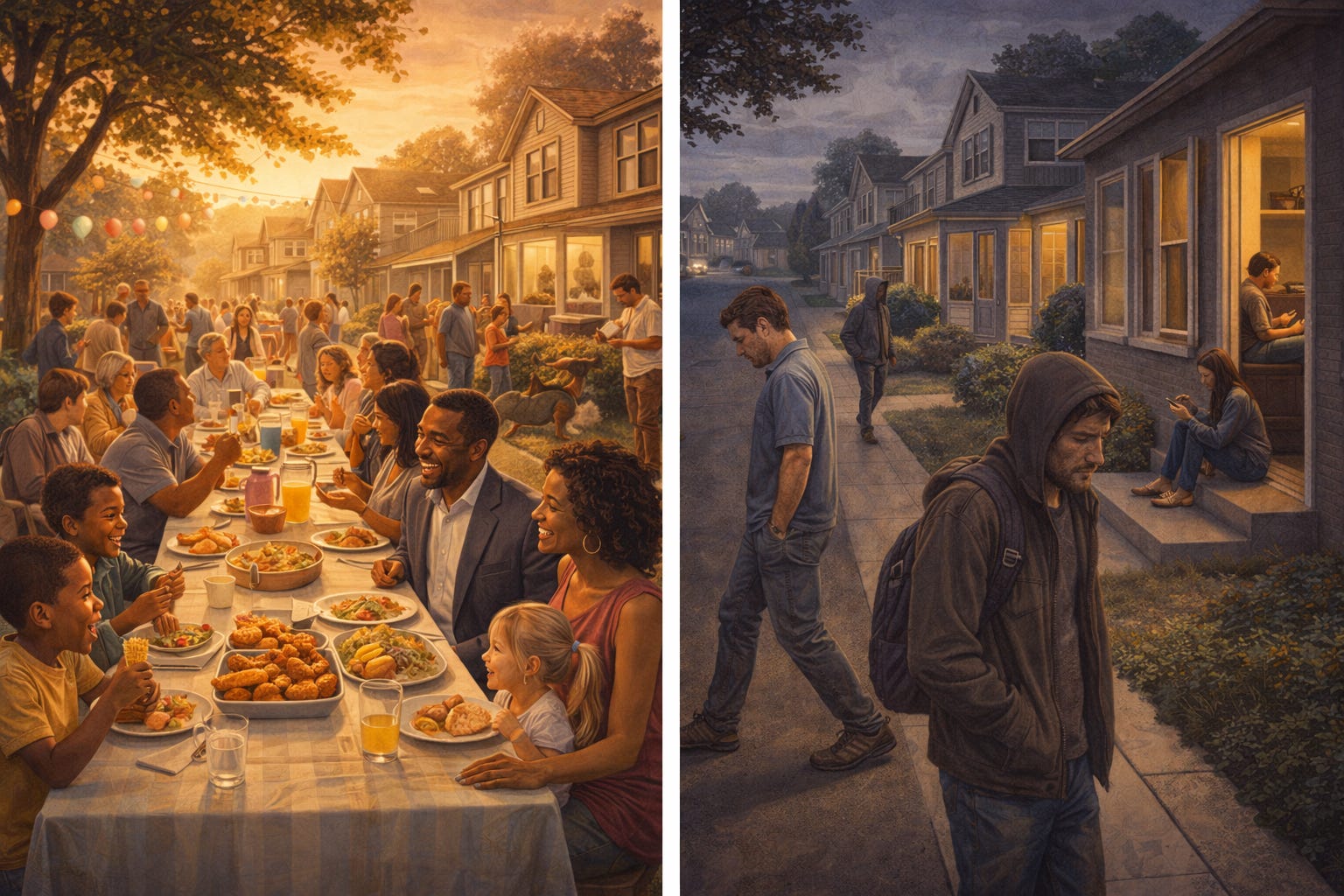
I keep catching myself doing it, holding a town in my hands like it is a photograph I can step back into.
Sterling, Illinois in the 1970s.
Not Sterling as an idea. Sterling as a lived atmosphere. A place where community felt like the default setting. Where school meant something. Where you did not have to perform worthiness to belong. Where the edges between “us” and “them” did not feel like the organizing principle of every conversation.
I know memory can romanticize. I am not naïve to that. I am not claiming it was utopia. I am saying something more specific, and more important.
There was a kind of social coherence, an ordinary dignity, that shaped kids whether we understood it or not.
You could feel it in the way adults talked to you. In the way a public high school could look like a civic monument, not a holding pen until adulthood is reached. Sterling High School’s stadium, built in the Works Progress Administration era and donated by a local businessman, was the kind of infrastructure that said we invest in our young people like they matter.
And you could feel it in the broader conditions of the town. Sterling was not floating in a vacuum. It was carried by an industrial and manufacturing base that, in the 1970s, was still strong enough to employ thousands and project a kind of stability that reached into daily life. Northwestern Steel & Wire, for example, expanded massive furnace capacity in the 1970s and reached an employment peak of 4,678 in 1979.
When a town has stable work, it does something subtle. It reduces the daily panic. It creates room for people to be more than their survival. It does not eliminate hardship. Nothing does. But it changes the texture of life.
Then we grew up, and the country changed.
Not overnight. Not in one headline. In a slow drift that became a shove.
Industrial decline. Disinvestment. The hollowing out of places that once felt self-contained. Sterling’s own riverfront redevelopment planning names this directly, how the Rock River riverfront is now being reimagined because of industrial decline and functionally obsolete industrial sites, with a stated focus on economic, environmental, and cultural sustainability.
That is not just urban planning language. That is a confession. Something that once held us stopped holding.
And when what holds a community weakens, jobs, institutions, shared spaces, the social fabric does not just thin. It gets replaced.
We replaced community with lifestyle. We replaced common ground with sorting. We replaced belonging with branding. We replaced “we take care of each other” with prove you deserve it.
And the cost was not only economic. The cost was relational, emotional, civic.
We became a country where people are starving for connection but terrified of being seen. Where everyone is busy and nobody is held. Where we use politics to express grief we never learned how to name. Where we cannot talk about systems without turning it into a moral identity fight.
We keep trying to live inside comforting stories. We keep trying to feel okay instead of becoming capable of the truth. And the truth is this: community is not a vibe. It is a structure. It is a practice. It is a set of conditions that make it easier for people to stay human with each other.
So when I write civic frameworks, when I draft documents about dignity and bodily autonomy and fair systems, I am not doing it to cosplay politics. I am doing it because I am trying to re-find what I once tasted, a world where people are treated as whole, and where we build the ground under each other on purpose.
Not to go back. To re-find.
That means we have to stop treating community as something that used to happen naturally and start treating it like infrastructure.
It means we have to rebuild the things we quietly dismantled: public institutions that feel dignified, not humiliating work that does not require people to surrender their bodies or souls shared spaces that are not just for spending money safety nets that do not punish you for needing them civic norms that make belonging possible even when you disagree.
And yes, sometimes it means reimagining old places, like a riverfront, not as nostalgia projects but as proof that we are willing to repair what was abandoned.
I do not want the past back. The past had its own blind spots, and any honest person knows that.
What I want back is the standard. The sense that people matter enough to invest in. That kids deserve dignity. That public spaces can be proud. That life can be coherent without being uniform. That you can belong without auditioning.
I am not searching for a town. I am searching for the conditions that let human beings be human with each other.
And I am done waiting for those conditions to appear by accident.