

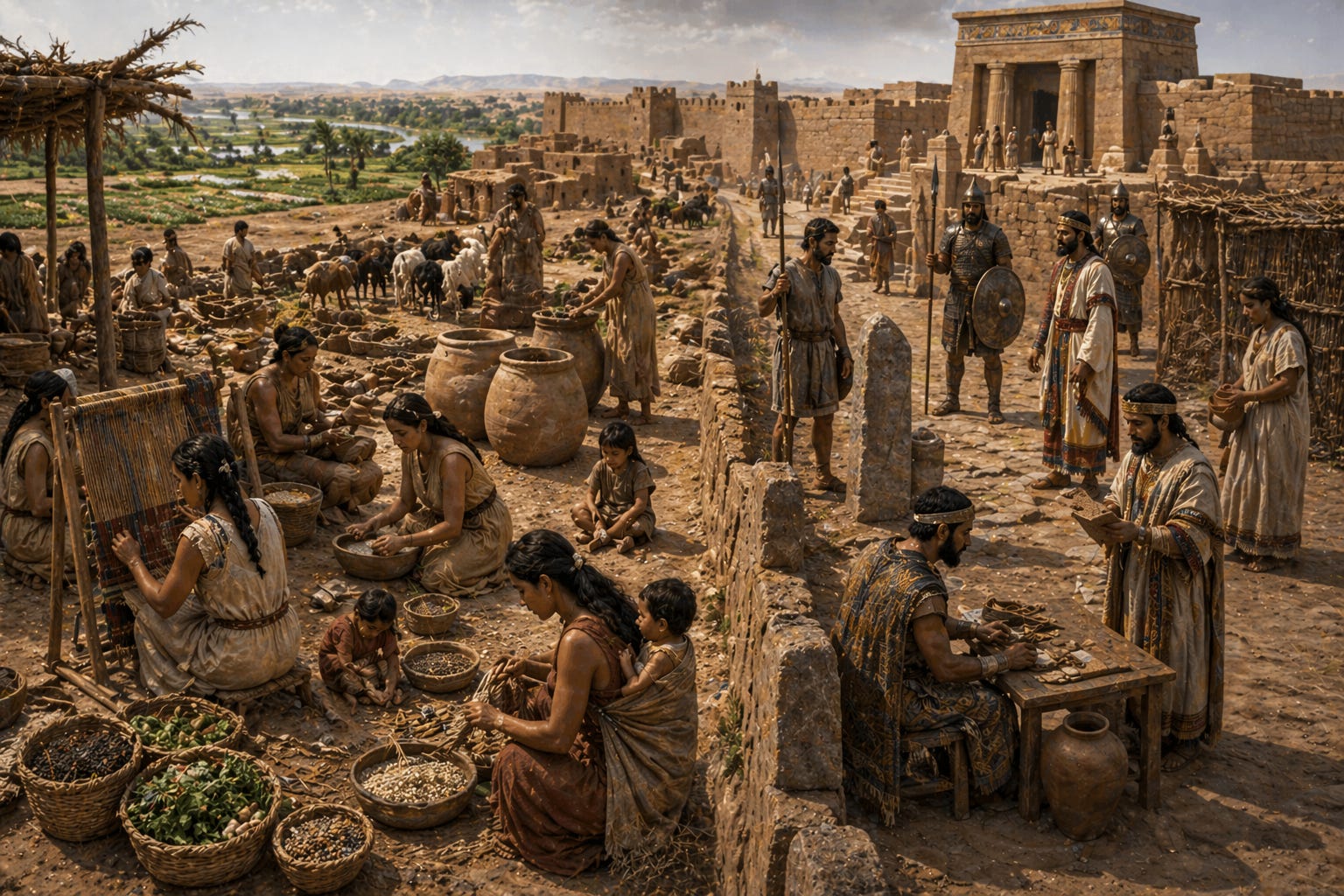
Before hierarchy hardened, human life had already been built on dependence, memory, care, labor, and continuity. Men were part of that. Women were part of that. No serious account of early humanity can hold for long if it insists one sex stood at the center while the other merely assisted.
But settlement changed the scale of things.
Once people remained longer in place, once food could be stored, once land could be worked and claimed, once herds, grain, tools, and dwellings could be counted as wealth, the terms of power began to shift. The question was no longer only how a group survived together. It became who controlled the surplus, who passed it on, whose children counted as heirs, and whose authority could be enforced across generations.
That hardening did not happen in a single moment, and it did not look identical everywhere. But the pattern is clear enough. What had once been a shared struggle to continue life narrowed into systems designed to control its terms.
Property changed lineage. Lineage changed inheritance. Inheritance increased pressure around paternity, and paternity placed women’s sexuality, reproduction, movement, and freedom under new forms of scrutiny and rule.
Once wealth needed a clear line of descent, women’s bodies became politically important in a new way. Not because women suddenly mattered more, but because men intended to pass power through male lines and needed control strong enough to make the claim stick.
This is where patriarchy stops looking like scattered male advantage and starts looking like structure.
Land, livestock, surplus, and family name did not simply create leadership. They created an incentive to discipline women into predictability. The woman who had once been central to continuity was now increasingly treated as a passage through which male continuity had to be secured.
Her labor was still needed. Her fertility was still needed. Her stabilizing role was still needed. But her autonomy became more dangerous to the order being built.
As settlement deepened, other institutions rose around the same logic.
Priesthood gave sacred language to hierarchy. War power gave organized force to hierarchy. Early state formation gave administrative durability to hierarchy.
What had once been local expectation could now become law, ritual, custom, penalty, office, bloodline, and throne. The question was no longer merely who did the work of life. It was who got to name it, rank it, inherit it, and rule over it.
Women did not disappear in this world. They still held households together. They still carried children, memory, food work, daily survival, and the practical continuity without which no settled society could last.
But men increasingly claimed the visible architecture built on top of that continuity. The title. The property. The lineage. The altar. The office. The public word. That is the theft at the center of patriarchy.
It did not create civilization from nothing. It took hold of a shared human inheritance and recast male control as the natural form of order. The old interdependence remained underneath, but the story changed.
Men became the builders in the official telling. Women became help, duty, service, virtue, and support, even while the system continued to depend on what women carried.
This is also why patriarchy has always needed more than brute force. It needs myth. It needs law. It needs religion. It needs family structure. It needs custom. It needs women themselves trained to defend an order that narrows them.
A power system lasts longer when it can present itself not as domination, but as nature. By the time recorded history sharpens enough to give us names, much of this hardening is already underway.
Women appear in the record, but often through institutions that have already confined the terms of their visibility. We meet them as daughters, wives, priestesses, queens, mothers of heirs, keepers of households, or exceptions near power. The narrowing has already begun.
That is why the next step matters.
Before we reach the denied women history bothered to name, we have to understand the world that was built to deny them.
The structural shift described here is also a shift in visibility: what sustains life becomes less visible, while what organizes it becomes named as power.