

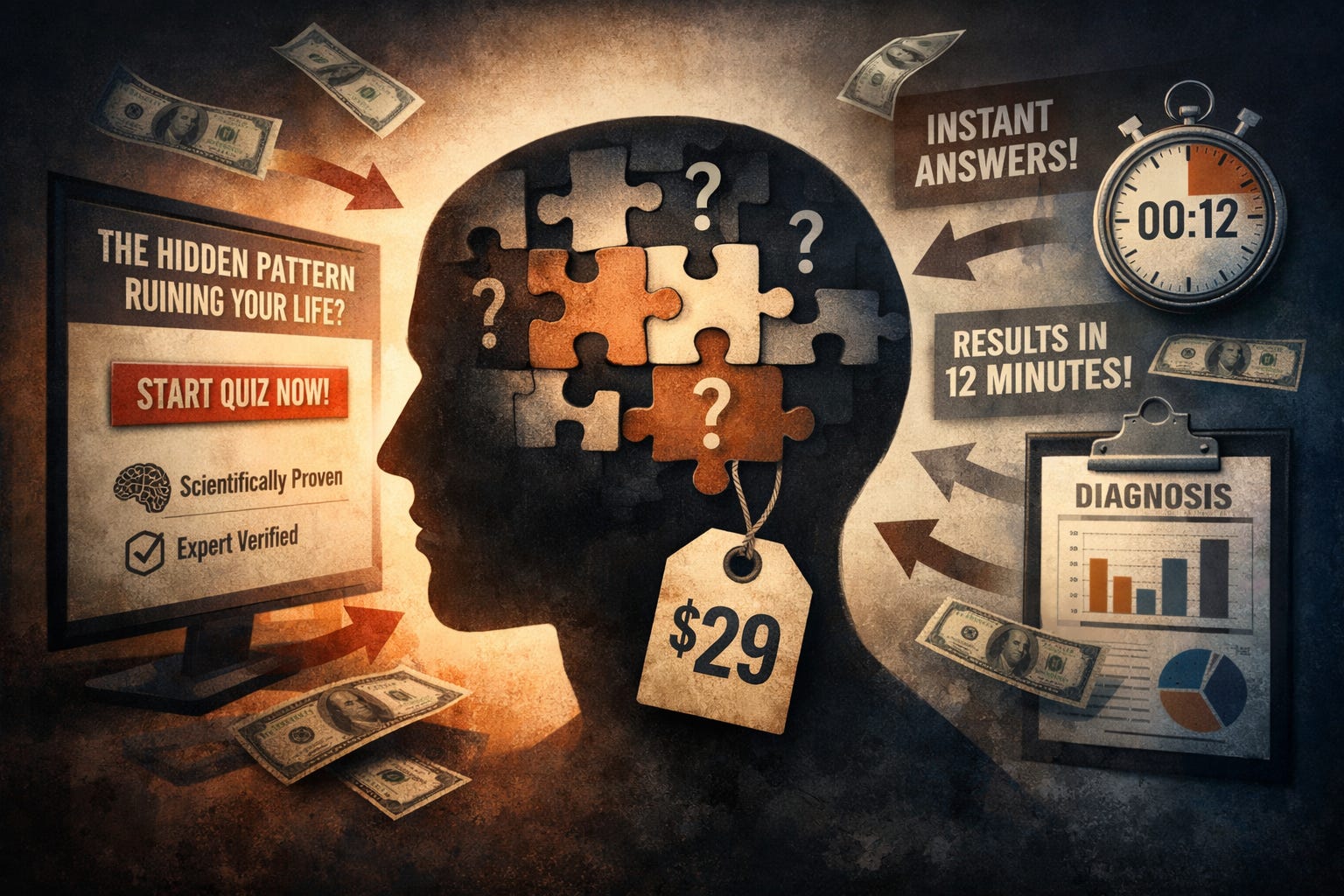
A certain kind of ad is everywhere now. It tells people that a hidden childhood pattern explains their failed relationships, their distress, their habits, or the parts of themselves they have never fully understood. It borrows the language of psychology, wraps itself in institutional credibility, and promises a fast answer. In twelve minutes, it says, you can uncover what years of self-work somehow missed.
This is not just cheap marketing. It is a public failure being monetized in real time.
People are vulnerable to these pitches because many of them are carrying real confusion. They know something feels off. They know their reactions do not always make sense. They know their relationships can follow patterns they do not fully understand. They know loneliness sharpens the hunger for explanation. When that confusion meets polished language, scientific theater, and the promise of relief, the sale is already halfway made.
The deeper problem is that we have left too many people to build self-understanding out of fragments. A little from social media. A little from therapy language stripped of context. A little from partisan identity talk. A little from pop neuroscience. A little from advertisers who have learned that the self is one of the easiest things to sell back to a person once it has been made uncertain. In that environment, self-diagnosis becomes a market, emotional confusion becomes a customer base, and incomplete knowledge becomes an opening for manipulation.
We should be clear about what this is. It is not only a mental health problem. It is an education problem. It is a media literacy problem. It is a consumer protection problem. It is a democratic stability problem.
A public that cannot interpret its own experience is easier to sort, easier to frighten, easier to sell to, and easier to govern through distortion. People who do not know how to place emotion in context are more likely to mistake intensity for truth. People who have not been taught how development works are more likely to grab the first explanation that flatters their pain. People who cannot recognize manipulative framing are more likely to trust a claim because it sounds clinical, urgent, or institutionally blessed.
We do not fix that by turning schools into therapy offices. We do not fix it by flooding children with jargon. We fix it by teaching basic human literacy more seriously than we do now.
Students should learn how stress affects attention, memory, and behavior. They should learn how emotional states shape judgment without becoming identity. They should learn the difference between pattern recognition and overreach, between influence and expertise, and between overlap and equivalence. They should learn how persuasion works, how algorithmic media rewards intensity, and how commercial language borrows authority to sell certainty. They should learn how relationships work at the level of reciprocity, repair, boundary, conflict, and distortion.
Adults need this too. Community colleges, libraries, and public programming should treat these skills as part of civic life, not private luxury goods for people who can afford endless self-optimization. A society that leaves ordinary people to learn about their own minds from advertisements and influencers should not be surprised when confusion becomes profitable.
That is the issue. When the public does not teach people how to understand themselves, the market will sell them distorted explanations of their own minds.
And it will do it with a smile, a study, a timer, and a checkout button.